Tuesday, 15 February 2011

Another elliptical halo

Two posts and and three days back there was an elliptical halo in the sky and today ellipse appeared again. It had been a cold night with down to -30° C, and during the daytime as the thin cloud cleared and sun started shining more strongly, also crystal glitter in the air increased. Couple of times I looked out and saw only pillar and poorly defined subsun, but last check came also with faint elliptical halo. Above are different versions of the photos, stacked 13 frame average and lighten images and two single images. Heavily usmed average stack seems to indicate two slightly separate elliptical halos.

This formed in crystals precipitating from very low, almost invisible cloud layer. Temperature at Tampere stations ranged from -15 to -20° C at the time of the observation, the coldest being at Siilinkari on the lake Näsijärvi. I am not sure if heat plant plumes had anything to do with this. The connection was not obvious, at least.

Edit 15 February: Eetu Saarti saw much better ellipse in Kangasala the same day.

Original post in Submoon


Sunday, 13 February 2011

Fake sun

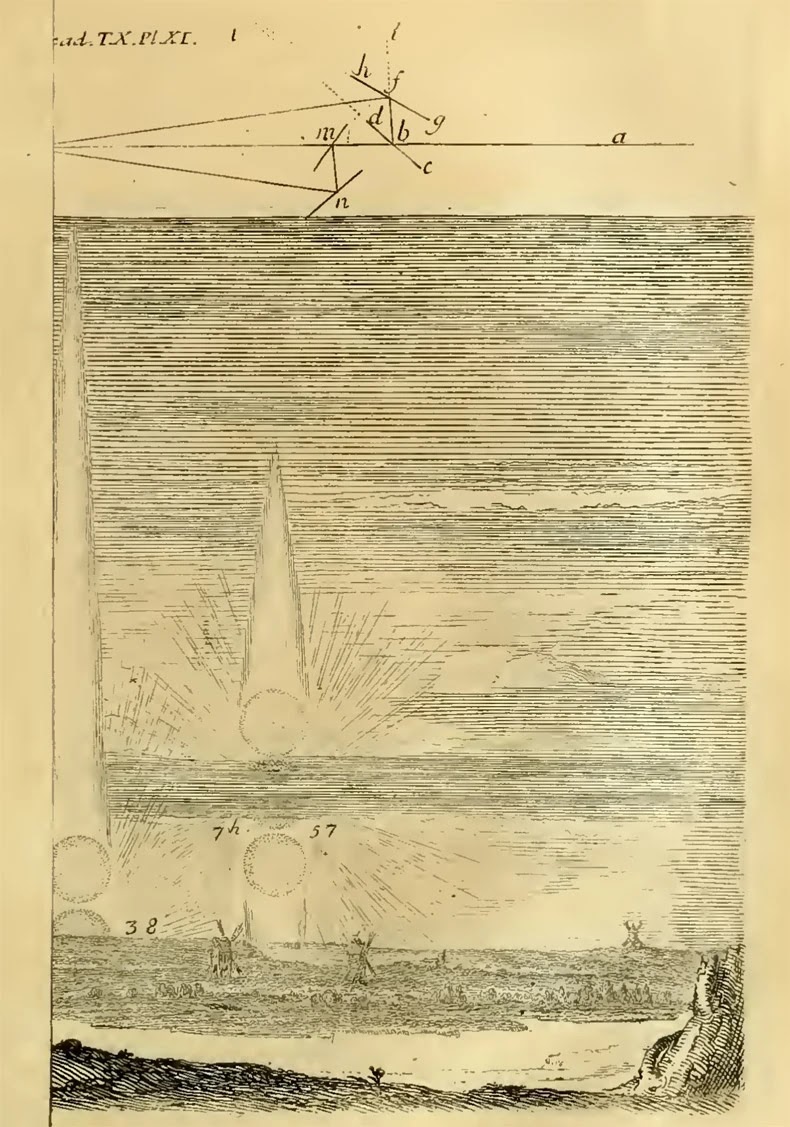
Julie Bronson's photos above show a largely forgotten effect of a sun pillar, the fake sun. It was photographed on 19 January 2009 in South Central Minnesota, USA.

Sometimes, when low sun is just behind an edge of an opaque cloud that is precipitating ice crystals, an image of the sun can been seen below or above the cloud in the icy virga. The effect is so perfect that one is easily fooled to think it is real sun. It is blindingly bright, circular and about the size of the sun. Only when the true sun comes up from behind the cloud, the cheat is revealed.

Today this optical effect of sun pillar is almost unknown, but in the past sky watchers have made detailed notes on it. Auguste Bravais listed in 1845 five persons who have observed the fake sun, including Johannes Hevel, Pierre Bouguer and Giovanni Cassini. Above is shown the observation by Cassini on 18 January 1693. Unfortunately it is a bit cropped from the left.

Julie Bronson's images of the fake sun may be the only ones existing. Her documentation of the phenomenon is commendably extensive and comparison with Cassini's 300 years old observation is good. I have seen fake sun a couple of times during 25 years of sky watching. Appearances of this effect are short and camera must be handy when the time comes.

Original post in Submoon


Saturday, 12 February 2011

Possible elliptical halo

Half an hour ago I was talking with Jari in the phone and monitored the sky at the same time. There was Stratocumulus drifting fast and it was turning into ice. I saw an elliptical halo and eventually got some photos, but I am not so sure about this anymore. Maybe it is an ellipse, maybe not.

Update: the sky got almost completely overcast for a while, but then Stratocumulus receded and I was ready with camera waiting for the ellipse. Which appeared and also shows up clearly in the photos (the second collase). All together this was a beautiful case. Fast moving low clouds, crystals in the air, iridescence... I have seen in similar conditions an elliptical halo in Kilpisjärvi while walking up the Saana mountain. Possibly they are not that rare there in early spring around March.

Update II: it turned out many people saw this in Tampere, Helsinki and Lahti. Best photos took Olli Leivo and Jari Luomanen. If my memory is correct, the temperatures in Tampere stations were between -10 and -14° C.

Original post in Submoon


Sunday, 6 February 2011

Halo observations by J. R. Blake in the Antarctic (part II)

Completing the first post of Roger Blake's halo observations in the Antarctic, here are the rest of his halo drawings together with the written descriptions. The display at midnight between 2 and 3 December 1958 comes as two dravings in Blake's book. It was remarkalbly accurate observation of a complex diplay with all four kaleidoscopic arcs, especially when one takes in to account that it was observed from a moving dog sledge. The display had also its contribution to halo science: both Tricker and Greenler used the observation to support the theoretical considerations of the kaleidoscopic arcs. In the drawing these arcs are 1) helic arc; 2) subhelic arc; 3) subanthelic arc and 4) Tricker arc. The observational account in the above image is not given full, but only from the part concerning these arcs.

Original post in Submoon


Friday, 4 February 2011

Diamond dust halos at -2° C from Italy

Diamond dusts close to freezing point are not common. This display, photographed by Francesco Cadini on 3 February 2011 a few kilometers outside Milano, occurred when Francesco's car thermometer showed values between -1.5 and -2° C. Taking into account a possible inaccuracy, he says that it could not have been colder than -3° C.

The display formed from thick water fog. Cadini tells that in the area where the display was seen there is a phenomenon called the "chemical snow",  which occurs in high pressure situation with fog and clear sky above the fog. The abundant pollutans in the air are supposed to initiate this chemical snowing and in one case 2 cm of snow accumulation has been recorded. There is an Italian language description of the phenomenon.

Most likely the pollutants were also responsible for the transformation of the water fog to observed diamond dust. A quick look at some papers reveals that if certain substance acts as an immersion freezing nuclei and contact freezing nuclei, the latter works at much higher temperatures. So probably the formation of this diamond dust was initiated by pollutant particles colliding with water droplets. Once the process starts, sudden freezing of droplets may produce splinters that further freeze other droplets and chain reaction is created. The water droplets also evaporate and the released water vapor deposits on ice particles, and through this growth we get the crystals with proper faces for halo making.

Supercooled water fog in general has a tendecy to turn into diamond dust locally. If you drive around the city when it is below freezing you are likely to encounter spots of diamond dusts.  Usually only the lower layer of the fog turns into diamond dust and thus you can see halos only at night in the light of streelamps. Sometimes, though, as in Cadini's case, a whole fog column turns into ice crystals and sun or moon halos can be observed. The process punches a hole in the fog and in the photos above the edge of the foggy wall is seen clearly.

Cadini's display has also weak Moilanen arc, which shows best in heavily usmed image. He suspects that this might be the first Moilanen arc photographed in Italy.

Original post in Submoon


Wednesday, 2 February 2011

Old photos of halos from anthelic and subanthelic region

Alan Clark sent these scans of his old slides. The anthelic arcs in the first two photos were photographed in 1980 in Canada, while the two latter images with subparhelic circle, subanthelion and possible faint arcs upwards from the subanthelion were photographed in 1978 on a flight across the US, en route to NASA Ames. Halos suffer markedly when scanned from slides but it is always nice to see any documents of these rare halos.

Original post in Submoon


Tuesday, 1 February 2011

Halo observations by J. R. Blake in the Antarctic

There are two books devoted to halo observations in the Antarctic in 1950's. One is by the Swedish meteorologist Göstä Liljequist and another by the Australian glasiologist Roger Blake. The images above are from Blake's book "Solar Halos in Antarctica", which I found for sale in an Australian antikvariat a few years ago. Blake was in a project called the "Souther Seismic Traverse", using the Australian research station Mawson as a base for the trips further south. The time he spent in the Antarctic spanned from 30 September 1958 to 17 January 1959 and halos were a sideline research for him, clearly inspired by the Liljequists's work in the early 50's. Above are shown three displays from Blake's book.

The first display, observed from a field trip at the location 70.1° S and 62.1° E on 21 November 1958, contains 9° halo. Blake wrote the following notes on it: "The parhelic circle extended only about 10° either side of the sun, being rather faint. It formed a closed semicircle with a very faint Hall's halo, the radius of that halo being approximately half that of the 22° halo, but observations being greatly impeded by the sun's brightness."

The second display was seen near the first display's location, on 28 November 1958. It has sunvex Parry arc and halos at the anthelic region: "Through the anthelic point was a bright, white vertical pillar, reaching the ground. Also visible was part of the parhelic circle, the intersection of the two arcs being a 'spot' of greater intensity. The parhelic circle did not exists elsewhere."

The third observation on 29 November 1958 was made in the same area as two previous ones. It has several interesting features: "The 22° and 46° halos were both very brightly coloured, and both 22° and 46° parhelia were present, both pair being very bright. The vertical pillar extended from the horizon to the top of the 22° halo, which was brilliant. From this point extended the upper contact arc which merged smoothly with Parry's Arc; both these arcs were coloured and very bright. [... ] The circumzenithal arc was also present, being very brightly coloured. A fairly bright, coloured arc, passing through or close to the zenith and concave to the sun was visible, the colours being very pure and distinct. Because of its position, it was difficult to obtain any estimates; however, it appeared to have approximately the same curvature as the 22° halo. The full 180° of the parhelic circle was visible on either side of the sun, being intersected approximately 90° from the sun by a pair of white pillars extending from the horizon slightly above the parhelic ring. The points of intersection resembled mock-suns, though white. Also at 180° there existed a somewhat fainter, white pillar extending to just above the horizon, the point of intersection with the parhelic circle again being brighter. The display disappeared as the cloud cover increased."

Now I could go on discussing what Blake really saw in 29th November display, but that would not lead anywhere. Suffice to say: a photograph would have been nice.

Original post in Submoon