Thursday, 15 January 2026

Review of the Rovaniemi 2023-11-11 Display and further research on the MS halos in the Borlänge and Naapurinvaara Displays


©Marko Riikonen


The Rovaniemi Display of November 11, 2023 – possibly one of the greatest and most bizarre Super Displays ever – a sentiment Marko and I both share. I was deeply fascinated by it when Marko first posted it.


https://www.taivaanvahti.fi/observations/show/119911
https://x.com/RiikonenMarko/status/1871867455959707898


Above are the original publication, along with additional photos and simulations uploaded by Marko at the end of 2024. In private correspondence with me, Marko mentioned that the identification of the 24d Column Arcs came from a suggestion by Nicolas Lefaudeux. The previous work of Nicolas and Marko has already addressed the simulation for most of the halos observed in this event.


However, previous simulations failed to match some halos in the photographs – for instance, the peculiar '35d Spot'. Some of the mysterious puzzles revealed in this event still require further exploration by halo experts and enthusiasts.


'35d Spot' is not at 35 degrees !


Ice crystals that produce 24d Column/Plate Arcs theoretically also produce 35d Column/Plate Arcs. But the problem is that the so-called '35d Spot' observed in this event does not align with the theoretical positions of 35d Column/Plate Arcs – it is clearly much closer to the light source.


Precise measurements show that the inner edge (closer side from the light source) of the '35d Spot' is about 32°, and the outer edge (farther side from the light source) is about 38°. Obviously, based on measurement result, they are not 35d Column/Plate/Parry Arcs. Some other types of halo must be present and is the main contributor to this strange bright paire of spots.


I also tried exotic pyramid crystals (Miller indices: 3 0 -3 2, 1 0 -1 2, 2 0 -2 1, 2 0 -2 3, 3 0 -3 4, 2 0 -2 5, and 1 0 -1 3), but none provided the correct answer. Perhaps the approach using exotic pyramid crystals was wrong from the start, because even if some special crystals that haven't been found in atmospheric samples can form 32° radius halos, it would be difficult for us to ignore the other halos that would accompany them.


Despite many failures, I have recently found a better answer – The 22° Parhelia of the 22° Column Arc.

↓


The first record of '22° Parhelia of the 22° Column Arc' ?


Multiple Scattering(MS) halos from 3-5 ray paths will be closer to the light source than 35d Column/Plate/Parry Arcs. However, differences in the order of 'the first/second type of crystals'  can lead to different halo manifestations. I tested various combinations, and ultimately concluded that only the '22° Parhelia of the 22° Column Arc' provided the best match. The '22° Column Arcs of the 22° Parhelia' were ruled out due to unsatisfactory position and shape. MS halos related to the Parry arcs were eliminated because they were too sharp and also ill-positioned.


The second scene taken by Marko also supports this conclusion. In this scene the camera pointed towards the zenith, and Marko had stacked the images, which is more conducive to revealing the ideal morphological characteristics of halos than a single image. 

↓


Precise alignment work showed that the '22° Parhelia of the 22° Column Arc' once again performed very well. This time, even without the contribution of 35d Column Arcs, the '22° Parhelia of the 22° Column Arc' alone aligned the shape/position of the '35d spots' in the stack-image very well.

↓


So, did Marko capture another Borlänge Arc? No. I suggest that the situation in Rovaniemi on 2023-11-11 was completely different from the Borlänge Display, Sweden, 2018-12-14.


Previously, on Taivaanvahti or TheHaloVault, the Borlänge Arcs were defined as a combination of both the '22° Parhelia of the 22° Column Arc' and '22° Column Arcs of the 22° Parhelia'. This conclusion is likely based on simlations in Halopoint. However, this might be incorrect.


https://www.taivaanvahti.fi/observations/show/79745
https://thehalovault.blogspot.com/2018/12/complex-halo-display-borlange-sweden.html


After using Zhang Jia Jie's program for further research, we can see the differences – the position and shape of the MS halos in Borlänge and Rovaniemi Displays are not the same. In the Borlänge Display, people likely only observed the '22° Column Arcs of the 22° Parhelia', with the '22° Parhelia of the 22° Column Arc' either not being a major contributor or not appearing at all.


A similar conclusion applies to the Naapurinvaara Display in Sotkamo, Finland, on November 25, 2020. Simulation results suggest that the main contributor among the MS halos were the '22° Parhelia of the 22° Column/Parry Arc', not the 22° Column/Parry Arcs of the 22° Parhelia. The situation in Kuopio, Finland, on November 20, 2022, was the same.


https://www.taivaanvahti.fi/observations/show/95033
https://thehalovault.blogspot.com/2020/12/two-years-ago-halo-community-got-its.html?m=1


I'm unsure if there are other records of Borlänge Arcs around the world. The halo community can help verify this. If there has been no prior confirmed record of the '22° Parhelia of the 22° Column Arc', what Marko captured may very well be the first record of this phenomenon.


A proposal to redefine the Borlänge arc


It was previously widely believed that both of the '22° Column Arcs of the 22° Parhelia' and the '22° Parhelia of the 22° Column Arc' should appear together, which if why the Borlänge Arcs were defined as a mixture of two halo phenomena. But now, should we consider the case of 'only one of them appears alone' – in such cases, they no longer fit the name 'Borlänge Arcs'. Jokingly speaking: a rock band typically has 3, 4 or 5 members; when one member appears alone, they cannot be fully equated with the entire band.


To me, instead of creating two new names for the '22° Parhelia of the 22° Column Arc' and the '22° Column Arcs of the 22° Parhelia', it might be better to redefine Borlänge Arcs to apply only to the '22° Column Arcs of the 22° Parhelia'. This way, we only need one new name – a dedicated name for the '22° Parhelia of the 22° Column Arc'. Similar work also applies to redefine the Naapurinvaara Arc.


So, what should the new name be? Riikonen Arc? - that name has already been used for another halo. Perhaps Rovaniemi Arc is a name worth considering, or perhaps we should strictly name these MS halos according to their ray paths? In any case, Marko told me he has an article on halo nomenclature ready for publication, perhaps we will find better solutions for above discussions in his article.


Thursday, 1 January 2026

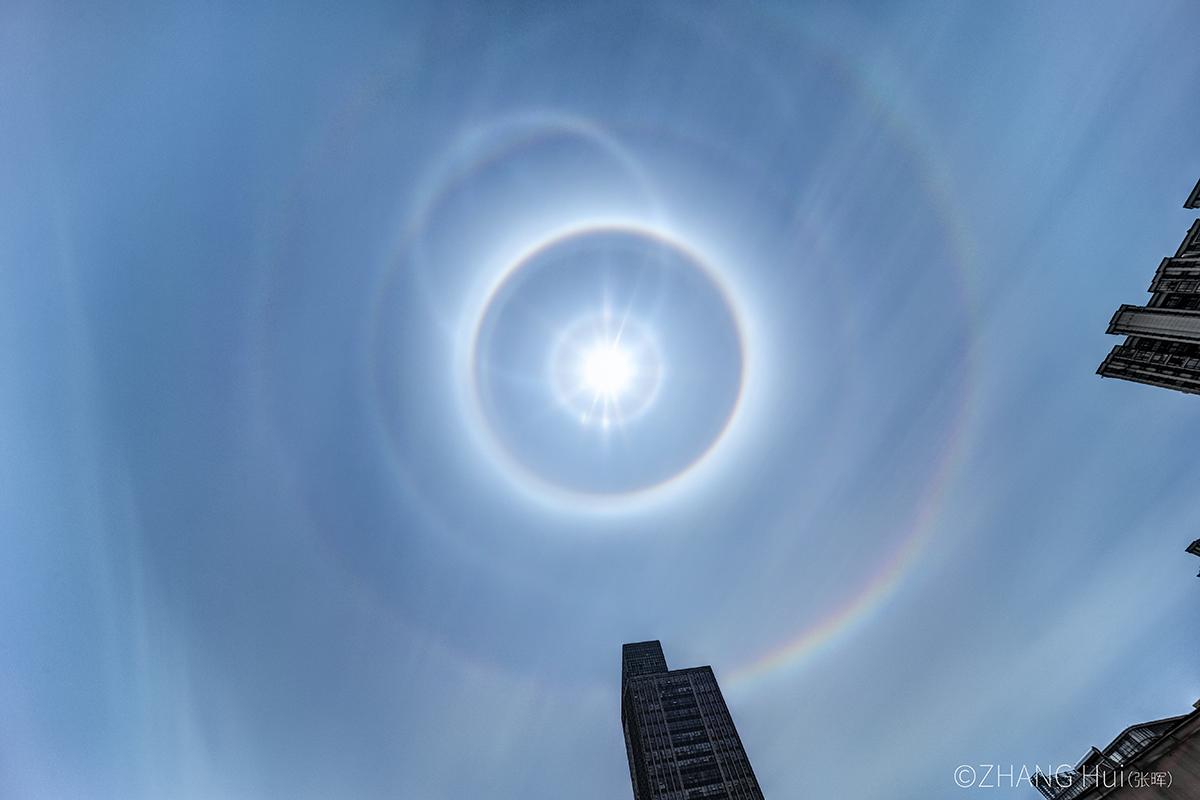
Diffracted 22° Parhelion (Sundog's Corona) from BeiJing, China(2026-Jan-1)


A strange spot appeared on the inner side of the right 22° Parhelion. Obviously, it was not any odd radius halo.


To me, the reason for this phenomenon is the diffraction and interference of light. The USM images seems to support this speculation. 

↓


These rare images were taken by ZHANG Jin Rong from the Chinese sky enthusiasts' community (in BeiJing, on January 1, 2026, from local time 15:50 to 15:56). 


Several years ago, when the "multiple CZA" was discovered, it was also considered extremely rare. But nowadays, at least dozens of people around the world have captured the "multiple CZA". Perhaps, in the near future, more diffracted 22° parhelia will be recorded. Now I'm already looking forward to the discovery of the diffracted CHA. Anyway, what a crazy New Year gift for 2026!


Wednesday, 27 August 2025

Sub-Liljequist and probable 'sub-Liljequist Blue Spot' in high cloud above China


The sub-Liljequist 'Parhelion' in high-clouds is rare. On August 14, 2025, a user '太平洋蓝藻'(ID: 516836436) from ' Bilibili.com'(a polular vedio website of China) captured the first record of this event in China during a flight over the Yellow Sea. the sub-Parhelic Circle and sub-120° Parhelion were captured at the same time.


What makes this particularly remarkable is that on left of sub-Liljequist 'Parhelion' in the photograph shows a distinct blue tint, suggesting the possible presence of 'sub-Liljequist Blue Spot'. Pinson HUANG from the Chinese halo watching community was the first to identify this possibility and made the initial simulations. I refined the simulation parameters based on HUANG's work, and the results showed a good alignment with the photograph. SUN Hao Xuan(孙浩轩) and Jing Xiang from the Chinese halo watching community assisted in image authorization and joined in the related research process. KiloNova(千新星), SONG Xi Pei and QIAN Kun from the same community provided crucial information in the analyses of flight data and lens characteristics.


The photograph was taken at 16:43:26 (UTC+8). Based on the CZ5855's flight information(N37.96, E122.98) retrieved from https://flightadsb.variflight.com for that specific time, it can be further concluded that the solar altitude was 22.3 degrees.


The unevenness of cloud layer should be considered as the cause of the unevenness of the sub-PC, but some simulation results quite support the existence of the sub-Liljequist.


Friday, 9 May 2025

Halos of Venezuela

South America is pretty much a blank slate what comes to halo enthusiasm, so it is encouraging when we got contacted from Venezuela by Franklin Fernández, who had written an article presenting the best displays captured in his country. Judging by the random big displays that have popped up from different corners of South America over the years, there is reason to think the continent as one of the better areas for halos, and now the Venezuelan displays Fernández has scoured from the internet add credence to this notion.

What is more noteworthy is that the best displays are concentrated in the western part of the country which is where the Andes mountain chain ends. This gives more weight to what some of us may have already thought, that the curse of the equator is cancelled by the Andes. Unlike in the Philippines where I have been observing, or Singapore of which halo scene I have heard from Jia Hao, all-sky displays must be a regular occurrence along the tropical segment of the Andes chain and presumably sun pillars are not such rarities either. And we don't know what kind of odd radius jewels there might be lurking as these shows don't tend attract so easily the attention of the uninitiated.

Franklin's article is available in Academia.edu and Scribd. He will keep adding displays to it as they come and says the document has already created buzz. Could this be the start of Venezuela and eventually the continent's other Spanish speaking countries waking up to halos? All prospects are that a dedicated observer, in particular along the Andes chain, would be in for reaping it big.

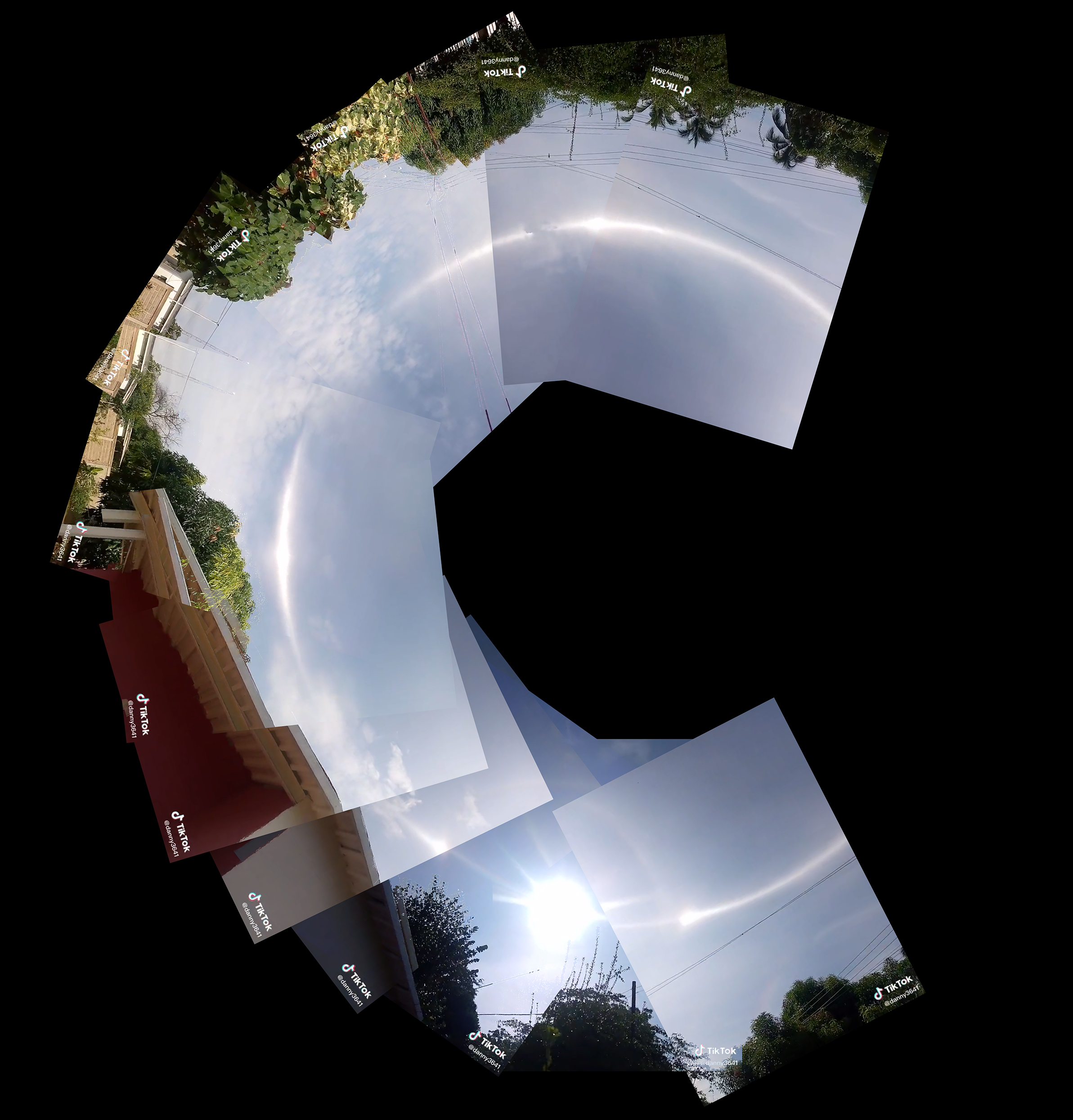
(The display above was captured by TikTok user danny3461 on 6 October 2024 in Macoa near the city of Machiques at the west of the country. In my hastily made stitch the parhelic circle is full despite the large gap on the right. The show was documented by a handful of other people as well. See also the impressive high sun display on X of an unknown date in Caracas)

Thursday, 20 March 2025

A grand Bottlinger's rings in diamond dust (2025-Jan-12, China.)

 A spectacular event of Bottlinger's Rings occurred on January 12, 2025, in Hemu(禾木), Xinjiang, China. For China, this was the first time the phenomenon was observed in diamond dust (rather than being captured from high-altitude aircraft). 'Javen嘉文儿', a user from the video website 'bilibili.com', directed his photography team to captured extensive footage. We are permitted to share the related files here.


vedio here


Footages show a solar elevation angle of 11 to 12 degrees. The lack of ice crystal sampling is regrettable, and it is hoped that valuable ice crystal samples can be obtained the next time such event occurs.


The original web link: https://www.bilibili.com/video/BV1jKKweuEQG/?share_source=copy_web&vd_source=e1764a76e81b36e4cb1d6f24f1f6a9ee


(We'd like to thank: Sufflection_, Jingxiang and Danyang(佩佩), for their assistance in related communication.)

Saturday, 18 May 2024

High-altitude pyramid column arcs and kaleidoscope sky (6 May,China)

 Every year from March to May seems to be the pyramid column arcs' season for China. In the 2024 season, the most eye-catching display occured on 6 May, ChangSha, HuNan Province. At altitude of about 71.3°, the Pyramid column arcs, PC and Wegener crossed each other, bringing a spectacular picture of the sky.


(张晖)ZHANG Hui's stack image through a stack of 112 photos spanning 10 minutes. BGR and USM processes make arcs clearer.


Below are the results of a preliminary simulation using ZHANG Jia Jie 's program.


Well, now we are already looking forward to the second half of the year. Unlike March to May, June to August seems to be the peak time for pyramid plate arcs and 28° arcs for China. Please wish us luck.


JI Yun


Wednesday, 6 March 2024

Two below-sun Tape arcs in German Alps, 9 January 2024


by Lasse Nurminen:
 
One of the great things in the modern day observing is the possibility to explore the web for observations around the world. It gives just so much more to this hobby.
 
Once again I was browsing a German website´s forum (https://forum.meteoros.de/) about halos. There are several threads with links to halo displays visible in a network of cameras widely spread over the mountainous area in Central Europe (https://www.foto-webcam.eu/). In a post from Ruben Jakob (https://forum.meteoros.de/viewtopic.php?f=2&t=61705#p243845) one of the links at first looked like only a well formed infralateral arc, but something was disturbing me. Just as if there was a faint arc next to it, what could it be?

After a little thinking I thought it must be something related with the lower Tape arc/Parry infralateral. I took a couple of screenshots of the changing view with the available 10 minute steps and run them through a little Photoshop process to make the faint halos better visible. After that I had no other ideas but to let Mr. Riikonen to take a look at the situation in hands.
 

by Marko Riikonen:
 
Nurminen mailed me some photos of this 9 January 2024 display in Balderschwang, Germany. His hunch of something going on there was right. As shown by the title photo, two below-sun Tape arcs – one tangent to 46° infralateral arc and one to supralateral arc – are visible. The former is well established: although still a high rarity for any halo hunter to bag, over the years a representative collection of specimens have accumulated from ice fog displays. The latter is a much more furtive animal. It's been photographed in a couple of spotlight displays, but the only previous celestial light source record is the display that Herman Scheer photographed on 18 October 2010 in Sonnblick Observatory, Austria (https://www.ursa.fi/blogi/ice-crystal-halos/superb_diamond_dust_display_in_austria/). However, the 9.5 degrees sun elevation meant the two arcs were superposed, contributing about equally to the joint arc's intensity. And given in spotlight beam we have photos of only either lower arc, here is what raises the Balderschwang display on pedestal: it is the first record in which both arcs are visible individually at the same time.

 
The webcam took a photo every 10 minutes. The display started at 14:30 (title photo, sun 15.1°) and was seen until 16:10 (sun 4.4°) after which the sun got too low to shine anymore to the ice fog. At the end of the post the full sequence is shown. The most interesting stuff was in the first hour and above are three stages from this interval with (a bit wider angle) simulations using HaloPoint: 14:40 when the two arcs are distinct and nicely separated (arrows); 15:20 when they are already quite merged; and 15:30 when a practically perfect superposition is seen.
 
There are 8 arcs to this family, but normally we regard as Tape arcs only those that are solely made by Parry orientation. This reduces it to four arcs – two obliquely from the sun on 46° infralateral arc, two on supralateral arc – into which number also belong the two arcs in Balderschwang photos. As to the naming, the situation is unclear, at least on the level of individual arcs. Tape himself has used terms Parry infralateral and Parry supralateral (also some usages of 46° Parry by others can be found in the internet). But it appears that Tape only associated two of the four arcs with these names. If we look into the monolithic A General Setting for Halo Theory (1999) by Tape and Können, we see that while the other arc in the Balderschwang display would be called the Parry infralateral, the other one is "unnamed" (page 1581, left column, last paragraph). And given there have been really no serious suggestions stemming from the generic "Tape arc", the task of naming this quartet members appears to be still before us. As the arcs divide into above and below light source pairs, the names could play out like this:

upper Tape/Parry supralateral (arc)
upper Tape/Parry infralateral (arc)
lower Tape/Parry supralateral (arc)
lower Tape/Parry infralateral (arc)

However, because supra and infra are synonymous for upper and lower, there is a bit of the feel of those "logical monstrosities" that Tape writes about in the Nomenclature Woes chapter of his book Streetlight Halos (second part, page 170). Moreover, naming of any halos from double oriented crystals should be such that it takes into account also the corresponding arcs that arise from raypaths involving a reflection from horizontal crystal face and that's where the above suggestion again performs poorly by extending what are already quite long-winded names. What's the solution? Alphabet letters would seem to be one:

Tape A81✔️+33...-27
27

counter-Tape A'861
+33...-24
24
20...24
Tape B71✔️-33...+27
counter-Tape B'731
-33...+24


counter-Tape A''831
-20...-27
never


counter-Tape B''761
+20...+27


Tape C15✔️+63...-3
3

counter-Tape C'164
+63...0
0
0
Tape D14✔️-63...+3
counter-Tape D'135
-63...0


counter-Tape C''134
0...-3
0


counter-Tape D''165
0...+3


Tape E31
+32...0
0

counter-Tape E361
+32...0
0

Tape F61
-32...0
counter-Tape F631
-32...0


Tape G16
+58...+90
never

counter-Tape G163
+58...+90
never

Tape H13
-58...-90
counter-Tape H136
-58...-90


The arcs made exclusively by Parry crystals run from A to D. The two arcs in the Balderschwang display come out as Tape C and Tape B. Arcs E to H are better known as made by plate oriented crystals and include circumzenith arc and circumhorizon arc, but should these occur solely from Parry crystals I agree with Alexander Haussmann that they be recognized also as Tape arcs (Haussmann points this out, as pertaining to circumzenith arc, in the comments section of my post http://thehalovault.blogspot.com/2017/10/halos-on-6th-march-2017-in-rovaniemi.html). Perhaps surprisingly, these specific situations appear still undocumented.
 
The table is just a sample from one of alternative nomenclature suggestions for halos from double oriented crystals that I have been working on. While the lettered versions seem to me the best way to go with Tape arcs, the above sample is not necessarily my favourite. For example, letters could be assigned to each arc differently, such as running from the most common arc to the least common arc. This kind of ordering may not be so clear-cut for all halo families, though. If we would apply it to the Tape arcs in the above table, swapping letters B and C would probably get it right. I hope to get the nomenclature article done with and posted here some day.
 
None of the reflection arcs in the right side of the table corresponding to Tape A-D have been observed – yet. They don't come out well with regular hexagons. Triangular(ish) shape, which is common in ice fogs, is better as demonstrated by the HaloPoint simulations below, arrows marking the reflection arcs. These tentatively named "counter" arcs may get overwhelmed when they occur on infra- and supralateral arcs, but the good thing about snow gun generated ice fogs is that every now and then Parry orientation dominates: there are displays in which Tape arcs are seen without infra- and supralateral arcs (example: https://thehalovault.blogspot.com/2016/11/a-pure-breed-uppervex-hastings.html).
 
 
Of the two upper oblique Tape arcs we are all well familiar with the one that appears on supralateral arc, Tape A in the language of the table above. It is "the" Tape arc that accounts for the great majority of observations of the four arcs. The upper arc that is associated with infralateral arc, Tape D, has been observed only in spotlight displays. There is a reason for this: its light elevation range tops at 3 degrees above the horizon, rendering it improbably hard to see in solar and lunar displays. We have some representative photos of this arc (example: http://thehalovault.blogspot.com/2017/09/halos-on-night-of-1415-december-2016-in_30.html) but no particularly good co-occurrences with arc A. Looks like there are only two such displays. First was the halo complex that Marko Mikkilä, Jarmo Moilanen and I watched in Rovaniemi on the night of 23/24 November 2015 (https://www.haloblog.net/2016/10/25/major-spotlight-display-possible-4th-tape-arc-component/). The second is this winter's crop, a display that I photographed on the night of 10/11 November 2023 in Rovaniemi, shown below as two versions of a 11x15s stack (arrows mark Tape D) and a simulation. The two upper arcs in these displays are the corresponding arcs to the lower arcs in Balderschwang display, but in swapped positions due to light elevation difference. By the standard of Balderschwang, lightsaber wielders still have their work cut out to capture a better defined instance of the upper pair.