Tuesday, 18 October 2016

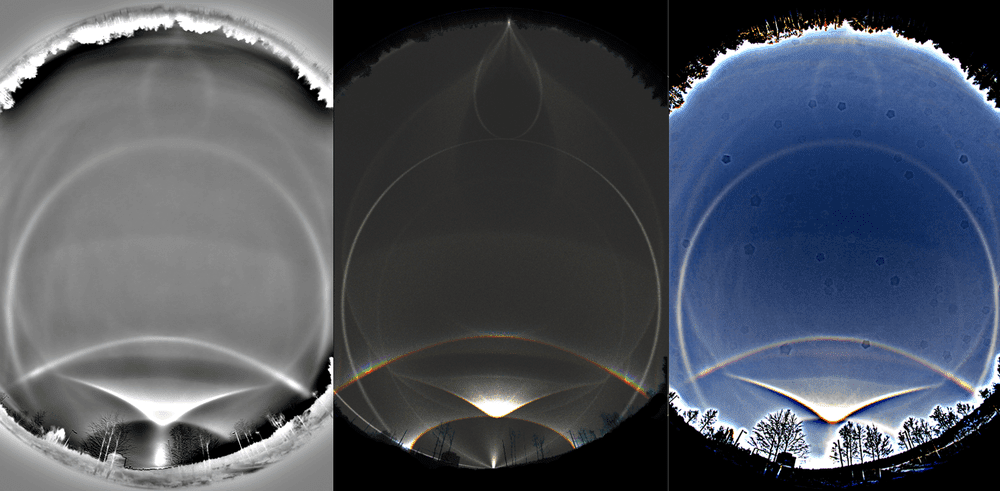
All rare halos are missing in this spotlight display, but why?


By Marko Mikkilä, Jarmo Moilanen and Marko Riikonen

The mystery deepens. In two previous posts we wondered why some displays are great in their column orientation halos even though the crystals have well caved ends. Here we show a case that appeared on November 22, 2015 in Rovaniemi, where crystals seem not much different, yet rare halos requiring basal faces are completely absent. Even the 46° supralateral arc gives just a whiff. Poor crystal orientations can’t explain the absence of rare halos as the tangent arc is quite sharp. Had we known only about this display, we would be quite happy to explain with cavities, but knowing about the other displays, it is quite puzzling.


Tuesday, 11 October 2016

Subhelic arc crossing at subsun (and some other stuff)


By Marko Riikonen

The four kaleidoscopic arcs carry in their name the location on the celestial sphere where their loops’ cross. For three of these halos – helic arc, Tricker anthelic arc and subanthelic arc – there exists photos showing the crossing.

But I knew of no such images of the remaining member of the quartet, the subhelic arc. So on the night of 5-6 November 2015 it was good to give it a try as diamond dust happened to form in an area where it was possible to place the lamp low.

It worked, although I must admit that there is really no actual cross to talk of as the subhelic arc sort of vanishes near the subsun. The display was better earlier, but then I was busy photographing at another spot nearby with less relief. By the time I moved the gear to the ski jump on the slope and took the photos for the stack above, the swarm had already lost its edge.

So there is room for improvement coming winter. Or maybe someone will photograph subhelic arc crossing from an airplane next time – just like the sub-120° parhelion and the missing segment of the subparhelic circle were photographed soon after their spotlight discoveries.

Subhorizon view for 33 degree light source elevation with regular hexagons in column orientation (h/d 1.5 dev 0.5). Simulation software: HaloPoint


At the ski jump I also switched the places of camera and lamp to see how the display looks on a positive elevation. Two photos are shown here, the upper one seems to be for a little less than 30 degree elevation and the lower one for a little less than 20 degrees.

Finally, the photo below shows the display when the diamond dust had just formed. Just like here, this is often the best stage, so it pays to come early and wait for things to start. Further below are the crystals for this stage. The marked cavities are worth noting. Maybe that is why I was not able to get a satisfying simulation. The sample also contained frozen droplets straight from the snow guns – the machines were just a couple of hundred meters away.

The temperature dropped from -2 to -6° C during the time I was out (from 10 pm to 7 am). I did not take note of the temperature when the action started, but it was lower than -2° C. If there is anything at all seen before it drops down to -5° C, things tend to be very unstable, switching quickly between ice and water fog.


Monday, 10 October 2016

Solar diamond dust display with 87° arc

A stack of 40 photos. An average stack has been combined with maximum stack to show the crystal glitter of the 87° arc. The photos were taken during ~2 minutes. Sun movement has not been accounted for.

By Jarmo Moilanen and Marko Riikonen

The diamond dust season is soon to arrive in Finland and it is time to wipe the dust off the equipment. In a meanwhile, here is the last winter’s starter for Rovaniemi, on October 30 2015. The temperature during the display was -5° C, a guaranteed number for great stuff.

So, what do we have here? First of all, visually the upper tangent arc was a breathtaking sight. In addition to its brightness, the myriads of moving crystals made it “swarm”, as if it were alive. The subhelic arc was also intense.

Then take a look at the zenith. There is an intensity threshold very familiar from spotlight displays, which we have been calling the 87° arc and which is made by 357 raypaths in rotating columnar crystals of triangular habit. Perhaps surprisingly, this is only the first time it has been observed with traditional light source. Most likely it would have been observable in some earlier photographed solar displays, but usually the photos don’t offer the luxury of all sky views.

We spotted 87° arc first visually, which we were quite happy about, as often faint effects only turn out from photos. Sun was behind the hill and not shining where we were standing, but some way up the crystals were lit. We saw crystal glitter on the sun half of the sky, cutting off abruptly at the zenith, leaving no glitter whatsoever on the opposite side.

Simulation and two versions of the stack which has 50 photos taken during 2 m 31 s.

Another feature of interest is the dark band between the Parry arc and the 46° halo. A simulation with HaloPoint having four populations of columnar crystals reproduced it quite well. Its formation is contributed by the 87° arc, 46° halo, Parry and 22° tangent arc. Crucial was making the area between Parry and tangent arc to have plenty of light by giving the four populations a continuum of limited rotations. Also, to enhance the upper edge of the gap it was necessary to keep 87° arc from extending inside 46° halo. The triangular column population with 10 degrees rotation did the work (the uppermost active population in the parameter table – number 3). Fully spinning crystals would have extended the 87° arc all the way to the sun.


Assuming the live crystal sample of this display is representative, we see that most crystals have end cavities and yet the subhelic arc (that uses both basal ends) is striking. According to the traditional picture, hollows are bad for halos, but this is not the first display to shake that belief, and actually simulations with column oriented crystals by Nicolas Lefaudeux in 2011 using idealized hexagonal cavities boosted the subhelic and particularly the Tricker arc. But then there are column displays where cavities seem to do their expected work and all rare halos are absent (we will post an example later). So it looks like it might not be a question of whether there are hollows, but rather of what kind of hollows there are.


Or maybe in nature the cavities are always bad, but in this case there were enough optically high quality crystals to make the strong subhelic arc. After all, not all crystals in the sample have cavities or the cavities are so small that their effect is negligible. It is also possible that there was more high quality crystals in the display than the sample lets us know – if they were small, we don’t see them much in the collecting dish because larger crystals have faster falling velocities and will dominate the sample.


Friday, 18 March 2016

Making divergent subparhelia with a spotlight


By Jarmo Moilanen and Marko Riikonen

Here is divergent light subparhelia flanking the pillar. Spotlight displays are classical displays with little divergentness involved. A way to create truly divergent halos with spotlight is to point it to the ground. The reflection from snow then acts as a divergent light source. Another way that might work is to cover the lamp glass with a layer of snow. That would be a shorter lasting solution, though, as the heat of the lamp will melt the snow.

Most spotlight halos are visibly formed of separate crystal glitter. Not the divergent parhelia. They are solid objects floating majestetically in the air. One feels humbled before their lofty heights, just as a lesser subject might feel in the presence of royalty.

Below is another photo of divergent subparhelia taken some hours later. And also a little lunar display from the same night, which was the 18/19 January night in Rovaniemi.

Wednesday, 16 March 2016

The hiding sub-120° parhelion


By Jarmo Moilanen and Marko Riikonen

Nothing out of the ordinary here. Just a plate display and its crystals. Visible are the usual folks: subcza, sub-Kern, sub-120° parhelion. The behaviour of the last one in spotlight displays is a little curious, though: while it comes out well in photos, visually it is cryptic. One has to run along the beam to see that ghostly spot of sub-120°. It is not made of big glitter like the sub-Liljequist parhelia – it does not seem to be made of much glitter at all, just faint diffuse spot of light.

Rovaniemi, in the morning hours of 19th January.

Monday, 14 March 2016

One display - three mysteries


By Jarmo Moilanen and Marko Riikonen

It is difficult to get a matching simulation of pretty much any spotlight display. Some details tend to be always wrong. But one can usually obtain what could be called an acceptable approximation of the real thing.

The shown display is a true rebel in this respect, for it comes with three anomalies too blatant to be swept under the rug. First, the subparhelia were brighter than parhelia (this we noticed also visually). Second, of the Schulthess arcs (the arcs from Lowitz orientation) only the concave component was visible. And third, there is no subparhelic circle opposite to the lamp.


We can not simulate any of these anomalies. The solitary presence of the Schulthess arc concave component is not a new thing, there exists a handful of such displays. The missing of subparhelic circle opposite to the lamp in this level of display is something unheard of, as is the inverted relative brightness of parhelia and subparhelia. In the simulation above (light source elevation -5 degrees) only plate oriented crystals were used. Below is a sample of the simulation crystal shape variation, the “mother shape” shown in the upper corner.


The display had also a weak segment of parhelic circle between subparhelia. The crystal shape shown above struck the right balance between the sub-Kern and the parhelic circle segment inside subparhelia.

The night was 18/19 January, the location the Sieriaapa bog in Rovaniemi. The temperature was – 29° C.

Sunday, 13 March 2016

Odd radius display and its crystals


By Jarmo Moilanen and Marko Riikonen

This odd radius display appeared on the night of 17/18 January in Rovaniemi at -29° C. Visible is the usual duo of 9° and 35° halos, and also what seems like 18° halo.

Crystals were collected. It is hard to make sense of most of the crystals. Many seem to have pyramid faces, but obvious pyramids were very few in the sample.