Saturday, 21 February 2009

44 parhelia in Estonia

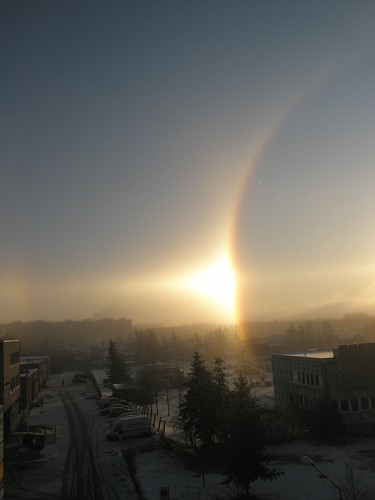
On 3rd of January it was possible in South-Estonia, Tartu to observe bright halo what was photographed by many people and was later reflected by media. Afterwards I was browsing the news ( 1 ) on ilm.ee and noticed that there might be 44° parhelion in picture taken by Aavo Omann ( 2 ). After closer inspection and browsing other captures it was clear that indeed it was 44° parhelion because there were no signs of 46° lateral arcs and the 22° upper tangent arc was weak.

Thursday, 5 February 2009

Halo display in Himos on the night of 2/3 February
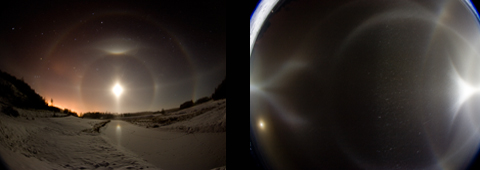

On the evening and night of 2-3 February 2009, I was testing my new HID-spotlight that I finally got earlier on that same day. What would be better place for testing than nearby Himos ski resort in Jämsä, Finland. After being there for a few hours and seeing nothing but 22° halo with my lamp, I decided to go home. Luckily, at the same time, the sky started to clear and I first saw a half moon and Parry arc on that. Then I noticed also 46° halo and quickly took a few pictures and started heading back closer to Himos where I found a place to set up my camera and lamp. I stayed on that same location all the time, because there was some wind and things may change quickly.

Lamp elevation was about 2 or 3 degrees. Haloes were supralateral arc, parhelic circle, Wegener, subhelic, suncave Parry, Parry supralateral, 46°halo, Tricker, Greenler, "Ounasvaara arc" ( 1 ) (first observed by Marko Riikonen -07) and more. Temperature was between -7 to -10 C. See a few pictures and videos ( 2 ).

Sunday, 1 February 2009

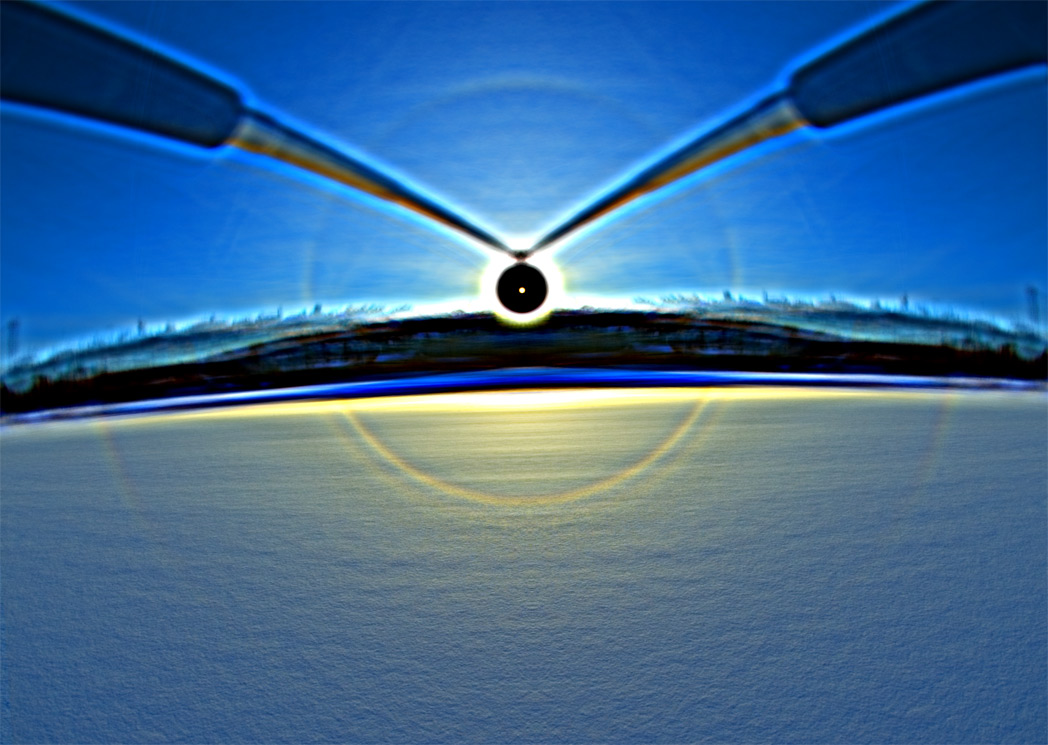
Stacking a snow surface halo

Above is a comparison of snow surface halo stacked from 40 frames two different ways (click image for an animation). The photo on the right with crystal glitter is hand-stacked with Photoshop using Lighten-method, which was introduced by Piikki in the early winter ( 1 ). The other photo is stacked automatically with Registax. Because of the crystal glitter, Lighten-method provides more realistic output, though of course this is much enhanced realism.

Camera was moved between every shot some 30 cm sideways. 24° halo is well visible in 148 frame mirrored stack ( 2 ). Pyramidal crystals were observed with microscope, but unfortunately I could not get them photographed. The display was photographed on 30 January in Tampere, on Näsijärvi ice.
Wednesday, 28 January 2009

Bright Tricker arcs in Prichovice
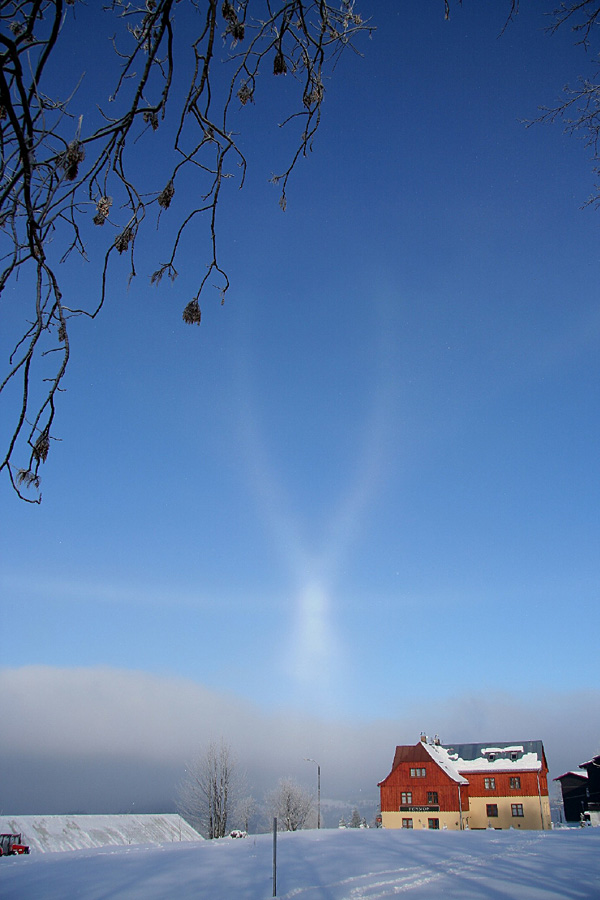
On 10 January 2009, Jan Smejkal observed a complex display in Prichovice, in which some rarer halo forms - such as the anthelion brightened by crossing Tricker arcs - were in action, too. The more frequent halo arcs included suncave and sunvex Parrys, Wegener, a faint helic, upper Tape arcs and subhelic arc ( 1234567 ). The photos also show a weak Liljequist parhelion ( 8 ).

Jan Smejkal described the weather during the complex halo in the following way: "On 10 January 2009, Prichovice was slightly above inversion, and time to time some very thin clouds crossed the sun. The display was observed at different intesities from around 9:00 until 11:30UTC when the sun got covered by clouds."

More information on the Czech diamond dust displays can be found in some articles at the following site: ( 9 ).

Text: Martin Popek and Matej Grek

Saturday, 24 January 2009

Bottlinger's rings from a Beijing - Singapore flight

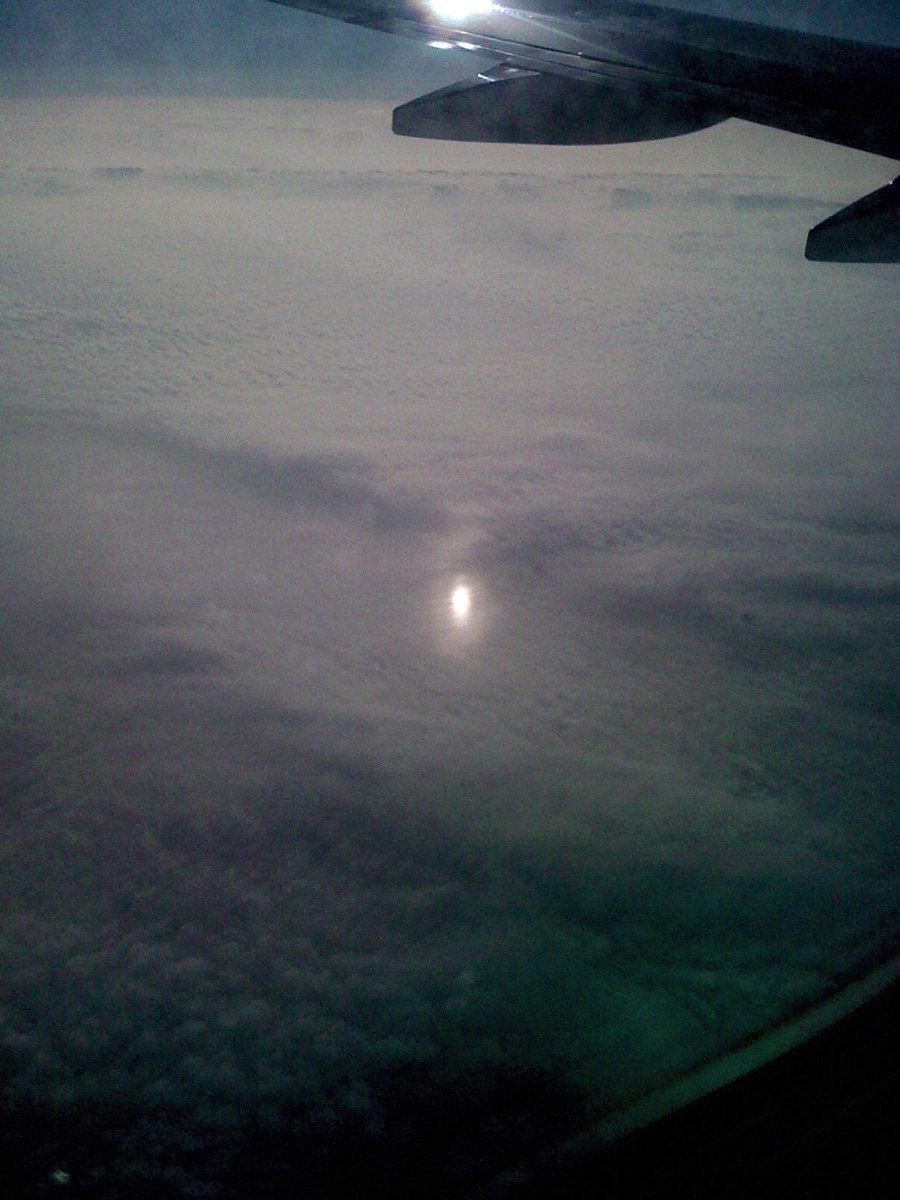
The photo on the right, and another one ( 1 ) were taken on an airplane from Beijing to Singapore on 3 January. The Bottlinger Rings appeared two times in total, when the plane flew above patches of dissipating AC clouds. I only managed to capture the first appearance. When the rings appeared, the subsun was glaring, and I got a feeling of the ring swelling and shrinking as the cloud moved, but I guessed it was only an illusion.

Text: Jia Hao

Wednesday, 21 January 2009

Elliptical halo from the Czech Republic
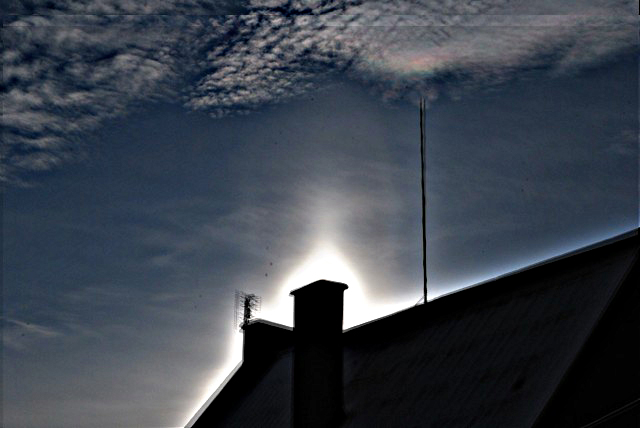
On 17 January, I (Matej Grek) went to Malenovice near Lysa hora in the Beskydy mountains to "hunt" halos in diamond dust, because humidity was near 98% and temperature below zero. However, as the temperature was still not low enough, they stopped operating the snow guns, so I went back to the train stop, and on the way, I noticed Altocumulus Virga clouds. They started to disintegrate into ice crystals ... so this was the chance to see my first ellipse ever. I looked through sunglasses and there was something that looked like a sun pillar. I blocked the sun with a chimney and started taking photos. In the train I looked at them, and noticed an elliptical shape. Back at home, I stacked the images, and Marko Riikonen also helped me by creating an animation ( 1 ). It has proved to be clearly an elliptical halo - my first one.

Text: Matej Grek

Tuesday, 13 January 2009

Halo display in Himos on the night of 9/10 January
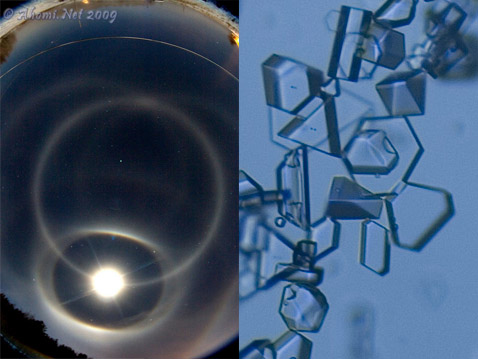
The display developed soon after the snow guns were started at 21:30 and began vanishing no earlier than 05 in the morning when Ac clouds rolled over. It was an unusually stable display, the swarm stayed in the same location and there were no much changes in the halo composition.

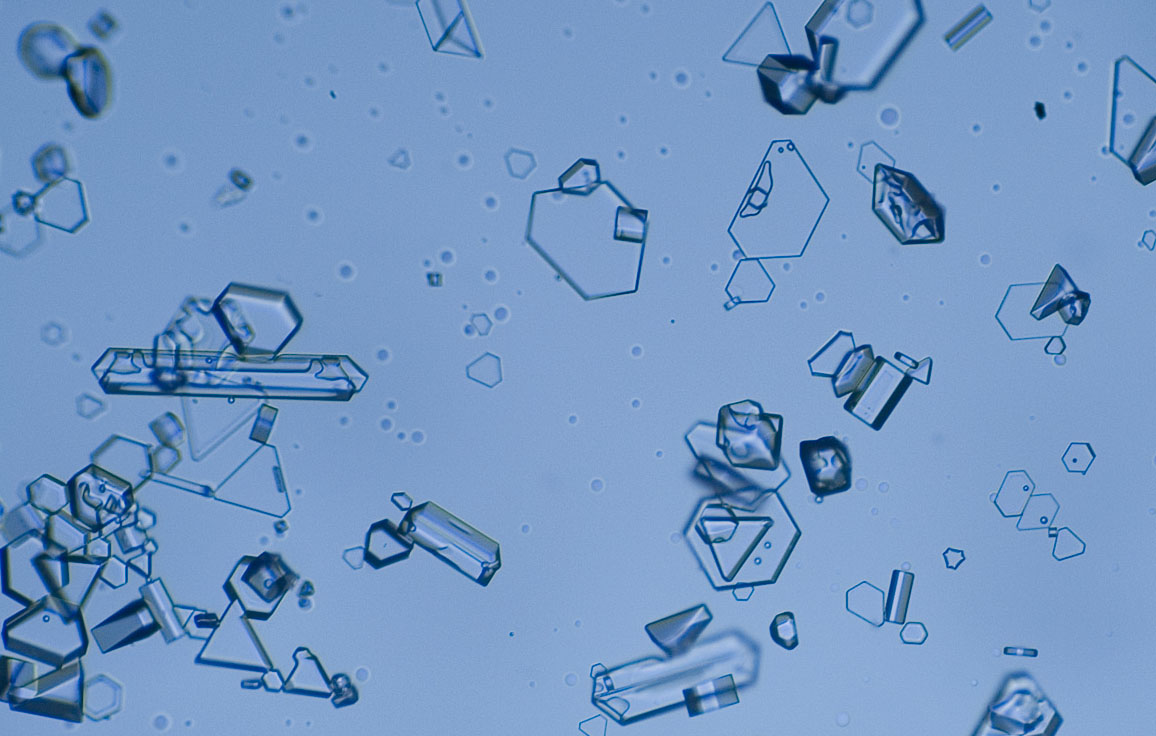
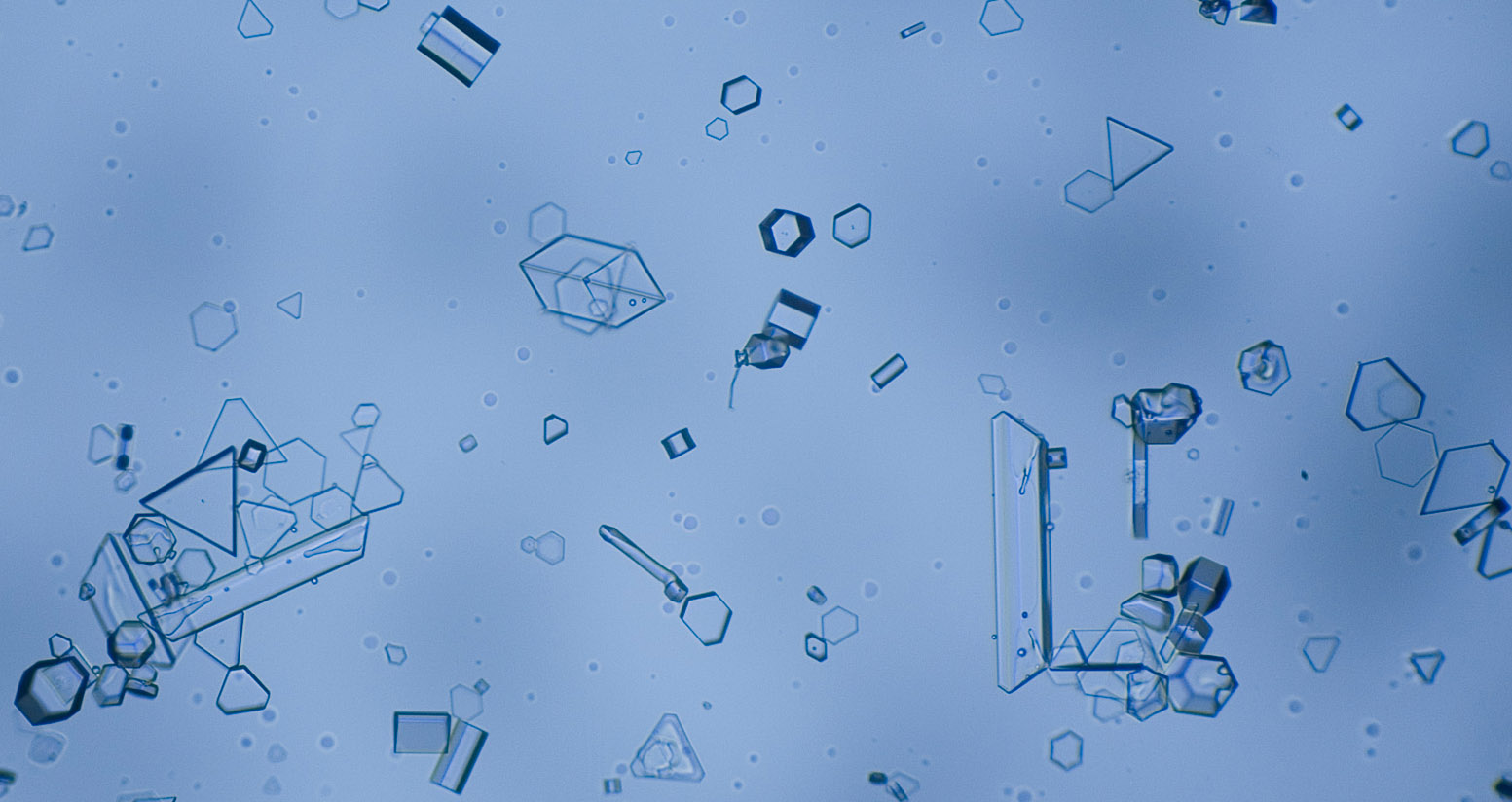
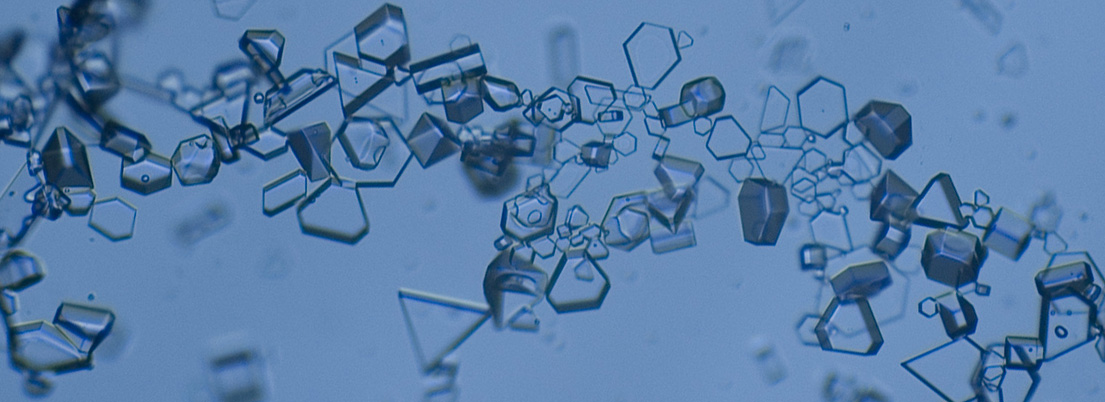
Jari Luomanen ( 1 ) and Mika Aho ( 2 ) photographed the display and took videos in the spotlight beam. I sampled crystals ( 3 - 4 - 5 ). Wegener arcs were full and both lower Parrys were visible.
Diamond dust halos were observed also in Sievi by Marko Mikkilä ( 6 ) and in Hyvinkää by Jukka Ruoskanen ( 7 ).