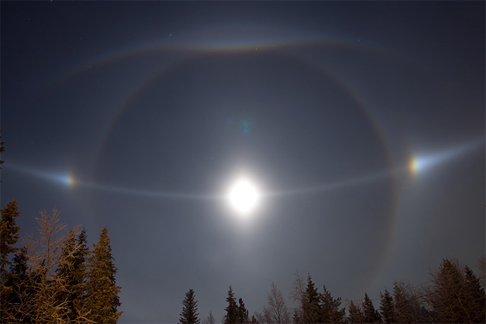
Monday, 30 November 2009
Moon diamond dust halos in Lappland

Wednesday, 25 November 2009
46° contact arc
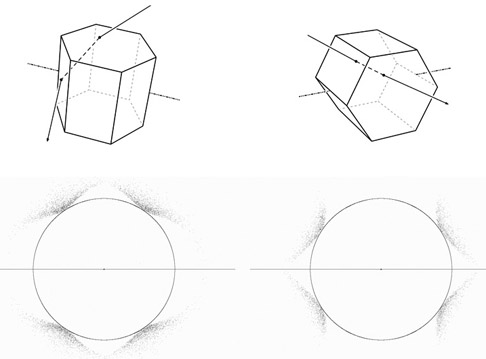
46° contact arc is formed by Lowitz-oriented crystals and it divides in three components. One of the components comes from raypaths that pass through prism face that is parallel to the Lowitz axis. This component is found straight above and below the sun. In spinning crystals light ray can enter both prism and basal face (1-3 / 3-1 type).
Two other components (shown above for 0° sun elevation) are formed by raypaths that pass through prism face that is at an oblique angle to the Lowitz axis. They are distinguished by the ray either entering (4-1 type) or exiting (1-4 type) this face. These arcs are not in the solar vertical and their position changes with sun elevation.
See simulations (Jukka Ruoskanen's software) where 46° contact arc components are shown from spinning crystals for different sun elevations ( 3 - 4 ). Normally, though, halos from Lowitz orientation are not indicating spinning-type orientation distribution. Rather, we will see 46° contact arc from either plate-Lowitz or Parry-Lowitz orientation ( 5 ).
On most sun elevations 46° contact arc components conform deceptively the curvature of the 46° halo. Circumzenith arc also can overlap upper components. Because of the delicate form of 46° contact arc, it may be very difficult to observe in high clouds. Chances are certainly better in uniform diamond dust.
Tuesday, 24 November 2009
Sharp Moilanen arc


Sunday, 22 November 2009
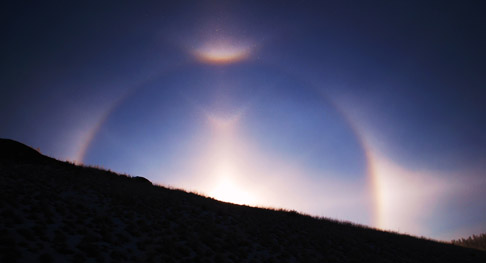
Subparhelia on ice surface

Once in similar situation also sub-120° parhelion and subanthelion was seen ( 2 ). If ice is thick enough, it is good take a little walk and and look around for these less conspicuous halos as well.
Friday, 20 November 2009
Helic arc in high clouds
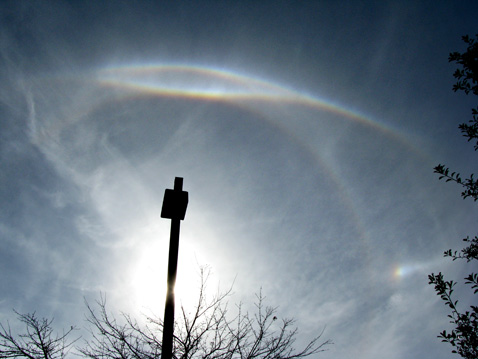
Helic arc is no news in snow gun generated diamond dust displays, but in high clouds the halo is extremely rare. Of the latter type, shown here is the latest case. The display was seen in Alpharetta, Georgia, U.S.A, in 5 December 2008 and the photo was taken by Thomas Faber. Click on the image to read Les Cowley's notes on the display. There is also a simulation included.
Tuesday, 17 November 2009
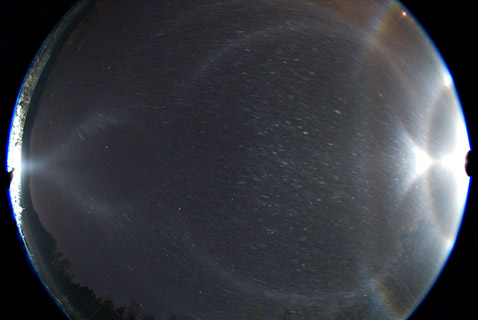
First spotlight display
Monday, 16 November 2009
Moilanen arc without Parry or tangent arc
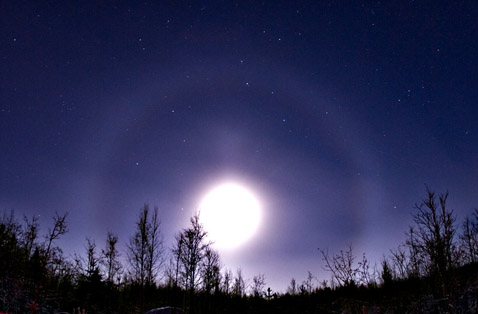
The photo was taken by Marko Mikkilä on 15 January 2009 in Sievi.
Subscribe to:
Posts (Atom)