Tuesday, 30 March 2010

Bottlinger's rings!

At last they are here: good photographs of Bottlinger's rings! Tim Stone's images of Bottlinger's rings over Illinois were published today in Les Cowley's site ( 1 ). The rings lasted only for a few seconds, but luckily Stone was already taking photos of the subsun when the rings appeared, and the phenomenon became captured.

The original observation was made by C. F. Bottlinger during an air balloon flight on 13 March 1909 over Göttingen, Germany ( 2 ). The phenomenon lasted long, from 1 to 1½ hours. Bottlinger suggested that the ring could form from a reflection in crystals falling in pendulum motion. Computer simulations by Lynch et. al. in 1994 ( 3 ) showed, however, that this motion would produce uniform elliptical glow instead of defined ring. As an alternative they suggested plate crystals in gyration motion for the explanation.

Intuitively it would seem unlikely that all ice crystals in the cloud would fall exactly in the same inclination angle to produce Bottlinger's rings. Bottlinger's rings form in the same Altocumulus virga as elliptical halos around the sun, for which pyramidal crystals with very low apex angles has been suggested as an explanation by dutch S. W. Visser in 1960. These crystals would produce also Bottlinger's rings. The gyrating crystals could make elliptical halos by assuming that they are reflections of the Bottlinger's rings from horizontal plate crystals. This was suggested by Lynch et. al. Simulations by Sillanpää et. al. in 1999, however, showed that this can not model the observed elliptical halos, while pyramidal crystals yield much more satisfying results.

A photograph taken by Claudia Hinz ( 4 ) also clearly proves that elliptical halos are not reflections of Bottlinger's rings. These two halos have not been observed simultaneously, but an almost simultaneous observation was made by Leena Virta and I in 1999 in Resolute Bay, Canada. We observed Bottlinger's rings from an airplane that was flying under the Ac cloud layer and when the plane landed, the same cloud showed elliptical halos around the sun.

Tim Stone's photos show also fainter ring outside the main ring. Assuming the gyration explanation this would require two ice crystal populations with constant inclination angles. It will be interesting to try to simulate this with pyramidal crystal model. Les has already a simulation on his site, but he says the parameters could be fine tuned. The rings' dimensions and sun elevation are provided, so anybody can give it a try!

Friday, 19 March 2010

Nomenclature woes

The kaleidoscope halos in a streetlight present some nomenclature problems. Please see the article Nomenclature Woes on my webpage (click the image above). I invite your suggestions for better names for the halos.

Walt Tape

Tuesday, 16 March 2010

46° halo on snow surface

I welcome all fans of halo! Yesterday, March, 14th I observed halo in interesting enough combination. In this sunny day, walking on the Finnish gulf, I always checked the sky on presence halo. But it was not in the sky, but underfoot, on a snow surface. It was faintly painted, but clearly distinguishable arc. Having seen it, I have been surprised, after all the sun was at height nearby 20°. Only next day, we with the colleague (Vladimir Galynsky) have solved that it was 46° halo.

I continued supervision. Where I went on ice of the frozen gulf, halo followed ahead of me - is visible the big area has been covered by crystals. Soon in the sky has started to inflame 22° halo which has then reached enough big brightness. This all looked very unusual - small halo in the sky, and big on the earth.

Nikita Kulanov - Saint-Petersburg, Russia

Saturday, 13 March 2010

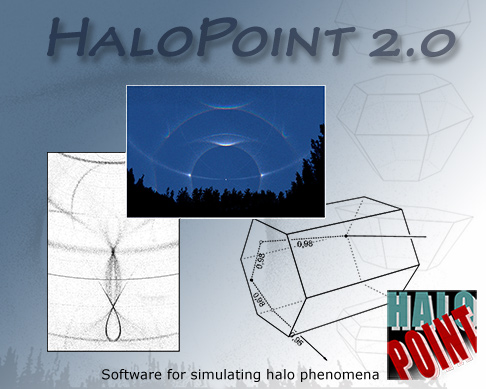
New halo simulation program, HaloPoint 2.0, released


In numerous entries of this blog there are halo simulations made with "a simulation software by Jukka Ruoskanen". The software has been under development for the past couple of years and has now reached the point where it is ready enough to be published. The software, HaloPoint 2.0, has its own webpage from which the software as well as it's user manual can be downloaded.

The software package is a zip-file. Simply extract it into a suitable directory and keep the two components of the software, HaloPoint.exe and Simulation.dll, always in same directory. The software runs in computers having Windows operating system (tested in XP and Vista). Also a .NET Framework 1.1 is required, which is already installed in most computers, but in case it is missing it can be downloaded for free from Microsoft pages.

In software homepage there are simulation examples together with parameter files so that getting started with the software is easy. In addition to the examples it is advisable to take a glance at the user manual so that the various features of HaloPoint 2.0 can be utilized.

Hope you'll have fun with it.

Sunday, 28 February 2010

Tapes arc, helic arc and subhelic arc observed in Austria

Last January, 27 th, I managed to get one of my best halodisplays during my long observation period of halos - I have observed these phaenomena more than 15 years already.

On my way home from work I observed 14 different haloforms within 1 and a half hour (14:15 - 15:45 CET). It started with a bright circumzenith arc, sundogs and a clearely vertically elongated left hand side 120° parhelion on a short parhelic circle. Later the 120° parhelion on the right hand side appeared. The highlight (about 15:15 CET) was the observation of the CZA, supralateral arc, 46° halo, suncave and sunvex Parry arcs, upper tangent arc, 22° halo with sundogs, Tape arc, helic arc, subhelic arc and a little bit later a small part of the left infralateral arc.

I run a simulation with Halosim from L. Cowley and M. Schroeder that shows the halos I have observed near the sun quite good. A report and many images can be seen by clicking the image above. I invite you to take a look at the site.

Karl Kaiser

Thursday, 25 February 2010

Peculiar 23° plate arc with an elliptical halo


The morning of 24th February at Riihimäki started with a solitary patch of supralateral arc ( 1 ) which was seen in a passing cloud and lasted for only a few minutes. Later on during the day a clearly elliptical glow could be seen in the vicinity of the Sun, and suddenly the glow started to have a defined shape: an elliptical halo. During the 2-3 minutes it took to gather photo gear and go back out was enough to lose the ring; the glow is all that can be seen in the 30 frame stack ( 2 ).

While the ellipse-stack was ongoing my attention was caught by two odd visitors: 23° upper plate arc and circumzenith arc. Immediately after change of lens the camera was grabbing images of that strange sight, see a 30 frame stack ( 3 ) and a 120 frame stack (taken with 3 second intervals, so total duration was about 6 minutes) ( 4 ).

The elliptical glow remained and sometimes seemed to have a true halo at its outer edge. The last two shots ( 5 - 6 ) show perhaps some kind of an ellipse, but it is hard to be confident since due to severe rush the images are not perfectly exposed and the 12bit sensor data is clearly in trouble because of the strong intensity gradient. Furthermore, the horrible dust of the lens spoils the images completely. Digital image processing methods, such as levels- and curves -adjustment and unsharp mask filter, are merciless regarding the cleanliness of the optical surfaces. Apologies for that.

During the ellipse - 23° plate arc - CZA -phase the sky was blue and snowflakes were floating down. The wind was not hard, but clearly noticeable and temperature in the ground was about -13°C. The halos seemed to be formed in an AC virga -type of "cloud", but the origin of the virga remained a mystery - there were no clouds seeding it. It is impossible to say whether the ellipse and the other halos were formed by the same cloud material or not. Some of the snowflakes were studied under microscope, but nothing peculiar was seen, just plain snowflakes.

On the 22nd of February Eetu Saarti managed to shoot a lunar elliptical halo in Tampere, whose duration was less than 30 seconds(!) ( 7 ).

Friday, 12 February 2010

Divergent light 22° halo on snow surface

The photo here shows divergent light 22° halo on snow surface in Eastern Siberia in January 1996. In airborne crystals divergent light 22° halo is a cigar-shaped surface, sometimes known as Minnaert's cigar, while on snow surface a slice of this cigar is seen. The illustration - made by Walt Tape - shows how the effect is formed. Lamp is on the right, observer on the left and in between is the cigar shaped 22° halo. The gray plane is snow surface and the red circle is the 22° halo on it. More images and illustrations are on my web site ( 1 ).

Marko Riikonen