Sunday, 31 January 2021

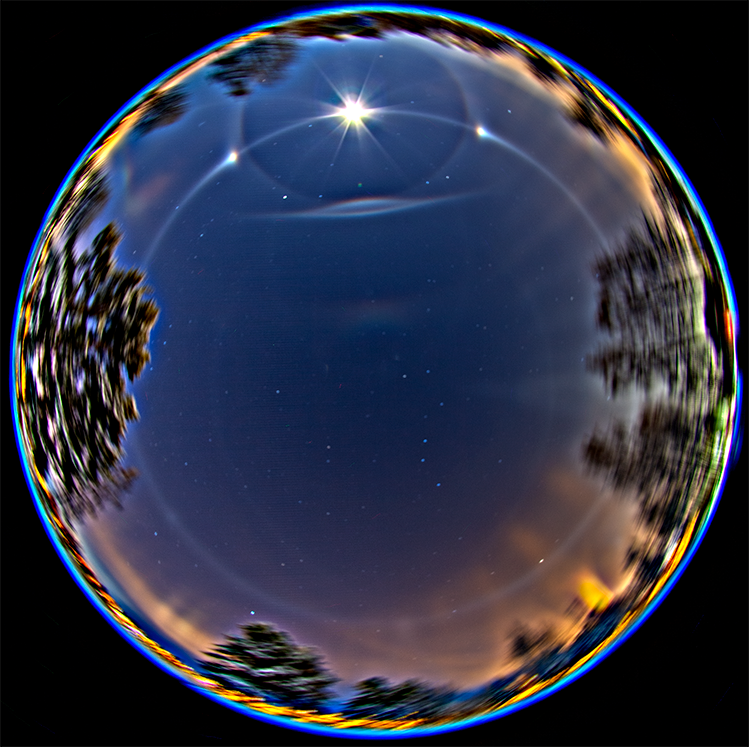
Double CZA spotted in Czechia


At the 19th of January 2021, Jarda Fous (the most active diamond dust observer in Czechia as of now) was planning a trip to Boží dar at Ore mountains where he managed to capture a doubled CZA. Temperature was oscillating between -10 and -8 degrees Celsius, low stratus clouds were hanging atop of the Neklid ski slope and snow guns were at full blast.
GPS coordinates are as follows: N 50°24.24398', E 12°56.31133'
All pictures were taken between 09:15 and 11:30 UTC. Doubled CZA was observed at 10:55 UTC. Jarda used Nikon D7200 with 8mm fisheye lens for wide angle images and Nikkor 18-105 f/3,5-5,6G ED VR for details.

At first, ice fog with low quality ice crystals only managed to conjure up a 22 degree halo with pahelia.

Later a whole myriad of halos developed - among the 22 degree halo and parhelia, a parhelic circle, colourful CZA with aforementioned doubling, 120 degree parhelia, upper tangent arc with uppercave Parry, upper Tape arcs, supralateral arc, 46 degree halo, Moilanen arc and helic arc could be seen as well. Kern was not observed, nor does it show on pictures and stacks.


Looking forward to all of your comments and remarks.


Thursday, 28 January 2021

A clear 28° halo on snow surface

Sunshine has been a rare phenomenon in Finland this winter. On 16th January, the sky was finally clear and temperature had dropped to -25°C, so I headed to a nearby lakeshore to observe possible surface halos. There were indeed 22° and 46° halos visible on the snow, so I took a set of 335 photos by moving back and forth of a 50 m stretch of a road along the lake. The mirrored stack revealed that this was an odd radius display with 18°, 20°, 23° and 24° halos present. An interesting feature was that 22° and 23° halos were equally strong and well defined in the stack.


Two days later I got another chance to photograph surface halos in the same place. The temperature was -8°C. Only a modest 22° halo with some bright glints outside it were visible to naked eye, so I did not expect much from the stack. Nevertheless, I took 147 photos. This time the mirrored stack looked even better than two days ago: a strong 22° halo accompanied by several odd radius halos, including a clear 28° ring.


A comparison with the previous display (limited by blue frame in the photograph below) provided another surprise: the prominent ”22° halo” was in fact a 23° halo and 22° halo was missing. So this was an odd radius display with 18°, 20°, 23°, 24°, 28°, 35° and 46° halos. Although there are not many observations of 28° halo on surface yet, it seems probable that it is not as rare as has been thought. This gives some hope that a crystal sample can be obtained one day.


The strong 23° halo and the absence of 22° halo in this surface display is interesting. It means that the usual ”22° halo” on snow may in some rare instances be something else than it looks, but it is not easy to detect such cases from the abundance of common 22° halos. For example, the first observation of surface 28° halo on 7 April 2012 by Jari Luomanen and Marko Riikonen looks rather similar as the current one, and it may perhaps contain 23° halo instead of 22° halo (yellow frame below, photo Jari Luomanen). Although all photos in this collage were taken with Samyang 8 mm fisheye lens, the result should be viewed with caution due to the robust alignment.


Monday, 25 January 2021

Parhelic circle without parhelia


The two displays above have both a faint parhelic circle, but the one on the right has a notable omission: there are no parhelia. These photos (12 and 7 frame stacks of about 2 minute exposures) were taken in Rovaniemi on the night of 3/4 January, in different locations and 3 hours between them. In Taivaanvahti less heavily edited versions are shown.

With the moon at 33 degree elevation in the right hand image – which was the latter shot of the two – the parhelia should be far enough outside the 22° halo to avoid being masked by it (even with its puffed up form). It seems to me the only explanation for this solitary parhelic circle is to assume special plate oriented crystals that allow only for an external reflection. Below are two simulations to illustrate this. The simulation on the left has the hits limit at 100 for both plate and random populations, on the right for the plate population only one hit was allowed – an external reflection. This gives the parhelic circle without parhelia.

Should this be the correct explanation, one may still ask why the restriction to external reflection applies only to plate oriented and not to random oriented crystals. Maybe there is something else going on here that has not occurred to me. In 2017 my camera captured a similar case.


EDIT 25 Jan: Added above a third simulation to imitate a buffed up 22° halo. It has 22, 23, 24° halos of about equal brightness. The parhelia are still outside of this broad ring.

I include also two spotlight views from this night. They were taken before I photographed the lunar display in the left hand image. Odd radius halos are visible, 24° plate arcs and 35° halo. Temperature was -20 C. Some more photos are shown in Taivaanvahti. The apparent 9° stuff in the right hand lunar photo is probably an artefact, the appearance of these features seemed to depend on the values of image enhancement.


The camera is Canon 40D, the same one that I have been using since the start of the season. It is gone now, it broke when I was ready to photograph a great plate display the another night. Even if this camera leaves much to be desired, such as dynamic range, the line noise, not having an integrated intervalometer, it is quite good where artefacts are concerned. Serious color banding artefacts are not a problem with this body.

Thursday, 21 January 2021

Streetlight halos in Lahti, 17 January 2021

After having spotted reasonably thick diamond dust from a distance while taking the sheepdog out, I spent good few hours outdoors observing and photographing divergent light halos in the surroundings of Pikku Vesijärvi park in Lahti, Southern Finland. As is generally the case in urban areas in this country, there were many lamp posts to choose from, but few of them provided any sort of darkish background for serious observing. Much of my time went into finding good spots and chasing the best swarm of ice crystals while also trying to avoid crowds of people. I found quite good conditions in the harbour area: very quiet this time of year but the lights along a boulevard are being kept switched on. For the best results I chose a lamp at the far end of the boulevard with nothing but a lake in the background.

Based on my visual observations, much of the display was dominated by singly-oriented column crystals with additional contributions from plate crystals at times. Temperature at the nearby Sopenkorpi weather station varied in the range of -7°C to -9°C.

The photo above is an unsharp-masked stack that consists of 10 individual 30 second exposures and covers some 10 minutes at around 9:15 pm local time. My interpretation of the photo is as follows:

  • The Y-shape above the lamp is the divergent light version of the upper tangent arc.
  • The horizontal arcs to the left and right of the lamp are the divergent parhelia.
  • The vertical line pointing to the top of the frame is the superlamp.
  • The curved lines pointing approximately to 11 and 1 positions from the lamp are the superparhelia.
  • Of the pair of arcs at 10 and 2 positions from the lamp, the one that goes above the other is the helic arc.

Some uncertainty remains on the identification of the arc immediately below the helic arc. Nicolas Lefaudeux (personal communication) has kindly offered two possible explanations that are both supported by his atlas of divergent light halo simulations: Firstly, corresponding to a hypothesis of singly-oriented column crystals (and the interpretation that the Y-shaped arc indeed is the upper tangent arc), this arc would be the divergent light version of Wegener arc. For the other possibility, we replace the idea of singly-oriented column crystals by Parry orientation, which means that the Y-shape would come from the upper sunvex Parry arc. The oblique arc below the helic would then be divergent light Hastings arc, potentially with a contribution from Tape arc, as the two overlap in the simulation.

The relatively strong presence of helic arc provides some support to the Hastings/Tape option. On the other hand, from what I could see visually for the most parts of the display, I would feel uneasy to exclude the presence of singly-oriented crystals altogether. The smart-phone photo below illustrates my point: the sparkles above the floodlight make no resemblance to Parry, but instead look much like upper tangent arc. Therefore I feel that at least part of the intensity is likely to come from the Wegener option.


Monday, 11 January 2021

Subparhelia on hood of car on 1-10-21

 Got home from work and being it was cold I ten to want to go over to my dad's car and look for halos in the frost crystals. I went over to look and saw some beautiful subparhelia along with subparhelic circle as well. I removed the lens off of my LED flashlight here is what I got in the photos. I also got a weak sub-CZA but it was to weak to be photographed


Tuesday, 29 December 2020

Halos on the night of 17/18 December in Rovaniemi


When you do spotlight, two things are desirable: a dark location and stable swarm. On the night of 17/18 December in Rovaniemi both were realized, totaling me more than two hours of exposure.

The sky had cleared up in the daytime and for the longest time I saw the sun, only its upper half at noon visible above the horizon from my 6th floor apartment. Some fingers of fog started to rise also here and there, promising a good halo chase for the night.

When I arrived to the slopes at 4 o'clock these fogs had disappeared and there was no diamond dust. Weather readings put the airport at -12 C while railway station was at -11 C. The airport being at a higher elevation (200 m / 650 ft) than the railway station (80 m / 260 ft), this means no inversion. Only when the temperature roles switch can diamond dust grow in clear sky conditions.

This happened after two hours, at 6 o'clock. The swarm spread south-west and engulfed the city center and the industrial area beyond. It was not worth to start photographing, though, given the light polluted locations and poor material – streelights had only pillars, no parhelia or tangent arcs.

I was hoping for the swarm to reach the southern end of the industrial district, so I could photograph in the large area there used by some earthmoving company. This location in Anttilanvaara is reached by an unnamed road and has a great dark segment spanning about a half a sky.

Finally the swarm engulfed the Anttilanvaara area and I got to work. By this time the temperature had plateaued in my tripod leg thermometer to around -20 C , and the stuff was mostly plate, with some Parry / column in the beginning. Below are shown stacks from the photos I took during the night.

The night's first set, 57 x 30s. In addition to plates, there is also Parry as evidenced by the helic arc. The arc emerging from subanthelion looks more like diffuse arc than subanthelic arc, telling there is also column, even if no subhelic or Tricker are visible. I saw the diffuse arc visually, but not tangent or Parry arc. The dark horizontal line in BR opposite to the lamp is an artefact. The lamp is about 8 degrees below the horizon. 


As the display of the previous image deteriorated, I looked around and changed to a place where more elevation was possible. Judging by the location of the subsun relative to the 22 halo, the lamp is about 15 degrees below the horizon. 54 x 30s. 


I noticed an additional brightening in the pillar and broke the previous set to turn the camera to photograph it. It was Moilanen arc as expected. 15 x 30s.


Once the Moilanen was gone the plate got again better and I returned to all-sky view. 12 x 30s. After this the swarm disappeared. I packed up to follow, its edge had receded to about 1 km towards the city. I visited a grocery store, buying potatoes and apples.


After shopping I headed back to Anttilanvaara to see it was engulfed again. This gave me this best set of the night before the swarm receded again. The edge moved several kilometers towards the city and I decided wrap it up. That was around 2 am. I think I should have just stayed: when looking from my window at 4 am as I was going to sleep, I could see the diamond dust cloud still resided in the same area over the city and possibly it might have extend its reach to Anttilanvaara yet once more. 57 x 30s. The lamp is here maybe about 30 degrees below the horizon.


Simulations to compare with the image above. The simulation on the left is made with regular hexagons, on the right with full triangles (h/d 0.5 dev 0.1 for both). There may be some of that blue spot at 100 degree azimuth from the subsun visible in the photo, too. It is from subparhelic circle raypath 3257. It seems to remain at the same distance from the sub-120 parhelion as the sub-Lilje blue spot on the other side, so there is some relationship here. Light source elevation is 27 degrees. The bulge this raypath makes in the subparhelic parhelic circle with regular hexagons has been identified in the great spotlight display that Jari Luomanen and Marko Mikkilä photographed in Sotkamo on 22 November 2014. It might be also of interest to see how those photos would look in BR.    


Here is shown only the 3257 raypath. On the left regular hexagons, right triangles. The intensities are comparable. The separate spot with regular hexagons is from 3276543875 raypath, but the part of the sequence that makes full round of the crystal (765438) can be reduced, so it is actually a 3257 raypath. Maybe this spot will be seen some day. In Parry crystals this same ten hit raypath makes subanthelic arc and is likely an important contributor to its intensity in some South Pole displays at least. The raypath is listed in Tape's Atmospheric Halos on page 130 and on page 35 is also a visualization of it.
 
So that's it folks. This post cleared the backlog and I have nothing more to report. Thus far the winter has been pretty low on the action, only a couple of singular nights of diamond dust. But I am sure in January-February a more hectic gear will be turned on.

Tuesday, 22 December 2020

Halos on 2. December 2020 in Rovaniemi

At midnight I decided it was time to go. The plume of the heat plant 6 km from my place had developed a kind of bend that could signify an inversion just starting to set in.

Turned out there was still plenty of time. It was windy and dry at the slopes. The gunning plumes died right away. Nothing else to do but wait.

Clouds arrived, covering more and more of the sky, but they were too high. Finally after 3 o'clock the action started, either because the cloud base lowered or it cleared up. It is not always easy to know because in clear sky conditions snow gunning makes often its own cloud some way above the ground, which may be thick enough to block even the full moon.


Lens hood is limiting the view in this seven photos stack when the display was at its best. In BR image inside the Tricker arc is a dark line. The location matches the subanthelic 46° supralateral arc, but it is certainly a borderline case. It is worth noticing how poor the lunar display is in comparison. That's most probably because the swarm was lying low.
 

Here the lens hood is off. A 14 frame stack. The Wegener arc was really impressive visually from the side of the beam – a colored, almost solid arc.


I started with a failed attempt to photograph on the incline of the eastern Totto slope where they had not yet made any snow. The swarm left me just as I got the equipment in place. A little later on the golf track I managed to get a handful of photos before the swarm shifted again. But I botched it by taking only the lens cap off my new 4.5 mm Sigma lens, not the lens hood. When I realized the mistake, the display was already declining. In general, the combined lens hood + lens cap of this lens is not that great. The lens hood thread is endless and you spend a life screwing it off.

There seems to be the other half of circumscribed halo visible here. The photo was taken at 4:48. Moon elevation 37.1 degrees.
 
Then I ended up photographing the display by the river at end of a short road called Venetie. Lunar this time. The swarm became stable and I think I was in exactly the right spot. A detail of some interest is the circumscribed halo that is seen at lunar elevation of 37 degrees. Well, it is only half a circumscribed halo as the other side is spoiled by trees and light pollution. But in any case I haven't seen before photos with circumscribed halo lower than 39 degrees. Theoretically, the limit light source elevation for circumscribed halo is 29 degrees. Probably it was here full still longer, but it is cut by the trees as moon goes lower.

I called it quits at 6:30 because the display was steadily worsening. As I drove to my place, and out of the diamond dust for first time since the action started, the sky cleared up. So, as to the question posed in the beginning of this post, whether this was a clear sky or punch hole display, the former was true. 

In hindsight, I should have done spotlight instead of lunar. Wouldn't have had to worry about the movement of the light source, and even with all the light pollution from the streetlights and moon, it would have most likely been the more interesting option results wise.


23 frame stack. Moon elevation 37.2-36.7. Moon movement has been accounted for in post processing for this photo and the ones below. All photos in stacks are 30 s exposures.
 
 
24 frame stack. Moon elevation 29.8-29.0.
 
Simulation for the image above, 29.5 light source elevation.
 
The night's last set 6:30 in the morning by the river at the end of the road Pieskätie. Nine photos stacked.