Wednesday, 16 December 2009
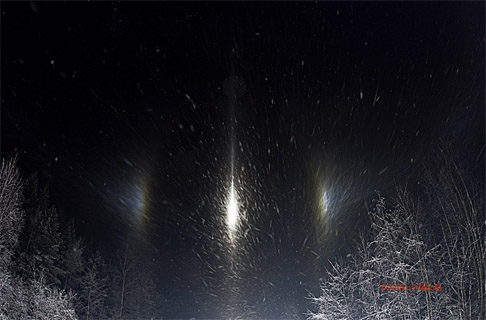
Low lamp subparhelia

Tuesday, 15 December 2009
Odd Radius Halos in Diamond Dust
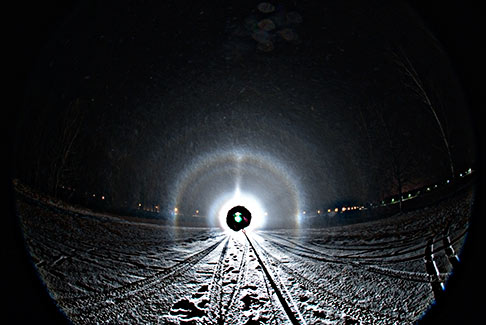
At the camera's LCD display the 18°/20° (?) and 35° halos could easily be seen. After first seeing them in the photo I thought I was able to see them visually too, but that was not certain. I did mess up the crystal sample, since the most-likely-pyramidal-crystals are distorted and round - the gear was still too warm during the sampling. On the other hand, if I would have waited longer, there would not be any signs of pyramids in crystal samples, since the pyramidal phase was gone in less than 10 minutes and did not reoccur during the rest of the night.
By clicking the image above the gallery opens.
Tuesday, 8 December 2009
When you see Moilanen arc - look below the sun!
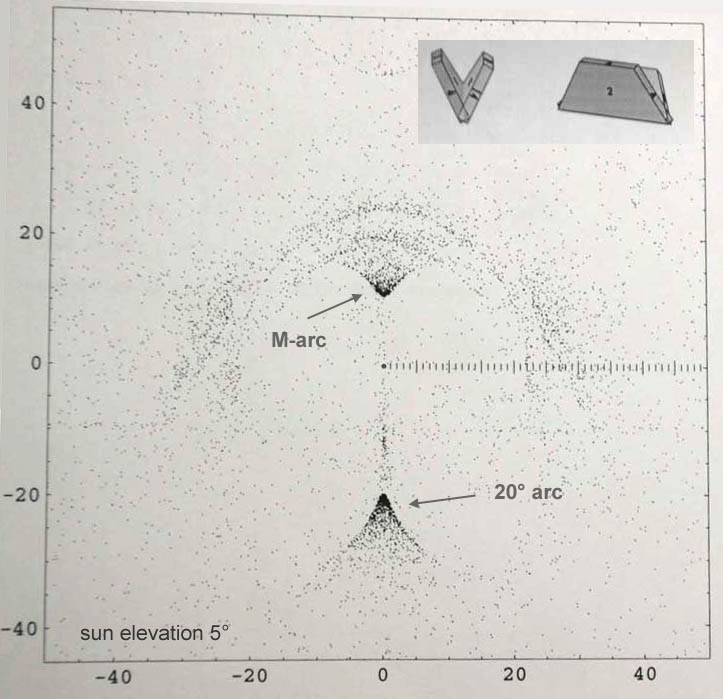
All of us are more or less skeptical about this explanation, but we think it deserves testing. The model predicts a strong lower 20° arc. We are asking that, if you are lucky enough to see an M-arc, then please put yourself in an elevated position and look for the lower 20° arc. There are other observing suggestions as well, but I think I will leave them for the blog.
(Walt Tape)
Monday, 7 December 2009
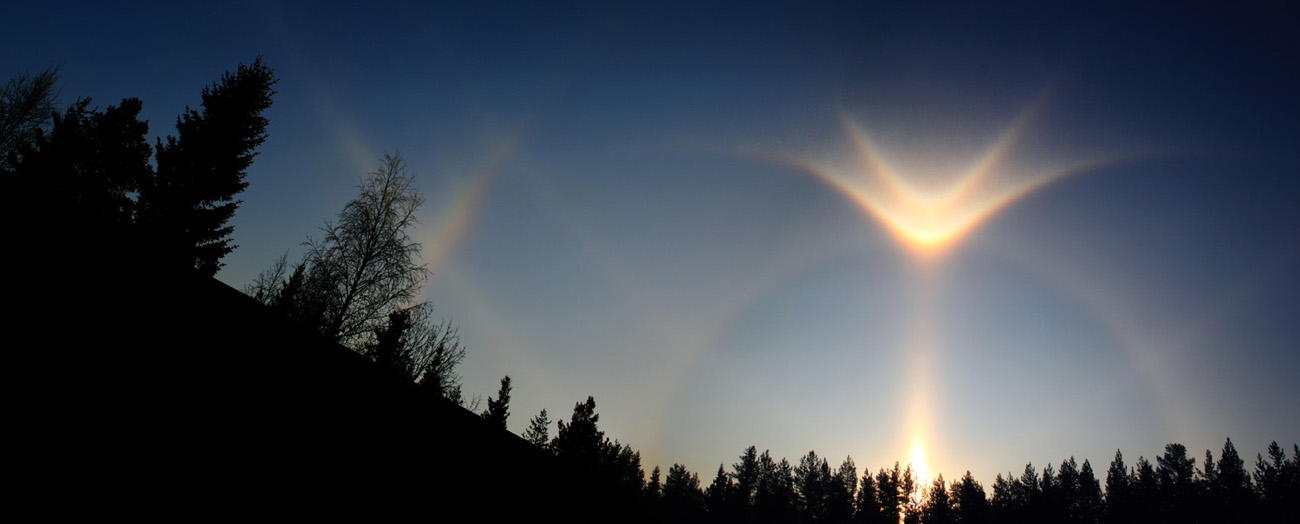
Bright sunvex Parry arc
Saturday, 5 December 2009
Lunar halo complex in Sotkamo, Finland
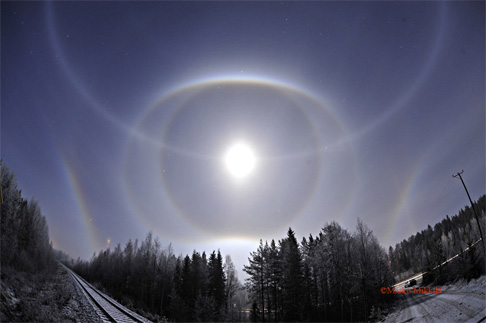
However, when darkness fell, the water fog cleared off and diamond dust started kicking in as the air got colder. In the beginning the moon showed no good halos but spotlight gave a reasonable display ( 1 ). Later also the moon halos catched on, as is seen above. Click on the image for more photos.

Simulation of the display ( 2 ) needed slightly flattened columns to get the subhelic arc intensity right. With any other crystal shapes, the part opposite to the moon where this halo is tangent to Tricker arc, was not visible. Intuitively those flattened crystals would take Parry orientation, so it looks like again we are not really understading it. Same effect was also present in the great Himos display last winter ( 3 ).

After midnight Mikkilä headed home because the high clouds in the background were becoming too disturbing. All together the halo hunting trip took 600-700 km of driving. Looking at the results it was definitely worth it. See also the photos by Jari Luomanen from the same night at the Sappee ski resort, and be sure to read his insightful description of the diamond dust formation on the right ( 4 ).
Thursday, 3 December 2009
Halo display in Himos on the evening of 2nd Dec 2009
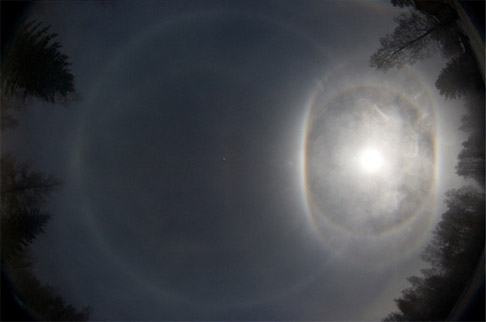
Arctowski's book of optical phenomena in the Antarctic
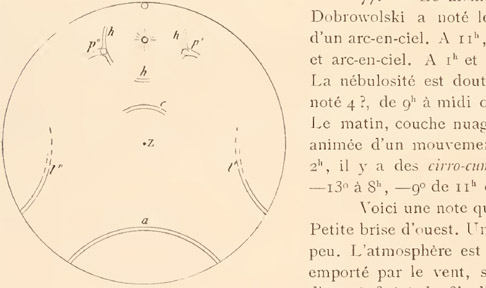
Shown above is his most well known halo observation, the one with the "Arctowski arcs" that in the drawing rise from the horizon at about 120° from the sun. There are also other peculiarities, for Arctowski reports the patches of h to be 26 - not 22 - degree radius from the sun and the circumzenith arc distance from the zenith to be 28-29 degrees, which is probably more than it should be at the observation's sun elevation.
But if we leave the measurements aside and look at the drawing, the sunside of the sky looks pretty ordinary. The Arctowski arcs, which he writes as being faint, could be misplaced 46° infralateral arcs. And the rainbow in the opposite sky could be a fogbow. So, nothing extraordinary there, except maybe for the fogbow, that still has not been captured on film with halos in naturally lighted conditions.
Any French speaking readers here who could translate Arctowski's account of the display (PDF page 40-41)? It looks like he had made some interesting notes on the halos showing up in nearby crystals. I can add it here.
Subscribe to:
Posts (Atom)