Thursday, 25 February 2016

Diamond dust halos on the night of 12/13 January, part II


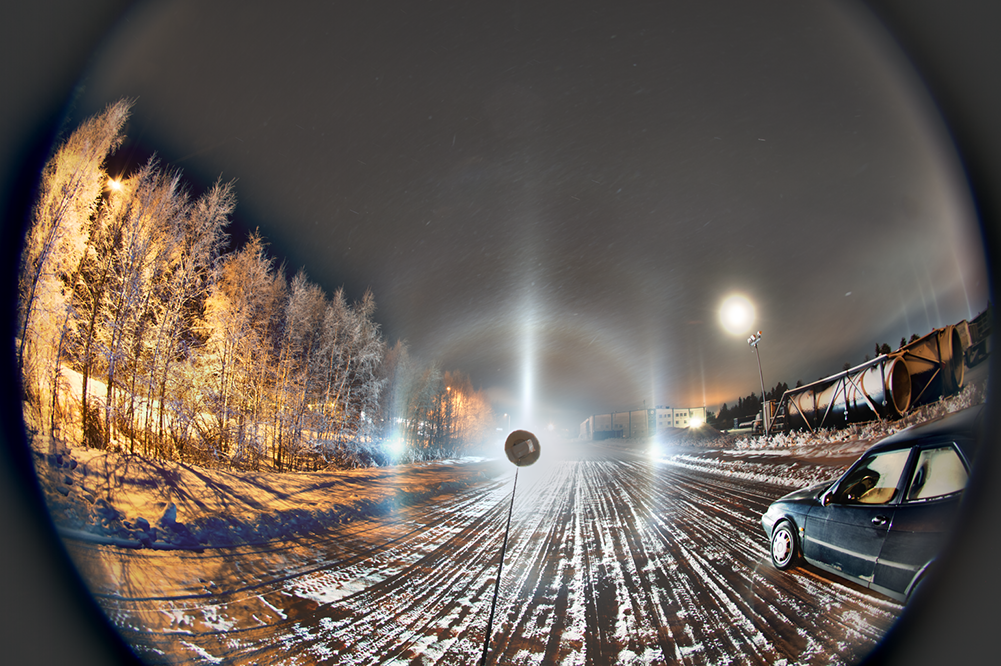
More photos from the 12/13 January night. The image above is a view opposite to the spotlight. Seen is blue circle, diffuse, Wegener and subhelic arcs. Below are two more images, the blue-minus-red image shows the “column 351/361”, which is the Kern arc equivalent of 46° supralateral arc. The lamp is about 5 degrees below the camera.

Marko Riikonen


Wednesday, 24 February 2016

Diamond dust halos on the night of 12/13 January, part I


With this post starts the presentation of January 12/13 night results in Rovaniemi. All photos are in spotlight beam. The image above is a singe frame with 30s exposure. Just basic halos there. In the rest of the images emphasis is on the crystal glitter formation that makes an intensity threshold at the zenith. The ray-path for this effect, which is quite common in spotlight displays, is 3-5-7 and here it is from column oriented crystals. What’s peculiar is the psychedelic colours of individual crystals, as shown by the left side image below that is a maximum stack of four frames. In the 20 frame average stack next to it the colours are washed away. The lamp is the usual 5 degrees below horizon. In the images below are two single frames which display the coloured glitter even more clearly and another maximum stack of 14 frames. Individual frames are all 30s exposures.


Marko Riikonen


Lunar odd radius display in diamond dust


On four out of last five winters Tapio Koski has photographed lunar diamond dust odd radius halos in the Rovaniemi area. These one-per-winter occurrences are almost solely responsible for lunar diamond dust odd radius displays photographed in Finland during those years. This winter we wanted take part in the tradition. Yet despite numerous odd radius displays we had harvested in the beam, those by the moon – or sun for that matter – were simply not coming.

Except on the night of 20/21 January, which was the month’s last diamond dust night in Rovaniemi. During the day, when driving in the city, we paid attention to Fairbanksian amber, a beautiful yellow glow in the sun direction that can be seen in cold weather and with which we became familiar on the successful halo expedition to Fairbanks in January 1996. This gave us an omen of foreboding that a night of big odd radii diamond dust was finally on the cards for Rovaniemi. Weather forecast was with us too, as the temperature was expected to drop to -33° C – the magic number that Walt Tape has given as being in the centre of the temperature range favourable for odd radii.

The display appeared as some thin water cloud that had momentarily overtaken the sky cleared away. The first halo visible was upper 23° plate arc, many others soon followed the suit. In the beam only a crappy plate dominated display was visible – the pyramid stuff was higher up.

Jarmo Moilanen / Marko Riikonen


Halos from oriented pyramids in the spotlight beam


On the night of 20/21 January we photographed oriented pyramid crystal halos in the spotlight beam on two occasions. The first occasion, shown above, got us completely unawares and the odd radii stuff was all gone in the next shot which would have had the exposure right. Colored and solid upper and lower 9° plate arcs were seen, but if they were still present when the camera was placed in the beam, they are nevertheless washed out by the overexposure. In the photo one still sees the 35° halo and lower 20° plate arc. The lower 9° plate arc was of the 23-6 type as the lamp was about 5 degrees below below horizon.

We drove around and switched on the lamp here and there, stubbornly trying to get a rerun, but to no avail. Diamond dust was already on the retreat, the air was drying up even though it was around -33° C. Yet we managed to get something just before it all evaporated, as shown by the image here:


A little simulation study as was necessary to see whether it was column (left) or plate (middle and right) pyramid stuff, but that did not give definitive answer. The plate scenario simulations are identical except that in one is 22° halo and in the other 23°. The 35° and 18/20° stuff above the lamp were initially noticed visually which prompted us take the photo series for this stack.

These last photos were taken at 3:30 am. The two photos below are the first photos of the night at 6 pm. We photographed these lunar and beam displays simultaneously. No odd radii yet at this early hour.

Marko Riikonen / Jarmo Moilanen


Tuesday, 23 February 2016

Pyramid crystals and odd radius halos, part II


More halo and crystal photos from the 20/21 January night. While this second crystal sampling and photographing session was under way, the display in the beam was photographed constantly, but again odd radius halos are not visible in the photos, expect perhaps for a suggestion of 35° halo at one stage (not shown). Yet again the sample was littered with classical pyramids as shown by the images in the gallery.

The picture above is an appearance of odd radius halos after the crystal business was over with. It is a “blue minus red” (br) of stack with total of 9m30s exposure and contains 9°, 18° and 35° halos. Three more halo images are in the gallery, first a single frame from the stack above, then two that are versions of another stack, the br displaying full 46° halo.

Jarmo Moilanen / Marko Riikonen


Monday, 22 February 2016

Pyramid crystals and odd radius halos, part I


The night of January 20/21 in Rovaniemi was a night of odd radius halos. Here are shown mostly crystals collected during a half hour period. At the same time photos were taken continuously in the spotlight beam, below is one of those stacks. The sample contained plenty of traditional type pyramids – something we have not yet seen this winter. So it is curious that odd radius halos are not conspicuous in the beam photos and at times even completely absent. Maybe the abundant cavities in the crystals caused too much disturbance.
The stack is from a stage where the odd radius stuff was at its best, taken towards the end of the crystal collecting period. Visible are 9°, 18° and 35° halos. The temperature during the night was around -33° C.
Jarmo Moilanen / Marko Riikonen


Wednesday, 29 April 2015

Sliced and offset reflection susbun


Laying down on sofa in the warmth of a glassed balcony in a flats building in Kirkkonummi and looking at the sky, it seemed like sun was soon to get behind a thick sausage of cloud. A lazy thought occurred - like a barking of an old dog that has lost faith in barking but does it anyway because that's what the dog is supposed to do - that maybe this time reflection subsun will appear. The lake was there: a week or so earlier I had seen at about the same time (it was closing 8 pm) from this same balcony reflected cloud rays.

Soon the sun was behind the cloud and nothing happened. Then, after an indeterminable time, still assuming a plate orientation on the sofa, two short slivers of light against the cloud caught attention (the first photo above). Cloud rays, I thought. Seconds pass. Cloud rays, yeah. More seconds pass. Um, somethings not right, they are still vertical. Better get the camera.

So I took photos during the about 10 minutes that the phenomenon lasted, from about 1955 to 2005, on 28 April, 2015. All of them are shown above in original and unsharp masked form (get larger size from bottom right). Two anomalies catch eye. First, the phenomenon is cut in thin slices. Second, parts of it are offset from the solar vertical. This is seen in the photos toward the end of the series where the pillars develop also higher up from the initial location (which by the cloud rays was pretty much the location of the sun behind the cloud) and are offset to right from the sun vertical.

I though I was looking at an anomalous reflection subsun, but when sun came out and no normal pillar was seen, I didn't know anyore what to think. Sun went back behind the cloud but the phenomenon never reappeared. Near sunset sun was shining again and as it sink down a beautiful saturated red twilight developed in the clouds above. No pillar could be seen. But then suddenly, when the color was already fading, the pillar appeared as shown by the photo above. Maybe when the sun got enough low under the horizon its rays did not light anymore on the lowermost non-ice parts hanging down from the bottom of the cloud, but instead were shining only on the higher icy parts. The masking curtain of the lower parts thus removed the pillar had the stage now.

But the main issue is what were the reflecting surfaces that made slivers and caused the offset. I don't know.