Wednesday, 22 April 2020

New Halo - Triple CZA (Jensen arcs) in Denmark

* All photos in the post are copyrighted to Anders Falk Jensen

* * For ease of reading, in the following texts: CZA = circumzenithal arc, CNA = circumnadir arc.

On April 14, a layer of high quality crystal cloud blanketed Denmark and treated sky watchers there with a feast of rare halos. Among those lucky ones, Anders Falk Jensen was probably the most prepared and dedicated, and what he has captured this day will go down in halo history books as a legend.

Let's first enjoy Anders' halo chasing story and beautiful images.

" The Jutland Display

When I got up that morning I was looking out the window and noticed the bright parhelia and colorful superlateral arc. I quickly put on clothes, grabbed a camera and ran outside our house after telling my son and wife to have a look. I found a whole-sky display was surrounding me and I was completely blown away!

Solar elevation: 15.6°

At first I thought I was looking at a diamond dust display because of the brightness of the haloes and temp below freezing, but this turned out to be high clouds. I reached out and tried to touch the halos, it felt like they were so close! I knew this was an important display, so I took a series of images between 8:10 and 8:30 at our place in Them near Silkeborg, trying to cover as much of the sky as possible with 24 mm on a Nikon D700. I noticed arcs going upwards from the parhelia, odd shapes of the 120 degree parhelia, sub-helic and Wegener arcs crossing above the Liljequist parhelia, among the more familiar halos.


Parhelia at this stage sport at least two 'tails', indicating the presence of Lowitz arcs. Solar elevation: 15.6°

120° parhelia, subhelic arc, Wegener arc, blue spot and (?)Liljequist parhelia. Solar elevation: 16°

Unfortunately I had to go to work, so I drove off. I stopped to take more pictures minutes later in the nearby village Salten, since the halos still were bright and I had a good view from there. The anthelion with tricker arcs was making a nice appearance here.


 120° parhelia, subhelic arc, Wegener arc, blue spot, (?)Liljequist parhelia and Tricker arc. Solar elevation: 17.4°

 Tricker arc. Solar elevation: 17.7°

After a few minutes I decided to drive further south and kept one eye on the sky while driving on road 52. After a while I noticed the halos were getting brighter again, so I made a stop near the little place called Addit. The CZA was at this point extremely bright, so I also made some shots of the zenith region, looking for the Kern.


The Kern arc can be seen on the left. Solar elevation: 19.8°

Then I got on the 52 again. Southeast of the town of Brædstrup I noticed something strange was going on with the CZA, so I pulled over to make photos at the village of Bredstenbro at 8:58 local time. When I got out of my car I was seeing a double CZA and a I felt like I was on another planet, what an amazing sight! I could not tell what was happening here.


Double CZA. Solar Elevation: 21.6°

After this exciting photo session, I continued further south towards my workplace, rather uplifted. The display was rapidly fading from 9:10. The last halo I saw that day, was an orange lower tangent arc near eastern horizon at 9:26 local time.

Anders Falk Jensen "

The display is obviously an extremely high quality one with loads of great stuff. However, the mysterious 'double CZA' in the last stage completely stole the show. As far as we know, such phenomenon has never been photographed in the past. We're looking at a NEW halo here!

As if a 2nd CZA isn't enough, when we treat Anders' photos with aggressive processing, a 3rd CZA vaguely appears below the 2nd one!

Processed by Marko Riikonen. Sun elevation: 21.6°

So how do we explain this stack of CZAs? So far the experts have come up with three hypotheses, but each has its flaws:

Theory 1 (proposed by the Chinese halo community) - Concave pyramidal plate crystal

Similar to the ultra-flat pyramidal plate theory used to explain the elliptical halos, but with the pyramidal sections concave instead of convex. This will enable a reduction in the wedge angle between the top basal face and prism faces. CZAs coming out of such reduced wedge angles will be closer to the sun.

However, with the addition of extra pyramidal faces, other unwanted arcs will inevitably show up. To get rid of the unwanted stuff, we'll likely need plenty of triangular crystals. Simulation with such crystals is possible with Zhang Jiajie's program. Once he's got the time for it we'll update this post with the results.

Update:

Zhang spent some time making regular hex-shape concave pyramid crystals possible in his program and the simulation results are as follows. Apex angle used is -177°.


Simulations with ZHANG Jiajie’s program (https://github.com/LoveDaisy/ice_halo_sim/tree/dev/cpp). Sun elevation 21.5°.

Ignoring the weird-looking parhelic circle and 120° parhelia, it appears that the CZAs coming out of such concave pyramid shapes are very sensitive to pyramidal cavity depth and prism height. Thick crystals seem to create better results but there're the Kern elements which didn't show up in the display at all. There's also a x-shape arc sandwiched between the two CZAs which arises from 13-4 ray path. Besides, the two CZAs look perfectly parallel, while in the actual display, as pointed out by Nicolas earlier, the bottom one seems to exhibit less curvature. 

Overall, such concave crystal model seems to offer more cons than pros thus less likely to be the solution in this case.

Theory 2 (proposed by Nicolas Lefaudeux) - Plate crystal with slanted prism faces

By making the plate crystal's prism faces a bit slanted, the basal-to-prism wedge angle gets reduced too. Nicolas managed to closely replicate the triple CZA scene in HaloPoint, by introducing two crystal populations with prism faces tilted 3° and 6° respectively. 


Simulation by Nicolas Lefaudeux, with HaloPoint 2.0.

Simulation by Nicolas Lefaudeux, with HaloPoint 2.0.

However, the slanted prism faces shift the parhelia and parhelic circle down too. Triangular shapes in this case won't help much in eliminating them. 

Update:

As requested by Marko, simulations with regular hex-shape stack pyramids - crystals with one pyramidal segment with bigger apex stacked on another segment with smaller apex, were also carried out with Zhang's program. Crystals with height 0.0012, apex 3° and height 0.0002, apex 6° pyramidal segments stacked below a height 0.1 prism give us the following result:


Simulations with ZHANG Jiajie’s program (https://github.com/LoveDaisy/ice_halo_sim/tree/dev/cpp). Sun elevation 21.5°.

Though the parameters look bizarre, the result looks quite all right and almost the same as Nicolas' simulations with two separate populations. Parhelic circle and 120° parhelia still look weird and there seems to be no ideal way to make them look normal with this crystal model.


Theory 3 (proposed by Nicolas Lefaudeux) - Reflected CNA

The sea shore is located at some 30km east of Anders' viewpoint. Theoretically it's possible that the sun's reflection on the sea was sliced by the sea shore and strait into at least two patches of light blobs, acting as two sub-horizontal light sources giving rise to two reflected CNAs below the main CZA.

However, the CNA ray path is less efficient than the CZA path, making it difficult for a less-than-ideal light source to create a bright, sharp and colorful CNA. Even if the reflection gets as bright as the sun, the resulting reflected CNA will still be a lot dimmer than the CZA.

Nicolas later managed to find satellite images of April 14 revealing the cirrus cloud's evolution over Denmark. Video is copyrighted to sat24.com. Original link: https://www.youtube.com/watch?v=gMKsN4APgrk


It appears that at around 7:00 UT, which is the time when the triple CZA peaked, the cirrus was in the middle of a fast sublimation process. Anders' photos between 6:51 and 6:59 UT (8:51 to 8:59 local time) seem to corroborate Nicolas' findings.

Processed by Marko Riikonen. Photos taken behind windshield thus the extra reflections. Sun elevation: 20.4° ~ 21.6°

As can be seen from the sequence above, other halos in the display degraded as the cloud sublimated while the extra CZAs gradually appeared and gained strength. If erosion of crystal faces constitutes part of the cirrus sublimation process, theories 1 and 2 mentioned above could then become the more plausible solutions. Hopefully a repeat event occurs soon at different solar elevations so that these theories could receive deeper scrutiny.

Whatever the solution is, these extra CZAs, which should rightfully be called Jensen arcs now, will keep the experts busy for some time.

- Co-authored by Jia Hao, Nicolas Lefaudeux and Marko Riikonen

* There're more hidden treasures in this display. Please stay tuned for another post covering them. *

Thursday, 12 March 2020

A divergent 46 contact arc

Shown is a display on the night of 10/11 December 2016 in Rovaniemi. I observed and photographed it on an open bog called Rikanaapa, a dark location 7 km east of the ski center, which is around where you most often get diamond dust in Rovaniemi. I think it was one of those colder nights, with temps on the lower side of -25 C.


As I stood there, watching the display and letting the camera snap away photos, I was wondering why the glitter that was the circumnadir arc looked so broad. Photos confirmed this impression. A comparison of long series of shots taken in fixed configuration showed that in the beginning there was briefly a normal looking circumnadir arc (the first photo in the collage above) but then it thickened by extending towards the lamp. Actually, photos reveal it quickly stretches all the way to the lamp in a manner similar to divergent 22 tangent arc.

I was flummoxed and asked Nicolas to take a look when he was visiting in Rovaniemi March next year. He told what should have been obvious: it's 46 contact arc. At the same time also some kind of subparhelic arcs (Schulthess arcs) appear, so it all fits.

But at least one question still hovers in the air: why the 46 contact arc is divergent, with not much at all the classical form to talk of? Only in the second image of the sequence there is what appears to be a classical instance of the 46 contact arc, with some shape and red inner edge. After that it turns into divergent form.

It is also noteworthy that the occurrence of the 46 contact arc coincides with the occurrence of divergent subparhelia. Something in the crystal properties seems to sometimes favour picking up the divergent rays of the spotlight beam. I have seen some really strong divergent subparhelia come and go in the  beam and think they appear when plate crystals get thick. But even then you have also strong classical subparhelia. However, having just divergent 46 contact arc without its classical instance is puzzling.

CORRECTION (13 March 2020): in the second image it is not the classical instance of 46 contact arc. It is way too high up. Anyway, the 46 contact arc hypotheses still probably holds up for the explanation of the stretching of circumnadir arc towards the lamp.

Thursday, 5 March 2020

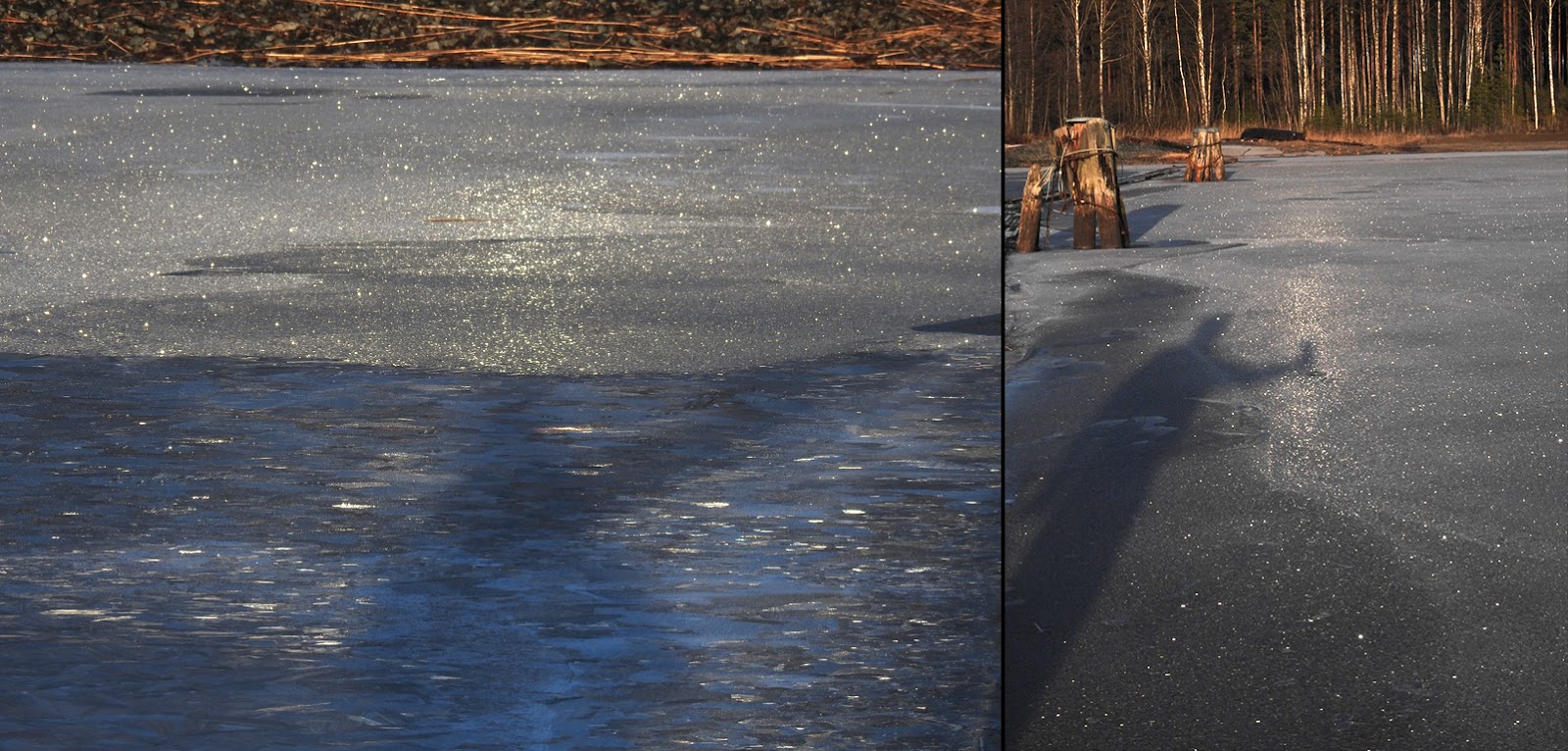
Halos on lake shore ice hoar frost

by Marko Riikonen and Petri Martikainen

Some fine surface halo displays were seen on lakes’ ice on January 9 and 10 in Finland. Photos were also taken on the night of 10/11 January when the moon was high in the sky. Halos appeared on two different surface-types, both of them showing completely different displays. Halos from what must have been azimuthally oriented crystals were seen on shiny, mosaic patterned ice surfaces. Near the shore in places hoar frost had developed, and on this less reflective surface more traditional type of displays appeared that were not from azimuthally regimented crystals.

In this post we will present our observations in Juva and Tampere concerning the hoar frost surface. The displays were quite similar in both locations. In Juva observations were done on both days, in Tampere mainly on the second day and the following night.

The halos were as follows:

46 halo/arc. A tightly confined and quite distinct segment of 46 halo appeared near the horizon on both locations. This might rather be defined as a kind of 46 arc because of the relatively restricted crystal orientations.

Helic arcs. In Tampere three surface helic arcs were visible. In Juva, where this feature was less well developed, two surface helic arcs could be discerned. In the night, with moon high in the sky, in Tampere a large, detached "Bottlinger's ring" helic arc was seen.

Subanthelion. In Juva, a prominent vertically elongated subanthelion was visible. In Tampere it was weak.

An arc at 45 degrees from antisolar point. Both in Tampere and Juva an arc that appeared to have a concave shape with respect to the subanthelic point was seen and photographed. It consisted of rather dense and faint glints. Its distance from the subanthelic point was measured from a stacked image at 45 degrees. There is likely a margin of error of one degree. Even though the arc appeared concave, it did not seem circular.


The display on 10 January in Tampere is shown above with a simulation. The composition of the display and the actual crystals on the surface (more about them below) guided our choice of parameters. Our initial simulation gave a strong 22 arc below the sun, while in the display there is no such feature. To solve this contradiction, we assumed that crystal attachment to the base might incapacitate two lowest faces which are needed to make this arc. To test, we curated the HaloPoint simulation software output file by removing all instances using these faces, and expectedly got rid of the 22 arc. Additionally, this also removed the extra 46 arc that is neither seen in the display. Comparison of scenarios with all ray paths considered and those having instances with two lowest faces removed, are below.


Crystals in simulations are oriented with their c-axis on average horizontally and rotated 17 degrees from Parry orientation. This rotation gives three upper prism faces (A, B, C) in different orientations to make three helic arcs to roughly match with those in the display (image above). Also, this gives the 46 arc near the horizon, the prism face responsible for it denoted with D. The precise parameters for simulation are below.


Below is a photo of the display towards the sun in Juva on 9 January. The 46 arc was prominent. No sign of 22 halo was seen on the hoar frost surface, but bright subparhelia were present in the shiny, mosaic-like ice surface further away. There are also two helic arcs visible on the hoar frost surface. These were detected only afterwards from the photographs, which is why they are only superficially documented. As their exact shape remained unclear, we used the parameters obtained from Tampere also for the Juva display.


Strong vertically elongated subanthelion, as shown by the two photos above, was seen in Juva on 9 January (sun elevation of 6.3 degrees). Below is a simulation using the same parameters as for the Tampere display above, with instances involving two lowest prism faces removed. No X-shape is seen in the photos, but glints in single photos may not be abundant enough to draw out the actual arc.

Subanthelion in similar looking conditions was first photographed by Jari Piikki in the display on 22 December 2007 in Juva (link to the photo is in the text).


The arc at about 45 degrees from the subanthelic point we were not able to replicate with simulations. Below is an image of this arc in Tampere on 10 January. The arc occurs on the same surface as the helic arc display above. The image is an average stack of 57 frames, the bottom version has been blurred.


We note that in Tampere on 10 January, on another hoar frost surface in a different part of the lake, a bottom part of the 22 halo was actually seen. This would rather seem to support the non-curated simulation scenario. Unfortunately no photos were taken. The observation was made at midday when the sun was at over 6 degree elevation, whereas in the place where photos were taken, and where nothing below the sun at 22 distance was visible, the sun elevation was at the time of the photography 2.7-2.9 degrees. In future observations this should be something to pay attention to.

The stacked image of 10 January in Tampere shows, however, some 22 stuff near the horizon. This may be the subparhelia from the mosaic patterned surface that had become partially mixed in the stack with the hoar frost surface. Or maybe there actually was also some near horizon 22 stuff in the hoar frost surface that wasn’t noticed visually.

In Juva close up photos were taken of the hoar frost surface near the spot where the vertically elongated subanthelion was seen. Below is one of these photos, showing what appears to be plate crystals in nearly vertical orientation. This suggested, together with the halo composition, that the displays might be simulated using plate crystals in relatively fixed upright position and with two lower faces disabled due to attachment to the base.


It seems that surface helic arcs can be produced by many kinds of crystals. A close look at the hoar frost crystals that lighted up a surface helic arc in Oulu on 30 and 31 January 2014 revealed that they were kind of blades with a step like structure. The light that made the helic arc passed through the crystals instead of returning back from the entry face as might have been expected. The step structure probably redirected the transmitted light. In Oulu displays the only halo was the helic arc and indeed that appears to be the case with most of the other surface helic arc displays that we know of, exceptions being these latest displays presented here, and a display observed by Jari Luomanen in Tampere on 27 December 2012 with two helic arcs.

Finally, in Tampere a trip to the lake was made also on the midnight between 10 and 11 January when the moon stood at 50 degrees above horizon (image below). Beautiful crystal glitter was seen with a distinct empty area at the subhelic point, where only a pale and diffuse reflection of the moon was visible. At this elevation two of the three helic arcs are located below horizon, the inner and the middle one (A and B). The inner one is detached from the light source and has become a huge, partially eaten doughnut encircling the subhelic point (essentially it is an oversized Bottlinger’s ring). Visually this was quite striking but photos are, expectedly, a disappointment. Additive stacking would have been needed to bring it to the level of visual impression.


Sunday, 1 March 2020

Secondary CZA from Sun Pillar

* For ease of reading, in the following texts: CZA = circumzenithal arc, CNA = circumnadir arc.

The Siziwang Qi display (http://www.thehalovault.blogspot.com/2020/02/intense-kern-arc-from-china.html) on Feb 14 2020 has almost certainly secured itself a spot in the halo history book, featuring record-high 44° parhelia, full circle Kern arc and off-the-chart overall intensity.

The story doesn't just end there.

In a discussion with Marko Riikonen, he pointed us to a similar Finnish moonlight display in 2013 (https://www.taivaanvahti.fi/observations/show/19422), during which a novel arc was discovered below the moon CZA. Seven years have passed and a repeat event is long overdue. Now the wait is officially over.

As more Siziwang Qi material emerged, one of them caught our attention. In the following iPhone photo by LI Tingfang, there seems to be hint of a long, sun-vex arc below the dazzling CZA.

© LI Tingfang, shown with permission

With some minor processing, the arc stands out and appears surprisingly well defined. It looks exactly like the novel arc in the 2013 Finnish display.

© LI Tingfang, shown with permission

© LI Tingfang, shown with permission

Back then, Nicolas Lefaudeux managed to replicate the Finnish display scene with simulation and identified the novel arc to be a multi-scattered secondary CZA created by the moon pillar. In the Siziwang Qi display, strong sun pillar appeared in most material and multi-scattering has been proven intense, so it's very likely Nicolas' theory applies here too. After some experiments, we managed to reproduce the secondary CZA in simulation by introducing a large amount of pillar-making wobbly plates.

Simulation by ZHANG Jiajie

At first the appearance of the secondary CZA in both displays baffled us. It's hard to imagine how the long and diffuse pillars create such a sharp-looking arc. With the help of ZHANG Jiajie's simulation program we were able to dissect the arc and fully grasp the underlying mechanism.

First let's review the CZA mechanism:

  • Light source altitude 0° ~ 33°: CZA ray path 1-3 works. When light source drops to 0°, CZA reaches minimum altitude of around 57°. 
  • Light source altitude -33° ~ 0°: CZA ray path 1-3 no longer works. Instead, the 'flipped' CNA ray path 2-1-3 kicks in and produces a flipped CNA overhead. This flipped CNA doesn't get lower than 57° either. 

Simulation by ZHANG Jiajie, sun altitude ranges from -35° to 35° at 2.5° increment.

When the pillar is treated as the light source in multi-scattering scenarios, it can effectively be viewed as an infinite number of light sources with altitude covering the 33° to -33° range. The 0° to 33° portion creates an infinite number of CZAs, while the -33° to 0° portion creates an infinite number of flipped CNAs. These two light clusters turn out in simulation as two broad, sun-vex, zenith-hugging arcs, both capping sharply at 57° altitude.

Simulation by ZHANG Jiajie, sun altitude 20.8°

These two secondary arcs together get us the sharp-looking novel arc in the Finnish and Siziwang Qi displays. As long as the pillar covers the horizon, the arc's overall appearance hardly changes as light source rises. The intensity of the arc peaks when light source sits low, which makes sense since pillar also peaks under the same condition.

Simulation by ZHANG Jiajie, sun altitude ranges from 0° to 25° at 5° increment.

When light source altitude drops below 15°, the arc's close proximity to the original CZA could severely hinder detection. According to the animation below, altitude 15° to 25° may be the most ideal observing window.

Simulation by ZHANG Jiajie, sun altitude ranges from 0° to 25° at 5° increment.

There's one thing in the actual display that doesn't go well with simulations. The azimuthal extent of the arc is very long in the actual photo, as if it'll go full circle. The simulated arc, however, hardly goes beyond the 46° halo. To make it longer in simulation, very thick triangular plates need to be employed, which doesn't sound very realistic. There're probably other light sources responsible for the arc's azimuthal extension and we'll need your help to figure it out : )

Jia Hao

Tuesday, 18 February 2020

Intense Kern arc from China


After years of waiting, we finally have the very first Chinese Kern display, and it's a big one.

On the morning of Feb 14 2020, a blanket of natural, high quality diamond dust lingered above Siziwang Qi (Dorbod Banner), Inner Mongolia for about two hours (later reports suggest the display lasted the whole day), treating the locals with a jaw-dropping plate display.

© TIAN Xiangyang, shown with permission

Crystal density and quality were so high that parhelia, circumzenithal arc, parhelic circle, 120° parhelia and even Liljequist parhelia all look insanely bright in photos and videos. Such intensity undoubtedly made multi-scattering possible. 44° parhelia showed up very well in most locations despite the relatively high sun elevation. In the following photo, the sun had risen to 20° and the 44° parhelia were still there.

© YANG Yongqiang, shown with permission

The true highlight of the display, however, lurked near the zenith. The circumzenithtal arc appeared not only bright, but also as a full circle, even to unaided eyes. The Kern arc, finally!

While most observers’ attention were drawn to the low hanging gems near the horizon, some did bother to look up and documented Kern arc’s grand debut in China. These two untouched handphone photos below speak volumes about the arc’s top rate quality.

© ZHENG Dan, shown with permission

© TIAN Xiangyang, shown with permission

The following videos will give you an idea of how crazy the scene was:


Once the initial excitements died down, we began to wonder about the Kern arc’s true origin in this display. The arc appeared rather smooth and uniform all around and somewhat broader than the circumzenithal arc. Could this broad, diffuse appearance be attributed to multi-scattering?

With the help of Zhang Jiajie’s simulation program (https://github.com/LoveDaisy/ice_halo_sim/tree/master/cpp), we found out that multi-scattering is capable of noticeably enhancing the Kern arc for both regular and triangular plate crystals. Also note how the gaps in the regular plate Kern arc get filled and smoothened out by multi-scattering.

Simulation by ZHANG Jiajie, sun elevation at 13°

Simulation by ZHANG Jiajie, sun elevation at 13°

The multi-scattering enhancements above have at least two components:
  • A secondary circumzenithal arc created by parhelia, parhelic circle and 120° parhelia
  • A secondary parhelic circle created by the original, single-scattered circumzenithal arc
Below is a comparison between the Kern arc and the above two secondary rings. They do appear broad and diffuse as expected.

Simulation by ZHANG Jiajie, sun elevation at 13°, semi-triangular plate crystals with c/a = 0.3 are used

These rings, when integrated, can get brighter than the Kern arc in simulations, especially when crystals are thin. So theoretically it’s possible for them to overwhelm the Kern and become the main player. In reality though, co-existence might be the more reasonable answer.

Back to the display itself, Marko Riikonen commented in our email exchange that this display is almost a clone of the legendary 1970 Saskatoon display (http://www.thehalovault.blogspot.com/2011/01/the-saskatoon-halo-display.html), in which the 44° parhelia were first photographed. According to Marko, visual sightings of the Kern arc were reported by the photographers but veracity of these reports has been much debated until recent years. Now that we have a repeat event with undeniable Kern arc presence, the Saskatoon chapter could probably be closed.

Best regards,
Jia Hao

Monday, 23 December 2019

Winter Solstice elliptical halo

I was outside working on the day of the Winter Solstice and saw AC clouds coming in and I anticipated elliptical halo and got my camera gear ready. Not too long afterward I saw ice crystals precipitating out the AC and using a telephone pole as a sun block got a small elliptical halo. It came and went twice. This I believe is my 2nd elliptical halo for the 2019 year.


Tuesday, 27 August 2019

28° arcs from Yunnan, China

Two rounds of week-long odd-radii outbreaks swept across southern China in July and August. The second outbreak turned out to be the more noteworthy one, involving predominantly Chengdu-like low sun plate displays ( http://www.thehalovault.blogspot.com/2018/10/time-machine-chengdu-display-from-july.html ).

Zhong Zhenyu, a member of the Chinese skywatcher community chat group, went halo hunting with his DSLR on August 21 after being informed of the on-going outbreak in his area. The community's collective effort paid off and Zhong was treated with some great celestial rarities.

© Zhong Zhenyu, shown with permission.
Upon first glance, the scene immediately reminds us of the Chengdu display, with 3 colored arcs piling up to the right side of the sun. The arc in the middle possesses the same color separation as the other two, especially when USM is applied.

© Zhong Zhenyu, shown with permission. Unsharp mask applied.

B-R analysis later carried out by Nicolas Lefaudeux further confirms the arc's authenticity. The left-side component also shows up in the processed image. At this point it's quite clear that we've got the third confirmed sighting of 28° arcs in China.

Processed by Nicolas Lefaudeux.

Over the past few years, this type of weak, low sun odd radius plate displays occur rather frequently during summer monsoon over southern China. Now with 3 confirmed and 1 possible cases of 28° arcs within 3 years, chances of these plate displays involving exotic arcs may not be as slim as we expected.

Jia Hao