Wednesday, 24 February 2016

Halos from oriented pyramids in the spotlight beam


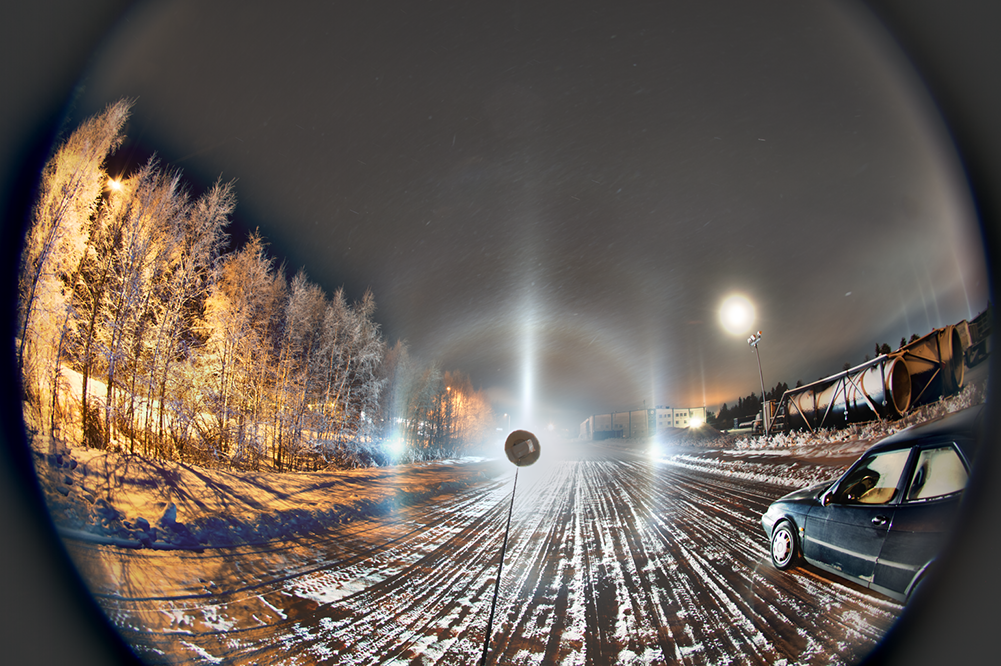
On the night of 20/21 January we photographed oriented pyramid crystal halos in the spotlight beam on two occasions. The first occasion, shown above, got us completely unawares and the odd radii stuff was all gone in the next shot which would have had the exposure right. Colored and solid upper and lower 9° plate arcs were seen, but if they were still present when the camera was placed in the beam, they are nevertheless washed out by the overexposure. In the photo one still sees the 35° halo and lower 20° plate arc. The lower 9° plate arc was of the 23-6 type as the lamp was about 5 degrees below below horizon.

We drove around and switched on the lamp here and there, stubbornly trying to get a rerun, but to no avail. Diamond dust was already on the retreat, the air was drying up even though it was around -33° C. Yet we managed to get something just before it all evaporated, as shown by the image here:


A little simulation study as was necessary to see whether it was column (left) or plate (middle and right) pyramid stuff, but that did not give definitive answer. The plate scenario simulations are identical except that in one is 22° halo and in the other 23°. The 35° and 18/20° stuff above the lamp were initially noticed visually which prompted us take the photo series for this stack.

These last photos were taken at 3:30 am. The two photos below are the first photos of the night at 6 pm. We photographed these lunar and beam displays simultaneously. No odd radii yet at this early hour.

Marko Riikonen / Jarmo Moilanen


Tuesday, 23 February 2016

Pyramid crystals and odd radius halos, part II


More halo and crystal photos from the 20/21 January night. While this second crystal sampling and photographing session was under way, the display in the beam was photographed constantly, but again odd radius halos are not visible in the photos, expect perhaps for a suggestion of 35° halo at one stage (not shown). Yet again the sample was littered with classical pyramids as shown by the images in the gallery.

The picture above is an appearance of odd radius halos after the crystal business was over with. It is a “blue minus red” (br) of stack with total of 9m30s exposure and contains 9°, 18° and 35° halos. Three more halo images are in the gallery, first a single frame from the stack above, then two that are versions of another stack, the br displaying full 46° halo.

Jarmo Moilanen / Marko Riikonen


Monday, 22 February 2016

Pyramid crystals and odd radius halos, part I


The night of January 20/21 in Rovaniemi was a night of odd radius halos. Here are shown mostly crystals collected during a half hour period. At the same time photos were taken continuously in the spotlight beam, below is one of those stacks. The sample contained plenty of traditional type pyramids – something we have not yet seen this winter. So it is curious that odd radius halos are not conspicuous in the beam photos and at times even completely absent. Maybe the abundant cavities in the crystals caused too much disturbance.
The stack is from a stage where the odd radius stuff was at its best, taken towards the end of the crystal collecting period. Visible are 9°, 18° and 35° halos. The temperature during the night was around -33° C.
Jarmo Moilanen / Marko Riikonen


Wednesday, 29 April 2015

Sliced and offset reflection susbun


Laying down on sofa in the warmth of a glassed balcony in a flats building in Kirkkonummi and looking at the sky, it seemed like sun was soon to get behind a thick sausage of cloud. A lazy thought occurred - like a barking of an old dog that has lost faith in barking but does it anyway because that's what the dog is supposed to do - that maybe this time reflection subsun will appear. The lake was there: a week or so earlier I had seen at about the same time (it was closing 8 pm) from this same balcony reflected cloud rays.

Soon the sun was behind the cloud and nothing happened. Then, after an indeterminable time, still assuming a plate orientation on the sofa, two short slivers of light against the cloud caught attention (the first photo above). Cloud rays, I thought. Seconds pass. Cloud rays, yeah. More seconds pass. Um, somethings not right, they are still vertical. Better get the camera.

So I took photos during the about 10 minutes that the phenomenon lasted, from about 1955 to 2005, on 28 April, 2015. All of them are shown above in original and unsharp masked form (get larger size from bottom right). Two anomalies catch eye. First, the phenomenon is cut in thin slices. Second, parts of it are offset from the solar vertical. This is seen in the photos toward the end of the series where the pillars develop also higher up from the initial location (which by the cloud rays was pretty much the location of the sun behind the cloud) and are offset to right from the sun vertical.

I though I was looking at an anomalous reflection subsun, but when sun came out and no normal pillar was seen, I didn't know anyore what to think. Sun went back behind the cloud but the phenomenon never reappeared. Near sunset sun was shining again and as it sink down a beautiful saturated red twilight developed in the clouds above. No pillar could be seen. But then suddenly, when the color was already fading, the pillar appeared as shown by the photo above. Maybe when the sun got enough low under the horizon its rays did not light anymore on the lowermost non-ice parts hanging down from the bottom of the cloud, but instead were shining only on the higher icy parts. The masking curtain of the lower parts thus removed the pillar had the stage now.

But the main issue is what were the reflecting surfaces that made slivers and caused the offset. I don't know.


Sunday, 22 December 2013

Hunting snow gun generated diamond dust halos

Dreaming of the greatest displays and rarest halos? Before the change of the millennium the only advise would have been to get your ass to Antarctic interior or some high Arctic location. Not a particularly feasible solution for the majority of us. But somewhere in the early 2000 photos of impressive displays started to appear and it was soon realized they were from the snowguns. The displays that have been the privilege of high polar areas were now available right on our doorsteps. Why it took so long to find that El Dorado of halos is a bit of a mystery, because the history of snow gunning at the ski resorts dates back much earlier than that. Possibly it had something to do with the advent digital cameras, which brought much more of those occurrences to our knowledge.

The snowgun generated displays may not appear as quite often as the displays in the Antarctic interior, but I would say they are more interesting. Most of the new halos during the last two decades have been discovered from snowgun originated diamond dusts. Snowguns seem to produce special halo making crystals and the darkness of the night also enable us to use the photons of a bright spotlight to make displays. The strong contrast between the crystals lit by the spotlight and the dark background sky has made it possible to discover many halos that would be too faint to see in sun or moon light.

Snowguns make diamond dust by producing nuclei around which the crystals grow from the water vapor in the air. The guns never produce ready halo making crystals, the crystals that come from the guns look like potatoes, no halo making faces there. It is the fine invisible cloud of small ice dust that come as a side product of snow making that acts as a substrate on which crystal growth takes place.

Most of the time the guns are running you don't have diamond dust. The air is normally too dry, below ice saturation and crystals growth is not taking place. On a very dry day you hardly even notice that the guns are on, because there is no ice cloud. That cloud begins to develop when the natural moisture of the air starts to reach ice saturation. But as long as it is below ice saturation, the diamond dust is limited near the guns - the moisture is supplied by the guns only and the crystals will evaporate short distance from the guns. Halos in this kind of diamond dust are not that impressive. Only when the natural moisture of the air exceeds ice saturation the diamond dust takes off from the snow guns and can extend anywhere between few hundred meters to, say, 20 kilometers. And then also the displays can be better.

To have these supersaturated conditions with respect to ice one needs either clear skies or low cloud or fog of liquid water that is on the same level as the guns. In the latter case the ice nuclei from the guns freezes the water droplets and produces diamond dust - one can picture it as a hole punch cloud on the ground. On rare cases diamond dust may develop also under overcast sky.

In addition to the conditions stated above, in Finland one usually needs to have pretty still air for the diamond dust development. Sure, there is usually slight air movement to some direction, but when it is clearly windy, the air is typically too dry for diamond dust. If flags or tree wigs are moving, it is too windy. Tree wigs tell also another story: if they start getting a frost cover, then the atmosphere has enough moisture for diamond dust development.

The first thing to do before you rush to the nearest ski center is to check whether the guns are on. The season may be over already. In Finland many places are done by the beginning of January, Himos in the Southern Finland makes snow probably longest, finishing at the beginning of February. In Lappland the season may be over already in some point of December. The lenght of the season depends also on the winter. This winter in Southern Finland has been very warm and guns will be running certainly for most of the January in many places.

Even if the snow making is season is on, nothing may happen at the ski center. No snow is made when it is above freezing. Some places say they start when temperature drops to -5 C. Some ski centers have automated guns that start when temperature and air relative humidity is right (too humid conditions are not favorable for snow making which contradicts with the conditions needed for diamond dust). And even if the temperature is low enough, the guns may stay quiet if there is only one night of cold between above zero weather period. Some places may have limited waters supply - the water may be supplied by an artificial lake that is drained empty in a couple of days and it takes a couple of days to fill up.

Because diamond dust halo hunter has plenty of equipment, especially when doing the lamp halos, a car is needed. I have done lamp halos successfully with a bicycle in Rovaniemi, but following the diamond dust from one place to another as it changes the location was some task. Biking is good for the health, but success is better with car.

A good ski center for halo hunter is circled by roads not too far away. The diamond dust often extends only less than, say, 1 km from the ski center. Having plenty of roads is of no help, however, if there is a never ending wall of forest all around. Open spaces are of necessity, the more the better. Open areas are especially important when you are doing the lamp halos in the night: you want the background to be dark, not a forest lit up by the lamp.

In general, you don't want light pollution. If it is possible to choose, look for a ski center that is in the middle of nowhere, the only lights being there the ski flank lights. If you befriend with the guys running the guns, they may even shut down those lights when you are taking photos nearby. Any light bulb shining in the lamp display photos it bad.

Perseverance is of utmost importance. Do not leave the place if the diamond dust seem not to take off. Often one needs to wait hours for the the conditions develop. In Finland the midwinter darkness may last, say, from 4 pm to 7 am. You are out there from the beginning and if you give up after 8 hours at 2 am because the conditions just keep staying at the threshold, you may likely have missed a display that eventually developed at 4 or 6 am. Also, do not lose faith if it gets cloudy at some point. Unless the forecast says it is really gonna get cloudy, the cloudiness you are experiencing is most likely temporary and will pass in an hour or two. I have many times fallen to this trick. And even if it gets cloudy, the display may continue under cloudcover. Clouds that arrive can be also so low that they are nucleated to diamond dust.

Usually the conditions disappear before the sun rises. If not, then you have to be ready when sun rises. Try to get some sleep in the twilight hours, or if you think you may not be able to get up, then stay up. If the nightly display was great then probably also the day display is great. Once I was out hunting the whole night, came home at the dawn, looked at the photos and tried to sleep a little and headed out again for the sun halos. The display was an exact copy of the nighttime display and provided an interesting comparison. But then, around midday there was some change in the crystal growth and a new halo, the reflected Parry arc appeared.

You hunt for the fun of it and you want photos. Getting photos is not always straightforward, though. Diamond dust can be anything from quite stagnant to very moving. The former is of course the optimum for halo hunter. At its best, the diamond dust can stay in one location for the whole night. You have all the time to set up the camera and lamp. The area where the display is best developed may be really narrow: move 100 meters any direction and the display starts to weaken.

At its worst the diamond dust is on constant move, the slight breeze is shifting direction all the time. Just when you get your tripod and lamp set, the action is gone. You pack the things, get into your car and try to figure out where it moved. Once you find it, the choreography may be repeated. This hardship is further compounded by all kinds of hassle with the equipment. The ways things can go wrong in the dark and cold are but many. Sometimes you may not get photos at all or just a couple of crappy shots. Interestingly, I found that things were easier when I was hunting with the bike. You have to be better organized with bike. And you are outdoors all the time, being one with the winter. It is just easier to get set up when the time calls.

So, that's it. I may continue this story later on if I remember something that needs to be said. In a meanwhile, you may also read the short post about the same issue from 2010. The next post will be about how to do the lamp halos.

Thursday, 21 November 2013

Subparhelic circle on snow surface


Subparhelic circle is traditionally seen from an airplane in ice clouds below. But it is exceedingly rare. A more productive way of observing subparhelic circle is in diamond dust using bright spotlight as a light source. A patch of subparhelic can be seen also on snow surface. Here I present such a case.

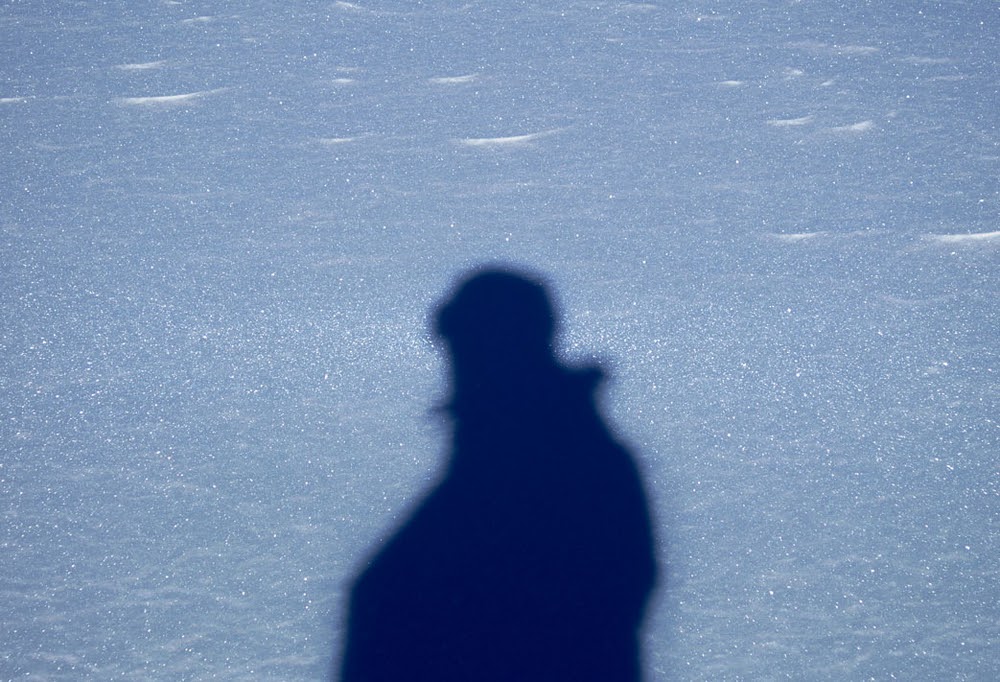
On snow surface subparhelic circle appears as crystal glitter on the sides of observer's head shadow. This is shown in the first two photos, which are different versions of the same peak hold stacked image of 46 frames. A single photo (third image) is not as convincing - snow surface halos have tendency to weaken markedly in single photos which is why stacking is good idea to bring them to the level of visual impression or even exceed it. In the first image the effect is somewhat on par with the visual impression.

The formation of subparhelic circle on snow surface requires two things: ample of sectored plates and strong wind. A dense snowfall of sectored plates in still air is not enough, because crystals falling the snow surface will orient themselves according to the irregularities of the snow surface - that is, in more or less random fashion. However, if the sectored plate fall is associated with strong wind, then the crystals are oriented on the snow surface with their large basal faces in more or less horizontal orientation to minimize the air resistance. This is the crystal orientation required for the formation of subparhelic circle.

Meeting these two requirements seems not easy. I saw subparhelic circle on snow surface first time in Canada's Resolute Bay on 15th March 1999. A couple of weeks later there was another appearance, indicating that the effect may not be that rare in the High Arctic. But I never went back and was from then on trying to see the effect here in Finland. On 15th March 2013 - exactly 14 years after the first observation - there was finally a success. The photos above are from that day when subparhelic circle appeared here in Joensuu.

I first saw a wide sun pillar on the snow surface, as shown by the fourth image. Because in Resolute the subparhelic circle was associated with similar pillar, I knew that in the opposite direction there must be subparhelic circle. The subparhelic circle did not seem completely symmetrical, the right side seemed to curve down more than the left side. The stacked images seem to confirm this slight asymmetry. This is probably due to crystals that had a slight tendency to point their tilted basal face to certain azimuthal direction. One can imagine this happening with a wind blowing from one direction.

In computer halo simulations that use simple hexagons subparhelic circle appears from raypaths that involve reflections inside the crystal. While in airborne crystals subparhelic circle is most likely formed by such raypaths, this probably can not happen in the sectored plates that form the subparhelic circle on snow surface. My suspicion is that in the latter case the subparhelic circle is formed from reflections on the external surface of these crystals. Sectored plates have ridges and depressions that form faces in 90 degree angles on their surface and a reflection from these faces produces subparhelic circle opposite to the sun in crystals having plate orientation. According to calculations by Lauri Kangas, external reflections produce three times fainter effect than what would appear from internal reflections in simple hexagons.

Probably the best places to see subparhelic circle on snow surface are in the High Arctic and Antarctic where strong winds are commonplace and presumably abundant snowfalls of sectored plates are not rare either. In more moderate climates treeless mountain tops could be most productive. In Resolute Bay strong wind had actually collected the sectored plates in large horizontal sheets of crystals. In the Joensuu case shown here, the crystals seemed to be in isolation.

So, next time you are surrounded by sunlit snow, look around. If there is crystal glitter, usually it is uniformly distributed, perhaps showing some circular halos. But if there is pronounced glitter in the form a wide pillar in the sun direction and not much at all glitter elsewhere, turn around and look at your shadow. You will most likely see the glitter of subparhelic circle emanating from the sides of you head shadow.


Monday, 9 April 2012

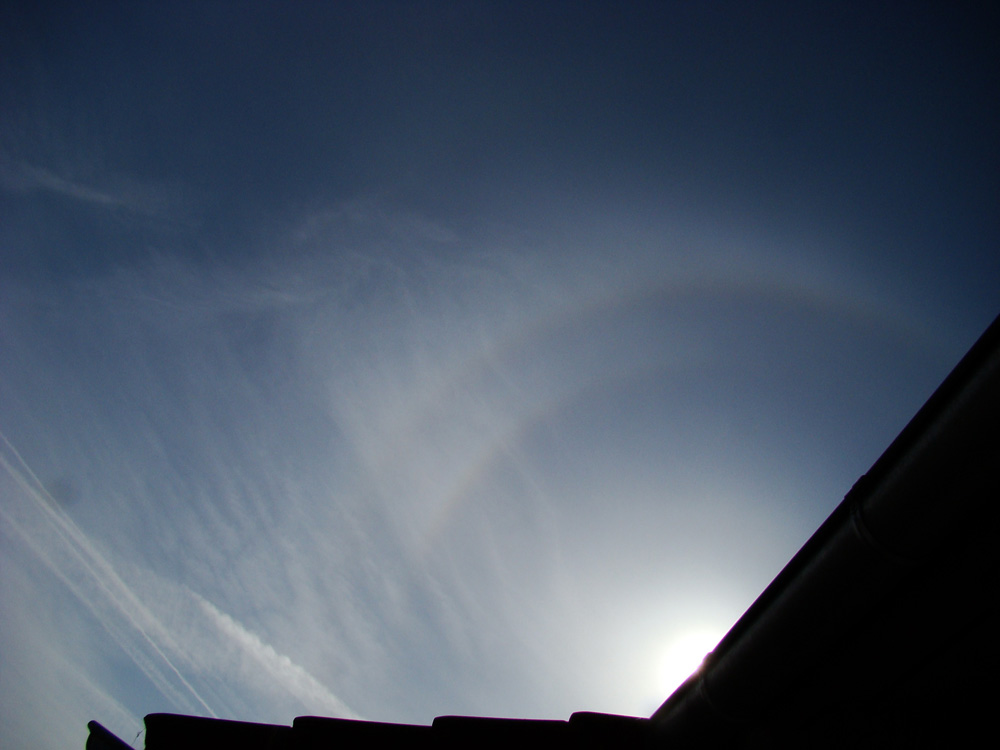
Odd radius halo - 2 April


Veit has sent this odd radius halo from southern Germany. He took the photos on 2 April 2012 at 10:48 CEST. More of his halo images cane be viewed in his Panoramio gallery ( 1 )