Hello everyone,
after several talks with Alec, I decided to make some digging into my old odd radius halos displays to search for rare halos and find out some more 28d halo (and 13d halos too).
Here are some examples of what I found so far that might be interesting to submit here to your assessment. I hope you will find those cases interesting.
For some of them, I still have all the raw files of the sequence, for others, I kept few raw images, but for all of them (exposed here at least) I made various time-lapses to keep sequence in B-R rendering, colour rendering, stacked with 4 or 8 images each, like the one I presented earlier in this blog.
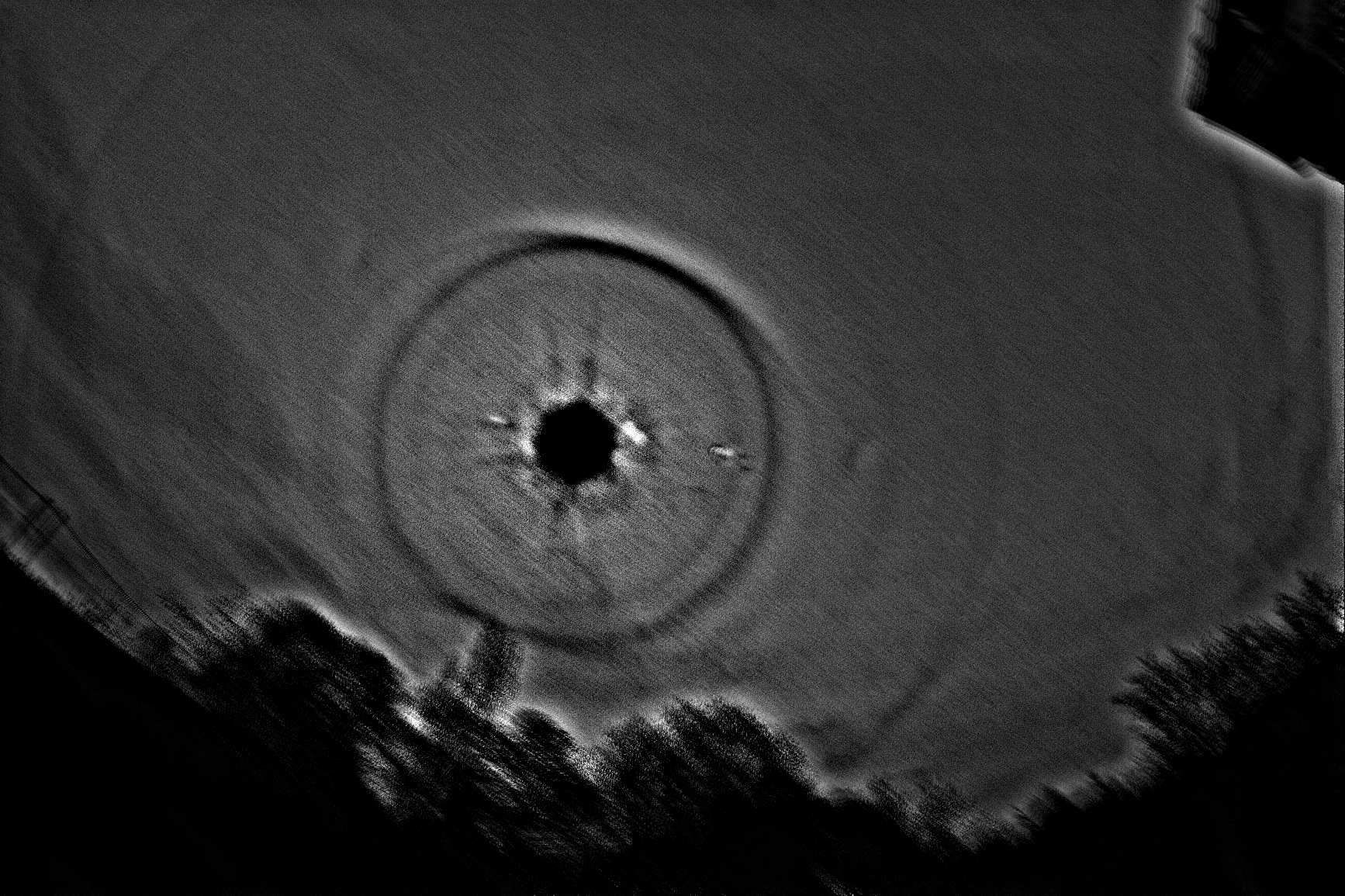
I will start with a sharp display of odd radius circular halos I got last year, in April, at the morning.
I'm not usually an early bird so I can miss some nice displays each year. For this one I got the chance to have the display still available to start a capture from my roof window. The center of my house is a stair tower which offer a nice blocking roof for the spot I am from. Therefore, with the shaprness of the display, the 9° ring was particularly well visible on B-R rendering before the sun comes out of the roof (because the diffusion of the light on the lens add noise up to the 9° ring area).
There is a first image, B-R rendered from a sole raw image, to give a view of the sharpness of the event:
Stacking with the above one as first image, with the 25 following images makes those odd radius halos more clear:
Well, in the light of recent search for 28+° ring, this was one of my first tries even if I was expecting, like for the 13° halo, to find it when the rings are not sharp. But if you don't try, you won't find anything.
So there is a processing the the previous stack to enhance sharp halo first then eventually larger borders ones if any.
There is a folder on my drive, so you can take a look at the time-lapses of the day. As usual, better download it rather than viewing it as a Youtube video, to have a better video compression (as is the original one)
Many years ago, I got a nice odd radius display at sunset, during a day of November 2014. The view is not ideal, as I placed my camera on the edge of a window, look south, with a wide angle rectangular lens, hence the distortion. (EoS 1200D + Sigma 8-16mm, set at 8mm).
I was so amazed by the display I sent it to Nicolas Lefaudeux to have his expertise on the matter. And then he told me I caught the 28° halo, again (but I don't recall why this 'again') ;-)
There is the display, B-R rendered, and unsharp masked.
Unfortunatly, I did not keep any raw file of this event.
There is a folder where are all the remainings.
And any old how, here are some I cannot say it is, but looks like there might be something there.... or not:
And while browsing at all of those, I realized I got at least a dozen of 13° halos, with at least one with the Moon. Which could make a post after this one, for the record.
And a last one, not for the 28d spotting, but only because I like it a lot:
Now, a couple hours after starting this post, I think I may go get some rest ;-).
Greetings from France.
Nicolas R.
Showing posts with label 35° halo. Show all posts
Showing posts with label 35° halo. Show all posts
Thursday, 18 May 2023





Sunday, 30 April 2023
Odd radius display on sunset time, 2022-10-16 (Jouhe, France)
Often, when I see the clouds coming from west, I try to do a high cloud sunset to see if there is something to see (like sun pillar and sunvex halos).
this day, we had mosly contrails making here and there some ice halos from my position, but nothing unusual to catch the eye (furtive sundogs, 22° halos, upper tangent and maybe Lowitz buddies but too short in time to be exploitable) (Time-Lapse of part of the day in here, South-South-East Field of View). To find other halos at sunset, the exercice can be tricky, as the global backgroud turn progressivly to yellow then orange so the b-r rendering is more complicated, with adaptation to make in the last 30-45 mins before the end of sunset.
As I don't have automatized this, I find myself resigned to make one setting for the whole sequence to save time in my processings.
And sometimes, something catch my eye, as it did this last 16th of october, last year.
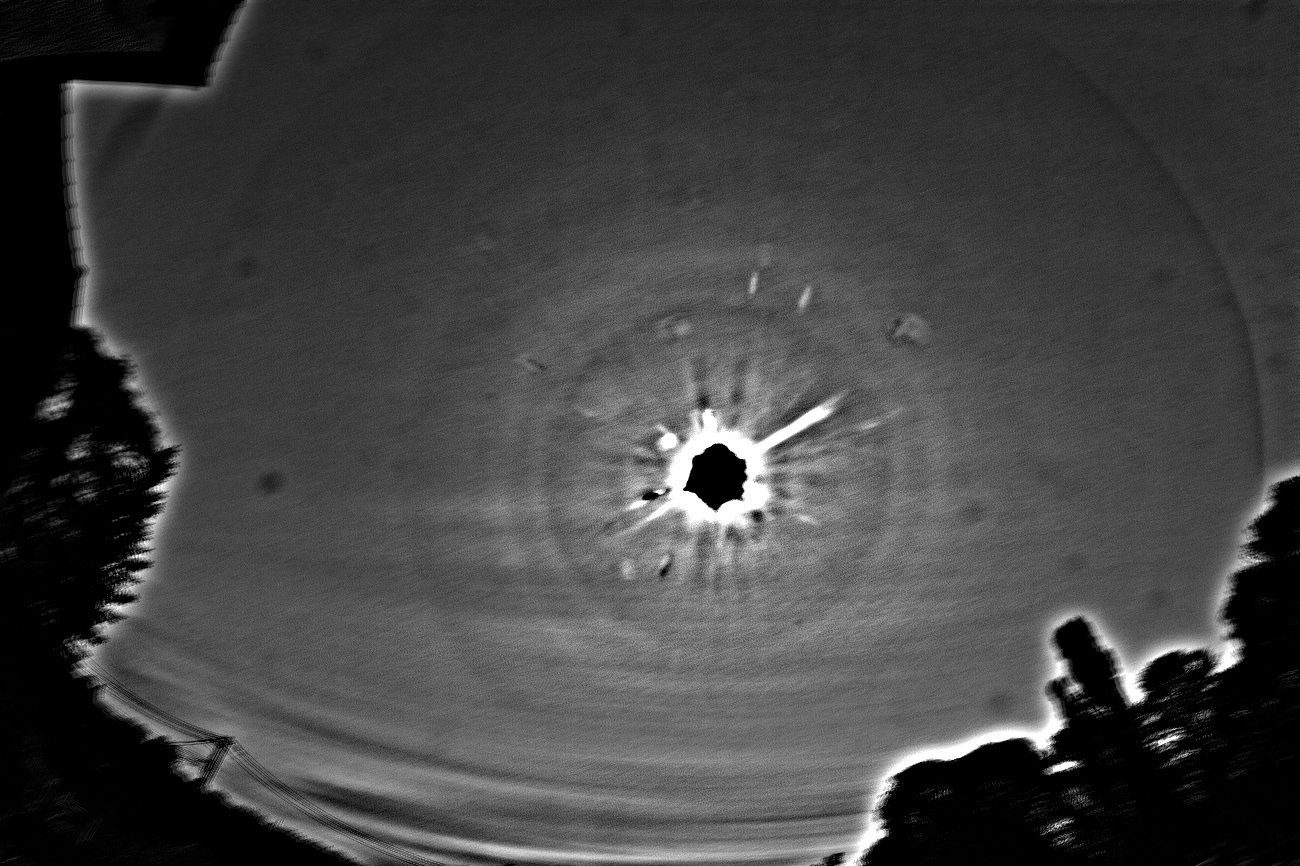
The three next images show 3 differents times of the event, with slightly different processings:
 2022-10-16-[17h14à18h58]-NNW-bw-v1-[4-2]-UsM-(49)-5s5-histo-UsM-h20-h28?-h35
 2022-10-16-[17h14à18h58]-NNW-bw-v2-[4-2]-UsM-(47)-7s7-UsM-histo
 2022-10-16-[17h14à18h58]-NNW-bw-v2-[4-2]-UsM(56)-6s6-UsM-h28?-histo
If needed, I can provide the bw sequence, so you can see (as I do with VirtuaDub) the evolution of the display and distinguish the 28° halo with dynamic (back and forth) play on the sequence.
A sequence you will be able to see there (Version1 & Version2), but with the compression due to GoogleVideo. Again, all raw images are still in my possession, as I guess I might not be done with this display yet.
this day, we had mosly contrails making here and there some ice halos from my position, but nothing unusual to catch the eye (furtive sundogs, 22° halos, upper tangent and maybe Lowitz buddies but too short in time to be exploitable) (Time-Lapse of part of the day in here, South-South-East Field of View). To find other halos at sunset, the exercice can be tricky, as the global backgroud turn progressivly to yellow then orange so the b-r rendering is more complicated, with adaptation to make in the last 30-45 mins before the end of sunset.
As I don't have automatized this, I find myself resigned to make one setting for the whole sequence to save time in my processings.
And sometimes, something catch my eye, as it did this last 16th of october, last year.
The three next images show 3 differents times of the event, with slightly different processings:


If needed, I can provide the bw sequence, so you can see (as I do with VirtuaDub) the evolution of the display and distinguish the 28° halo with dynamic (back and forth) play on the sequence.
A sequence you will be able to see there (Version1 & Version2), but with the compression due to GoogleVideo. Again, all raw images are still in my possession, as I guess I might not be done with this display yet.
Friday, 24 March 2023
Odd Radius Display Including 13° Halo, Vilnius, Lithuania 18th March 2023
The display occurred on 18 of March and I observed it from Vilnius, Lithuania.
For the whole day, cirrostratus clouds covered the entire sky. The clouds were moving eastward and also sublimating.
I started observing at 10:25 EET. At that time there were already odd radius halos present: with the naked eye, you could definitely notice both the 9° and 18° halos.
At 11:45, only the 9° halo was present, and at 12:00 the odd radius halos disappeared. After that, and until around 17:00, there were a faint 22° halo and tangent arc visible.
I photographed the halos in raw format with a DSLR camera. After enhancing the images, a 35° halo became visible, but I was surprised the most to see a ring between 9° and 18° halos, which appeared to be a 13° halo. After sending the images to The Halo Vault, I got a confirmation about this from Nicolas Lefaudeux and the Halo Vault team.
Here are some pictures from the display, last two of them in the sequence were processed by Nicolas Lefaudeux:
 |
| (All images copyright Donatas Gražulis) |


 |
| (Image processed by Nicolas Lefaudeux) |
 |
| (Image processed by Nicolas Lefaudeux) |
A similar feature appears in an older photograph that I took on 25 of June 2019. This is the only photo from that day that this appears in; it was taken with a phone:


- Donatas Gražulis
Thursday, 28 January 2021
A clear 28° halo on snow surface
Sunshine has been a rare phenomenon in Finland this winter. On 16th January, the sky was finally clear and temperature had dropped to -25°C, so I headed to a nearby lakeshore to observe possible surface halos. There were indeed 22° and 46° halos visible on the snow, so I took a set of 335 photos by moving back and forth of a 50 m stretch of a road along the lake. The mirrored stack revealed that this was an odd radius display with 18°, 20°, 23° and 24° halos present. An interesting feature was that 22° and 23° halos were equally strong and well defined in the stack.

Two days later I got another chance to photograph surface halos in the same place. The temperature was -8°C. Only a modest 22° halo with some bright glints outside it were visible to naked eye, so I did not expect much from the stack. Nevertheless, I took 147 photos. This time the mirrored stack looked even better than two days ago: a strong 22° halo accompanied by several odd radius halos, including a clear 28° ring.

A comparison with the previous display (limited by blue frame in the photograph below) provided another surprise: the prominent ”22° halo” was in fact a 23° halo and 22° halo was missing. So this was an odd radius display with 18°, 20°, 23°, 24°, 28°, 35° and 46° halos. Although there are not many observations of 28° halo on surface yet, it seems probable that it is not as rare as has been thought. This gives some hope that a crystal sample can be obtained one day.

The strong 23° halo and the absence of 22° halo in this surface display is interesting. It means that the usual ”22° halo” on snow may in some rare instances be something else than it looks, but it is not easy to detect such cases from the abundance of common 22° halos. For example, the first observation of surface 28° halo on 7 April 2012 by Jari Luomanen and Marko Riikonen looks rather similar as the current one, and it may perhaps contain 23° halo instead of 22° halo (yellow frame below, photo Jari Luomanen). Although all photos in this collage were taken with Samyang 8 mm fisheye lens, the result should be viewed with caution due to the robust alignment.

Monday, 1 June 2020
Odd radius display at low sun in Berkshire, UK

11-frame stack at sun elevation 2°: unsharp mask and colour enhancement (top), and background subtraction + blue-minus-red colour subtraction (bottom; the latter by Nicolas Lefaudeux).
In the evening of 24th May 2020, a notable display of odd-radius halos and their associated plate arcs occurred in Berkshire, UK. I first noticed faint traces of circular halos - 20° and 23° as I could later confirm from photos - at around 19:20 BST, when the sun was at 13° elevation. Less than 30 minutes later the sun had come down to 9° and first signs of the upper 20° plate arc appeared, making obvious the need to find a view down to the horizon. The display got weaker after some time but regained some intensity less than 30 minutes before the sunset. Unfortunately there were some lower-level cloud interfering with my view for most of the observing time.
Stacked and further processed images from the first stages of the display (below) reveal 18°, 20°, 23°, and 35° circular halos in addition to the aforementioned 20° plate arc. At the end of the display (above), the circular halos are less clear, but plate arcs at 20° and 35° show up better. Most interestingly, perhaps, there are suggestions of 28° circular halo and the associated plate arc at the upper left-hand side at solar elevations 7° and 2°. Previously 28° arcs have been reported in the Lascar display of 1997 and in a few more recent occasions in China, but possibly never before in Europe.

50-frame stacks at sun elevation 9° (top) and 7° (bottom): Background subtraction (left) and background subtraction + blue-minus-red colour subtraction (right).
Saturday, 14 April 2018
Odd Radius Display, Bolton, United Kingdom
On the 5th April 2018, there was a short lived but rather nice odd radius display in Bolton, a town situated in the north west of the United Kingdom. As I was preparing to go to work, I noticed the top of what I initially took to be a 22d halo. However, it rapidly developed and became more complex and very soon an 18d became easily visible to the eye. The display lasted about thirty minutes in total and I was only able to take a few single shots and a couple of stacks before it began to fade and I had to leave. Upon processing the images, 9, 18, 23, 24 and 35d halos with attendant plate arcs were identified as being present.

 |
| Processing courtesy Nicolas Lefaudeux. |

Thursday, 5 April 2018
Pyramidal Crystals Attacked Hungary
 |
| Photo by: Károly Tuszinger - Budapest, Hungary (single frame) |
Despite the government’s efforts to stop “invaders” at the border, a lot
of pyramidal ice crystals could penetrate our homeland on the 3rd of April. At
least 3 legions of them rushed across the country arriving from West and
reaching the Eastern borders late in the afternoon. The attack had left a lot
of people with severely high adrenaline levels – and a lot of excellent
photographs!
 |
| Photo by: László Dombai - Vép, Hungary (single frame) |
The first signs of the display appeared at early dawn when a vivid
circumscribed lunar halo formed with some moondogs, faint CZA and easily visible,
still faint supralateral arc. In some pics an extremely faint 9d halo was
noticed later (I could not see it while being outside). Then after sunrise in
the early morning, parts of 18d arcs were visible, probably they were 18d
parhelia, but this only lasted a very few minutes and they were also faint. For
some hours nothing happened, then at noon another pyramidal crystal containing
cirrus arrived and caused a fine display at my place which lasted for about 20
minutes. 9-18d halos were well visible and also the „22d” halo’s arc was too
broad to be a simple 22d halo. I took some pics around, but 35d was not
present. In the meanwhile the clouds drifted towards East, they were on their
way to Budapest and the surrounding area where a lot of people could observe
and capture the best of the show in the afternoon. This region had received the
elite commando of the pyramidal legions, with an extremely vivid display; the
arcs were easily seen even on the worst quality weather webcams’ images! Webcam videos of idokep.hu: Fót and Hajdúszoboszló, Hungary.
A
decent full circle 9d halo with colourful 9d parhelia appeared on most pics,
the full circle 18d halo with vivid 18d parhelia was also present, 23d full
circles with some cases of 23d upper parhelion (or at least the arc’s colour
was much more vivid at the location of the 23d upper parhelion). One wide angle
pic shows signs of a very faint 35d arc too. The show lasted about an hour (at
least the N parts of the capital). Then the clouds drifted on towards the East
and caused a less spectacular but still fine display late afternoon. The
northern half of the country was affected by the display or at least parts of
it during the day.
 |
| 35d halo on the single frame image of Péter Lenkei from Ötschergraben, Austria |
Of course this is the case when stacking would lure out more
detail, but most people just rushed out from their workplaces to capture the
rarity with their cellphone cameras, still the beauty of the show was that even
without stacking many details were visible.
I guess it was very lucky that the
clouds had done their best in the Budapest area where most of the population
concentrates, so many observers could capture the show. I can’t remember any similar
case of pyramidal display in Hungary in the past 20 years, it was so vivid, so
widespread and so complex!
By: Mónika Landy-Gyebnár
Monday, 30 October 2017
Display of 4th June 2017 in Pskov oblast

It was a weak odd-radius display which contained not only familiar pyramidal halos with radii of 9, 20, 24 and 35 degrees, but also a mysterious 13° halo! You can notice this diffuse 13° ring between 9° and 20° halos on the image above. You can also notice that the 20° halo is brighter than the 22°. The 35° halo is clearly visible on the image below.
With the naked eye only parhelia were visible during the display. The display was short and lasted about an hour and a half.

Saturday, 17 June 2017
Reign of the Pyramids
Well seems like most of the rare halos I have been getting are pyramidal this year and I like pyramidal stuff. This morning I got up and later on 18 and 23d halos formed along with a nice upper 23d plate arc and 18d plate arcs. Later on faint 9d halo and when looking at the convex mirror faint 35d halo and it shows up in Photoshop.


Monday, 29 May 2017
Large scale odd radius halo complex on Memorial Holiday 5-29-17
About an hour before midday a layer of cirrus stratus clouds began moving toward the sun and I looked up and saw a colorful 22d halo and I noticed it looked doubled all the way around and looking close to the sun I saw weak 9d halo. I grabbed my camera and then it got spectacular. The 24d halo not only was bright it was sharp and complete and was my best yet to date. While taking picture after picture I saw a segment of a larger halo appear and it turned out the be 35d halo. As the clouds moved thru it peaked with a total of 5 rings the 9,20,22,24, and 35d halos and the 35d halo I got today was my best to date. This could be my best pyramidal display to date but who knows I could get better some day.


Subscribe to:
Posts (Atom)