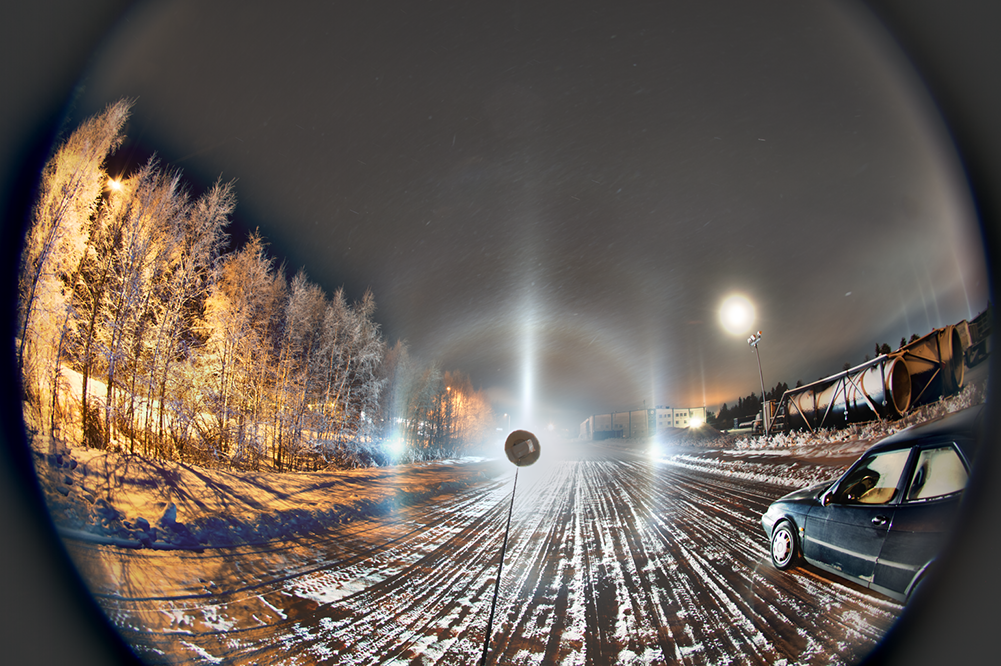
Dreaming of the greatest displays and rarest halos? Before the change of the millennium the only advise would have been to get your ass to Antarctic interior or some high Arctic location. Not a particularly feasible solution for the majority of us. But somewhere in the early 2000 photos of impressive displays started to appear and it was soon realized they were from the snowguns. The displays that have been the privilege of high polar areas were now available right on our doorsteps. Why it took so long to find that El Dorado of halos is a bit of a mystery, because the history of snow gunning at the ski resorts dates back much earlier than that. Possibly it had something to do with the advent digital cameras, which brought much more of those occurrences to our knowledge.
The snowgun generated displays may not appear as quite often as the displays in the Antarctic interior, but I would say they are more interesting. Most of the new halos during the last two decades have been discovered from snowgun originated diamond dusts. Snowguns seem to produce special halo making crystals and the darkness of the night also enable us to use the photons of a bright spotlight to make displays. The strong contrast between the crystals lit by the spotlight and the dark background sky has made it possible to discover many halos that would be too faint to see in sun or moon light.
Snowguns make diamond dust by producing nuclei around which the crystals grow from the water vapor in the air. The guns never produce ready halo making crystals, the crystals that come from the guns look like potatoes, no halo making faces there. It is the fine invisible cloud of small ice dust that come as a side product of snow making that acts as a substrate on which crystal growth takes place.
Most of the time the guns are running you don't have diamond dust. The air is normally too dry, below ice saturation and crystals growth is not taking place. On a very dry day you hardly even notice that the guns are on, because there is no ice cloud. That cloud begins to develop when the natural moisture of the air starts to reach ice saturation. But as long as it is below ice saturation, the diamond dust is limited near the guns - the moisture is supplied by the guns only and the crystals will evaporate short distance from the guns. Halos in this kind of diamond dust are not that impressive. Only when the natural moisture of the air exceeds ice saturation the diamond dust takes off from the snow guns and can extend anywhere between few hundred meters to, say, 20 kilometers. And then also the displays can be better.
To have these supersaturated conditions with respect to ice one needs either clear skies or low cloud or fog of liquid water that is on the same level as the guns. In the latter case the ice nuclei from the guns freezes the water droplets and produces diamond dust - one can picture it as a hole punch cloud on the ground. On rare cases diamond dust may develop also under overcast sky.
In addition to the conditions stated above, in Finland one usually needs to have pretty still air for the diamond dust development. Sure, there is usually slight air movement to some direction, but when it is clearly windy, the air is typically too dry for diamond dust. If flags or tree wigs are moving, it is too windy. Tree wigs tell also another story: if they start getting a frost cover, then the atmosphere has enough moisture for diamond dust development.
The first thing to do before you rush to the nearest ski center is to check whether the guns are on. The season may be over already. In Finland many places are done by the beginning of January, Himos in the Southern Finland makes snow probably longest, finishing at the beginning of February. In Lappland the season may be over already in some point of December. The lenght of the season depends also on the winter. This winter in Southern Finland has been very warm and guns will be running certainly for most of the January in many places.
Even if the snow making is season is on, nothing may happen at the ski center. No snow is made when it is above freezing. Some places say they start when temperature drops to -5 C. Some ski centers have automated guns that start when temperature and air relative humidity is right (too humid conditions are not favorable for snow making which contradicts with the conditions needed for diamond dust). And even if the temperature is low enough, the guns may stay quiet if there is only one night of cold between above zero weather period. Some places may have limited waters supply - the water may be supplied by an artificial lake that is drained empty in a couple of days and it takes a couple of days to fill up.
Because diamond dust halo hunter has plenty of equipment, especially when doing the lamp halos, a car is needed. I have done lamp halos successfully with a bicycle in Rovaniemi, but following the diamond dust from one place to another as it changes the location was some task. Biking is good for the health, but success is better with car.
A good ski center for halo hunter is circled by roads not too far away. The diamond dust often extends only less than, say, 1 km from the ski center. Having plenty of roads is of no help, however, if there is a never ending wall of forest all around. Open spaces are of necessity, the more the better. Open areas are especially important when you are doing the lamp halos in the night: you want the background to be dark, not a forest lit up by the lamp.
In general, you don't want light pollution. If it is possible to choose, look for a ski center that is in the middle of nowhere, the only lights being there the ski flank lights. If you befriend with the guys running the guns, they may even shut down those lights when you are taking photos nearby. Any light bulb shining in the lamp display photos it bad.
Perseverance is of utmost importance. Do not leave the place if the diamond dust seem not to take off. Often one needs to wait hours for the the conditions develop. In Finland the midwinter darkness may last, say, from 4 pm to 7 am. You are out there from the beginning and if you give up after 8 hours at 2 am because the conditions just keep staying at the threshold, you may likely have missed a display that eventually developed at 4 or 6 am. Also, do not lose faith if it gets cloudy at some point. Unless the forecast says it is really gonna get cloudy, the cloudiness you are experiencing is most likely temporary and will pass in an hour or two. I have many times fallen to this trick. And even if it gets cloudy, the display may continue under cloudcover. Clouds that arrive can be also so low that they are nucleated to diamond dust.
Usually the conditions disappear before the sun rises. If not, then you have to be ready when sun rises. Try to get some sleep in the twilight hours, or if you think you may not be able to get up, then stay up. If the nightly display was great then probably also the day display is great. Once I was out hunting the whole night, came home at the dawn, looked at the photos and tried to sleep a little and headed out again for the sun halos. The display was an exact copy of the nighttime display and provided an interesting comparison. But then, around midday there was some change in the crystal growth and a new halo, the reflected Parry arc appeared.
You hunt for the fun of it and you want photos. Getting photos is not always straightforward, though. Diamond dust can be anything from quite stagnant to very moving. The former is of course the optimum for halo hunter. At its best, the diamond dust can stay in one location for the whole night. You have all the time to set up the camera and lamp. The area where the display is best developed may be really narrow: move 100 meters any direction and the display starts to weaken.
At its worst the diamond dust is on constant move, the slight breeze is shifting direction all the time. Just when you get your tripod and lamp set, the action is gone. You pack the things, get into your car and try to figure out where it moved. Once you find it, the choreography may be repeated. This hardship is further compounded by all kinds of hassle with the equipment. The ways things can go wrong in the dark and cold are but many. Sometimes you may not get photos at all or just a couple of crappy shots. Interestingly, I found that things were easier when I was hunting with the bike. You have to be better organized with bike. And you are outdoors all the time, being one with the winter. It is just easier to get set up when the time calls.
So, that's it. I may continue this story later on if I remember something that needs to be said. In a meanwhile, you may also read the
short post about the same issue from 2010. The next post will be about how to do the lamp halos.