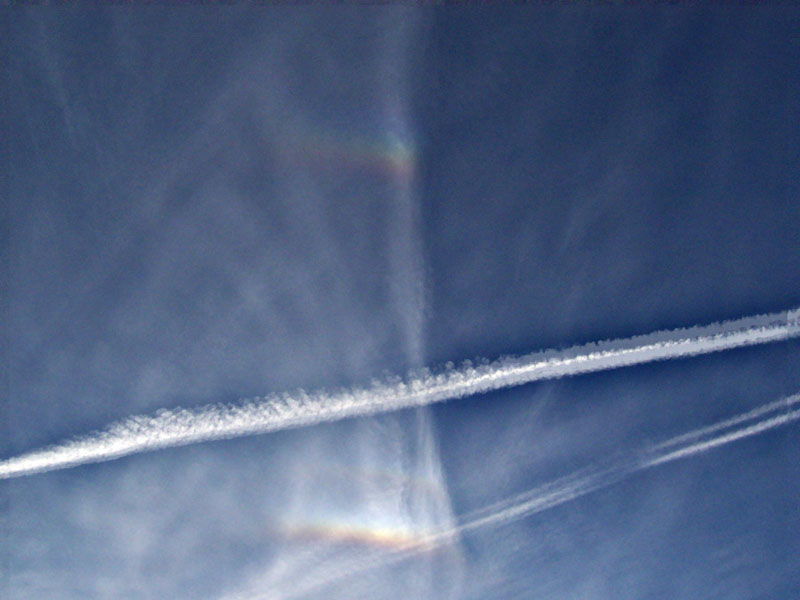
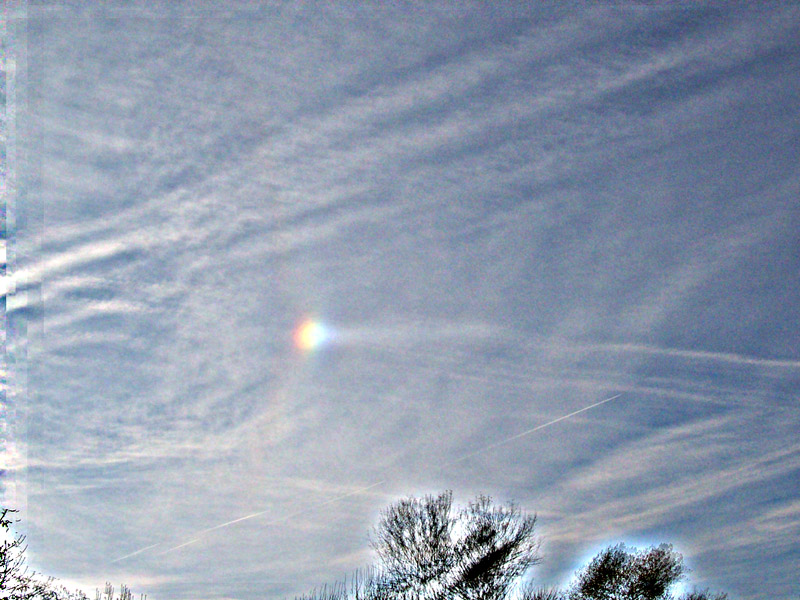
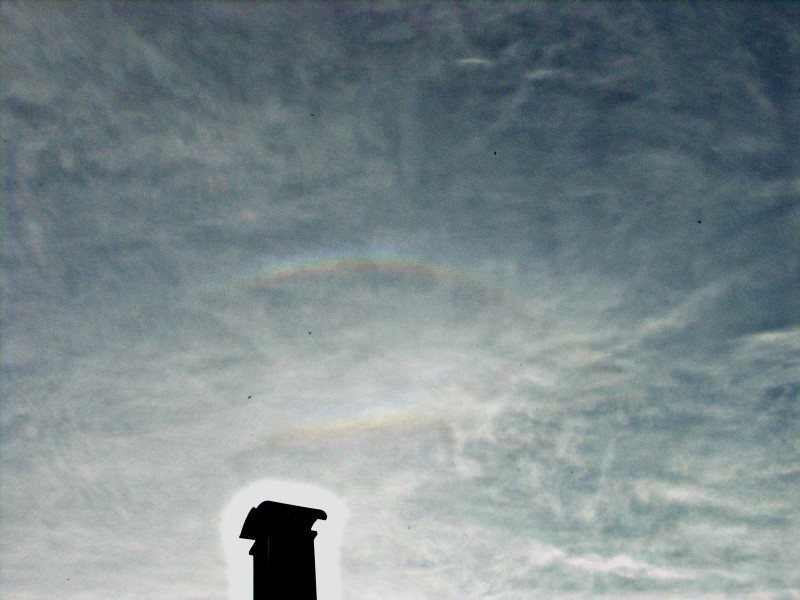
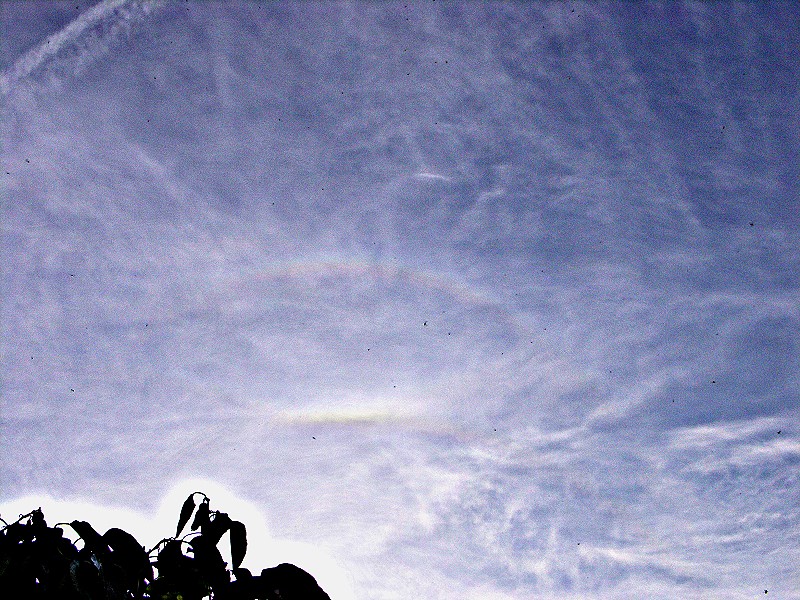
Showing posts with label upper Lowitz arc. Show all posts

Wednesday, 18 October 2017

Display of 3rd August 2017 in Pskov oblast, Russia

Every frame of animation is stack which covers 2,5 min. Colored version is here
At the begining of the display, beautiful cirrus covered the sky, but I did not notice any halos at the time. When I came out a little later, I was surprised to see a bright parhelion and a middle Lowitz arc which crosses it! Cumulus limited the display, so I could observe halos only in gaps between these clouds. There was one short episode when I saw bright upper tangent and suncave Parry arcs. The following rare halos were found in the stacks:

 -well defined upper and middle Lowitz arcs (1) and possible lower Lowitz arc (2)
-part of helic arc (3)
-supralateral Tape arc (4)

Thursday, 1 June 2017

The all-sky display of 30th May 2017 at Pskov Oblast, Russia

08-09
The first part of this display occurred between 6-50 and 8-30 hours. During this period only the 22 halo (which accompanied by other common halos in stacks) were seen in this part of the sky. However, at the end of this period a wonderful cloud crossed the sun. This cloud gave a complex of rare halos from Parry and Lowitz orientations - on the stack I found the sharp and bright upper suncave Parry arc together with the upper Lowitz arc. I saw a part of the middle Lowitz arc, which was below the right parhelion, with the naked eye (1).

Thereafter, cirrus clouds cleared, and in satellite images no high-level clouds were visible, so I went to a bicycle training although the meteogram would predict the arrival of a new portion of cirrus in the coming hours. If I had looked at sat24.com during my training, I could have seen that the air ahead of a low-pressure system after passing the Baltic sea, created fresh cirrus clouds above Estonia!

At 15-40 I found that far cirrus clouds which were visible for the last hour at the horizon, now reached the sun. At this moment I saw a colourful lower tangent arc. It was only 5 km to my house , so I accelerated in order to be in time to photograph it. However, a few minutes later I saw a large scale complex in the sky - above the sun there also appeared an upper tangent arc, both parhelia, and a full parhelic circle! The last few kilometers I rode as fast as I could. Luckily, I not too late!

16-17. All three Lowitz arcs are in one image. The B-R version is available here
Visually, it seemed to me that the bright parhelic circle contained a red fringe, which also surrounded a diffuse 120 parhelion. Blue minus red versions of some stacks clearly show this diffraction effect (2).  The cirrus clouds were beautiful, they contained not only a smooth veil, but also sharp textures like virga. What they are fresh was seen with the naked eye.

16-37
After half an hour, the bright parhelic circle disappeared, when clouds which produced it, drifted to the south-east direction. The upper tangent arc then started to get brighter. At this time I also saw visually both the infralateral arc and the 46 halo above the sun from the 11-00 to 01-00 positions. The complex became less bright after one hour, but at the same time, fragments of a distant parhelic circle was still visible.

17-08
Thereafter, I could see only a split upper tangent arc. With the naked eye I could not understand what it is - a Parry arc or a 23 plate arc. The stack taken during this period showed an excellent odd-radius plate complex!

Tuesday, 7 February 2017

Lowitz - the new normal?


In 2017, halo activity in my part of the United Kingdom has so far been very quiet with not much to get excited about apart from the occasional odd radius lunar halo. However, on the 6th February things improved a little with a nice little display which included 22°, both parhelia (sporting parhelic tails), uta, possible Parry, cza, supralateral and all three Lowitz variants. The upper and lower Lowitz were vestigial, but the middle Lowitz illustrated here was quite clearly defined.

This burst of activity got me ruminating about the frequency of certain types of halos and the nature of “rarity”. Compared to many of you 'old hands', I am a comparative newcomer to halo observation. When I first started to observe, many halos were still considered to be extreme rarities or at least exceptionally infrequent. Others, such as the Kern, were so rare that they were considered to be the Holy Grail of halos, so few were their sightings. What I have noticed over the last few years is that many of these rarities are seemingly becoming far more frequent and in my own mind at least, I have downgraded them from ‘rare’ to ‘infrequent’.

Take the Lowitz arc for example. It is only a few short years ago that its very existence was being doubted, controversial to say the least. First, there were a few sightings, then a trickle of photographic images emerged which confirmed it as a reality. Over the past ten years, their frequency has seemingly increased to the point where I will see several per year and look out for them as a matter of course. Whilst not commonplace, they are certainly hovering somewhere in that vague, nebulous no-man’s land between infrequent and relatively frequent. Likewise, the Kern. At first a mythical creature, but now we are seeing the first drips which will eventually become a trickle….

So what has caused this apparent change in frequency, this downgrading of status? I would like to posit two possible causes: the ubiquity of digital imaging and advances in image processing. It is not that these halos are actually becoming more frequent in reality but that the effect of digital imaging and the development of image processing techniques are revealing them to be present in many more displays than were hitherto thought. In the past, one would take a roll of traditional film, but prior to image processing what did one do with them? Answer, nothing in most cases. You either saw the halo on a particular frame or you didn’t. This resulted in some of these rare halos only showing themselves under exceptional conditions. With the advent of inexpensive digital cameras and image processing software we saw far more phenomena being recorded. However, it is only with the introduction of the B-R processing technique pioneered by Nicolas Rossetto and perfected by Nicolas Lefaudeux and to a lesser extent image stacking, do we really notice an apparent increase in all types of rare halos. These techniques alone have been responsible for the massive increase of rare halo frequency and the identification of several new halo species. We have now reached a point where what was new and exciting yesterday, is passé today.

I think this trend is going to continue as more and more observers embrace these new methods of working. We have already seen it occur in the wider field of atmospheric optics where photographic identification of higher order rainbows, especially the third and fourth orders, are now becoming a reality. One might argue where is the hard evidence to prove this is anything but a theory or personal opinion? This evidence is indeed hard to come by, however projects such as Lefaudeux's 'HaloCam' has demonstrated without a shadow of a doubt that certain halos are far more frequent than previously thought. For example, he has very clearly demonstrated that the 46° halo is present almost as often as the 22°, whereas at one time it was considered to be a very infrequent visitor to the skies. So not only will this trend continue, I think it will also accelerate, especially in the field of spotlight displays where new halos are being discovered on a very regular basis. Even in daylight displays, new halos are still being captured from time to time using these techniques.

A few years ago, it seemed like everything that could be seen had been seen. We are now on the cusp of a new era of halo research. Today may indeed be considered passé by some, but tomorrow is definitely going to be tremendously exciting! I want to be a part of that new wave of discovery.

Alec Jones

Wednesday, 25 January 2017

The Salzburg halo

On the 19th October 2013 Zbyněk Černoch was in Salzburg keeping an eye for halo events, since high cirrostratus clouds were rolling in. As they drifted towards the Sun, he first noticed bright parhelia. A few moments later, rather bright and colourful upper tangent arc with Parry arc and upper Lowitz appeared.


What stunned him later was a vivid arc similar to a parhelion, but located in the 18° region.


The arc lasted only a few minutes as the clouds were drifting away quickly. He haven't seen anything like this before.

After a few discussions the observation fell into oblivion. Until few days later when we thought we would like to figure it out once and for all.
It would seem that the arc itself is a fragment of 22° halo, but the halo itself was quite sharp and narrow in this observation.

After Zbyněk put together 3 photos to show that the 22° halo lies between the mystery arc and 22° parhelion, I decided to run some simulations.

I used pyramidal crystals with std of 15° in the c-axis and joined the simulation picture with the collage from Zbyněk.


My theory is that the mystery arc is actually an 18° plate arc. But there are some inconsistencies in the theory.

  1. The color vividness indicates that oriented crystals formed the arc. However 18° plate arc formed by oriented crystals has a typical convex shape which is absent here. 
  2. By increasing the std in the c-axis, halos from poorly oriented crystals are becoming more apparent, which is not the case here. 
  3. No other odd radius halos were observed. 
If it really is a case of an 18° plate arc, it is a really decent one.

Monday, 26 March 2007

A spring-starter in Finland

On 25th March a relatively small high-cloud area swept over Southern Finland and produced a fine halo for observers in Helsinki, Espoo, Turku and Riihimaki. In Riihimaki the upper Lowitz arc was continuously in the sky for over three hours. In addition to Lowitz, there were also pyramidal crystal halos (9 halo/column arc?, 24 lower plate arcs, 18 plate arcs), helic arc and Wegener anthelic arc.
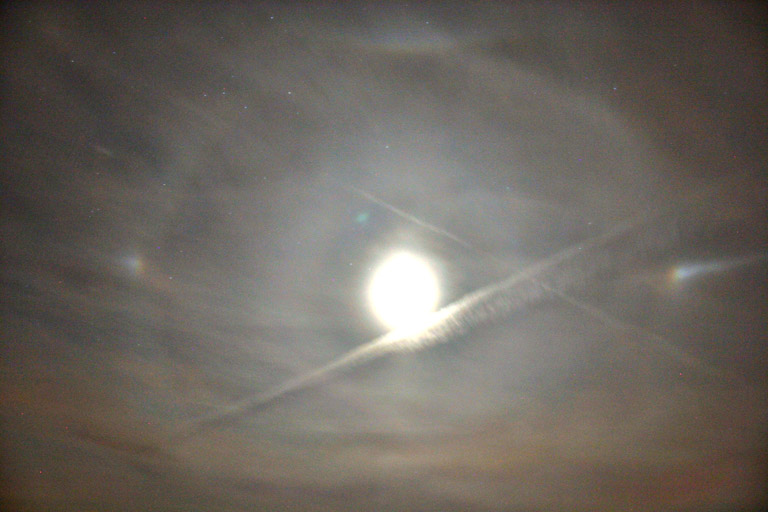
The photograph above is taken by Jukka Ruoskanen, and more photographs can be found here. In Helsinki the display was photographed by Marko Riikonen, in Espoo by Panu Lahtinen and Timo Kuhmonen and in Turku by Ismo Luukkonen

By Jukka Ruoskanen

Monday, 5 March 2007

Upper Lowitz arc in Germany


On February 21, Wolfgang Hamburg was on holiday in the Erzgebirge, but rather had snow there. Around noon, the cirrus clouds which already had caused an unusual halo activity in Bavaria (see one thread below), arrived at his position in Mulda. So between 1 and 1.30 pm, Wolfgang Hamburg also observed unusually bright sundogs followed by a beautiful display showing Parry arc and upper Lowitz arc. The enhancement of the unsharp mask shows the arc in the "Chinese eye" formed by the halos.

By Claudia Hinz

Monday, 6 November 2006

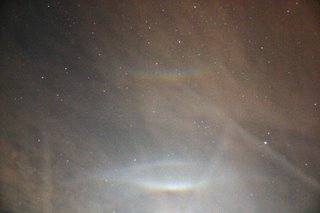
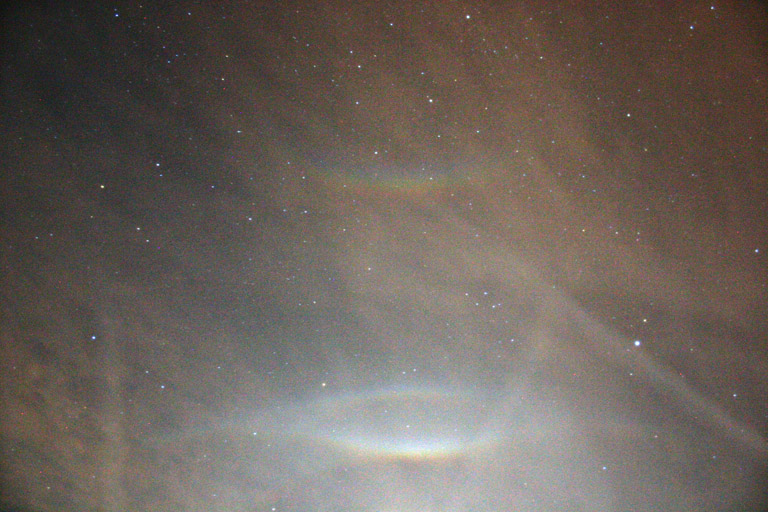
Lunar display in France with 9° halo and Lowitz arcs


On the evening of 30 October 2006, I saw this lunar display in the west of France, close to Nantes. The photos were taken between 18h and 21h UT, the moon elevation was between 19 and 24 degrees.

A lot of halos were visible, including 9° halo, upper and lower Lowitz arc and a bright upper suncave Parry arc.

The orange colour of the sky is due to a strong light pollution. The images have been processed to reduce this effect and unsharp mask has been applied to enhance the halos. I got also nice displays the 2 previous days.

More images of the display here: 1, 2, 3.
 
by Cyrille Badouin


Wednesday, 1 November 2006

Rare halos in Czech rep. Oct. 30 and 31


On October 30 in Prague was observed rare halos. Stepanka Kosova had
Lowitz arcs and 120 deg. parhelia (title photo). Lukas Shrbeny had nice 120 deg. parhelia too. I observed rare halos in two last days. On October 30 I saw: 9°, 20° halos and Parry suncave arc. On October 31 I seen: Parry suncave arc , upper and lower Lowitz arcs and probably circular Lowitz arc too. M.Popek and R.Manak seen 9° halos in Lunar displays.
 
by Patrik Trncak
 

Sunday, 15 October 2006

Lunar display with Lowitz arcs


Martin Jankovic and Lukas Kosarek from Brno (Czech Rep.) observed nice lunar display with bright parhelia at October 9. On photos was found clear upper and lower components of Lowitz arcs. More photos of this display are here.

Thursday, 12 October 2006

Circular Lowitz arc in Germany


At the end of September weather fronts from an ex-hurricane reached Germany. In the leading cirrus, Lowitz arcs were observed over two days. Hartmut Bretschneider in Schneeberg (Saxony) made the first sighting on 28th September. He first saw a parhelion with a Lowitz arc emanating from the parhelion when the sun was at an elevation of 14 deg. Later when the sun was higher there was a very bright Parry arc and an upper Lowitz arc (right photo). On evening of the following day Werner Krell saw a solitary upper Lowitz arc at Wersau (Hessen). His photo was taken at a sun elevation of 11 deg. [2, 3]
 
by Claudia Hinz

Tuesday, 10 October 2006

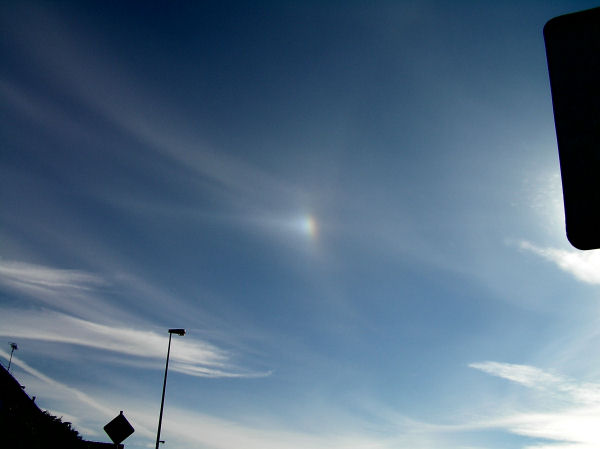
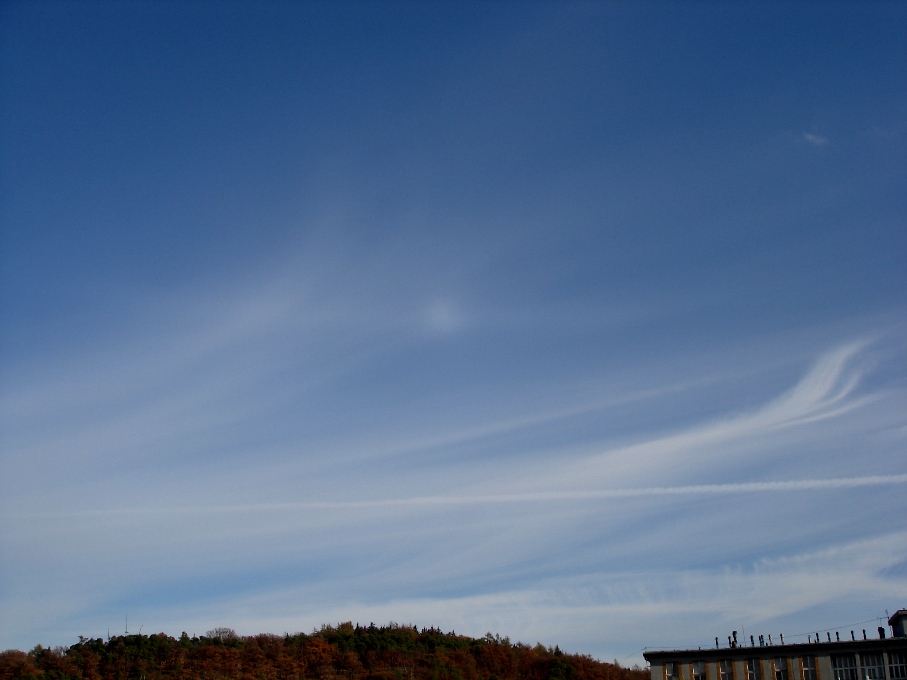
Lowitz arc in Prague

Upper part of Upper Lowitz arc was observed yesterday (9.10.) in Prague, Czech by Milan Cerny. Milan seen nice parhelia, upper tangent arc and Parry suncave arc. Red arrow show Lowitz arc. Here is second photo