Showing posts with label Parry arc. Show all posts

Saturday, 16 September 2017

Finnish Display 2nd September 2017

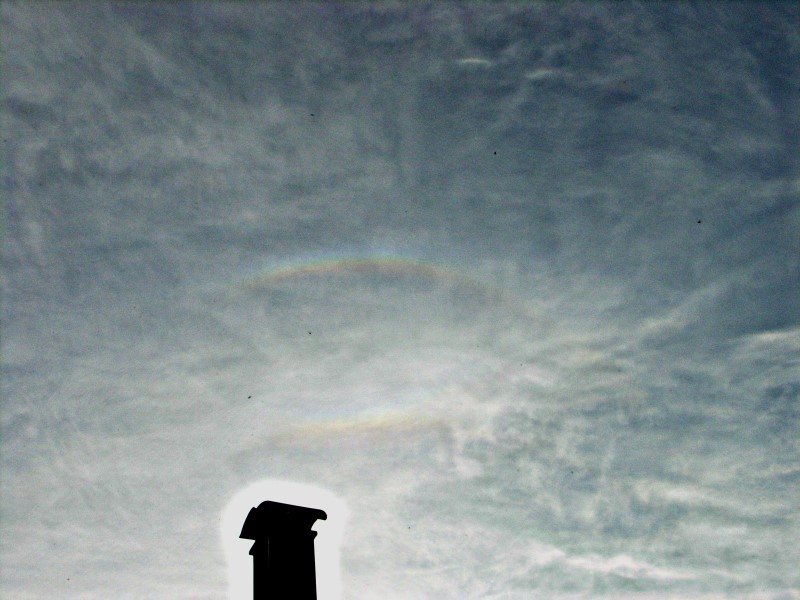
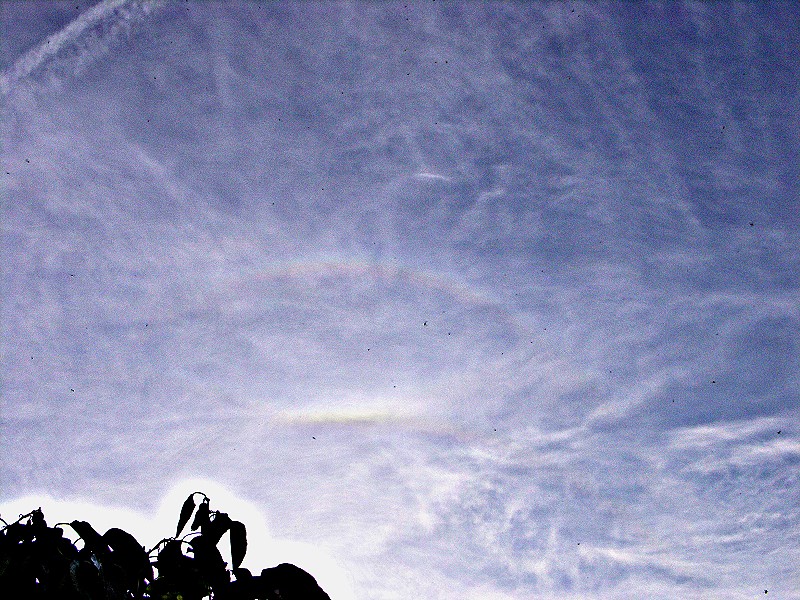
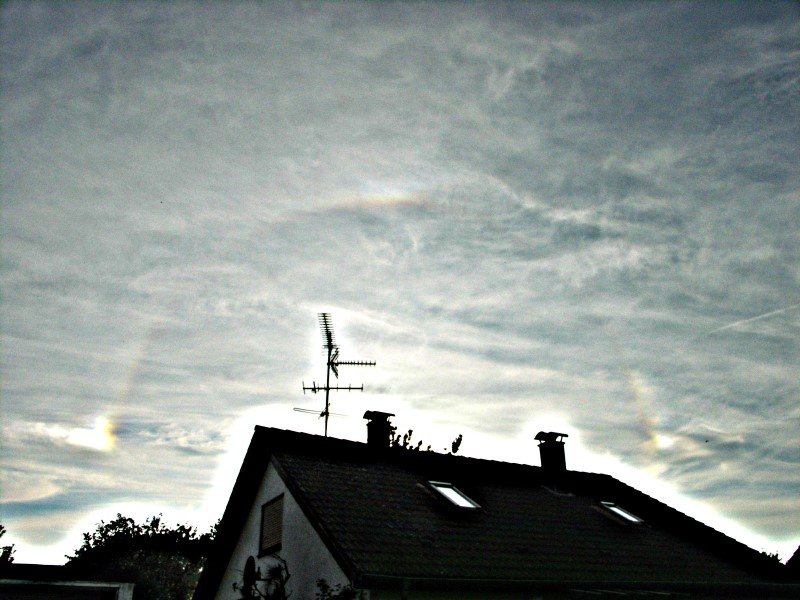
Kimmo Laitinen captured a nice display with Wegener arcs and a really strong lower tangent arc on the 2nd September 2017. I'll let Kimmo describe his observation in greater detail in his own words. 

He says, "we drove from Siilinjarvi to our summer house in Leppavirta via Kuopio. In Siilinjarvi the weather was sunny but before Kuopio a thin uniform layer of high clouds covered the sun and we spotted the first halos as we passed the city centre of Kuopio about 11.45.... At this point the 22 deg lower tangent arc was not so impressive and only a short section of the parhelic circle could be seen. Then we went on southward to the Puutossalmi cable ferry.... In Puutossalmi the 22 deg lower tangent arc was the most impressive and reflected nicely from the lake. After the ferry the 22 deg lower tangent arc disappeared but the parhelic circle became all the time longer and a very faint Wegener arc was seen by the naked eye. After driving a few km more southward the low clouds disappeared from the northern sky and the parhelic circle became complete about 12.30 in the village of Lansi-Saamainen in Leppävirta. The 120 deg parhelia were clearly visible and the intersection of the Wegener arcs with the parhelic circle was revealed from the images. After this the display got dimmer but still lasted for a few hours.


All images used by permission. © Kimmo Laitinen. 


Sunday, 2 April 2017

Subvisual odd radius halos in the UK

In the afternoon of 26 March, 2017, I was spending time outdoors with my family and wasn't too well equipped for serious observing. Of course, I had paid some attention to cirrostratus clouds drifting in the sky, but most of the time I struggled to see any significant halos. There were just occasional patches of 22° halo: or at least that's what I thought they were. But then the upper suncave Parry arc appeared so I had no choice but to start photographing immediately. After all, you don't get Parry every week, and in fact this was my first such encounter in 2017. During the next 20 minutes or so, I took a decent set of photos, but then gave up as it appeared that the display had become insignificant again.

My hope was to find a few more halos in the post-processing, and stacking did a good job indeed. The stack shown above is from the first 50 frames and covers a total of 196 seconds. On the left the unsharp mask is applied on individual frames before stacking. The version in the middle is a gradient-subtracted average stack, which is further processed by using the blue-minus-red subtraction technique on the right. In addition to the usual stuff and the Parry arc, we can identify upper and middle Lowitz arcs as well as a short piece of helic arc to the left from the circumzenith arc. But that's not all - there are also odd radius circular halos.

For comparison, the stack below is from the last set of 30 frames that I took more than 30 minutes after the last signs of the Parry arc had disappeared. This stack covers a total of 174 seconds. I didn't really expect to find anything special at this point, but took the photos anyway out of curiosity. Apparently the odd radius stuff is still in play. My feeling is that it had been there all the time, possibly long before I noticed the Parry for the first time and also long after I had got indoors to celebrate the Mother's day dinner.

What is shown below is an attempt to make the scene as clear as possible by combining photos from two different series into one stack. 100 frames are included, covering 13 minutes in time but missing about six minutes in the middle. My interpretation is that the relatively typical pattern of 9°, 18°, 24°, and 35° halos is complemented by the exotic 13° halo. But I'm not sure and it would be great to hear what readers might think of the case. Whether the 20° halo is missing altogether or masked behind the suspiciously wide 18° halo, I am not sure of that either.

Saturday, 18 February 2017

Another appearance of the mysterious Sub-Kern companion


The image above shows an arc that points towards the bulge in sub-Kern. Its formation is unknown. We captured the arc first time on two occasions on the night of 6/7 January 2016 in Rovaniemi. The current case was photographed in Rovaniemi too, on the night of 28/29 November 2016.

Judging from the crossing of helic arc and (what appears to be) Hastings over the 46° halo, the lamp must be around 3.5 degrees below horizon. I made some quick simulations. The upper one has plates, randoms, and Parry. Plate shaped Parry crystals were used to get the relative intensity of the helic arc and Hastings somewhat comparable to the actual arcs. Simulation has also subanthelic arc, and it seems to be present in the photo, although it is quite broad and diffuse. The lack of Parry arc in the actual display is rather curious.

To make sure that the mystery arc is not some kind of anomalous singularly occurring Tricker, the lower simulation was made with added column oriented crystals. Sure enough, location of the Tricker does not match.


The bulge in sub-Kern seems itself also anomalous and appears to be associated with the mystery arc. The bulge has not been photographed in the numerous displays without this arc.

Wednesday, 25 January 2017

The Salzburg halo

On the 19th October 2013 Zbyněk Černoch was in Salzburg keeping an eye for halo events, since high cirrostratus clouds were rolling in. As they drifted towards the Sun, he first noticed bright parhelia. A few moments later, rather bright and colourful upper tangent arc with Parry arc and upper Lowitz appeared.


What stunned him later was a vivid arc similar to a parhelion, but located in the 18° region.


The arc lasted only a few minutes as the clouds were drifting away quickly. He haven't seen anything like this before.

After a few discussions the observation fell into oblivion. Until few days later when we thought we would like to figure it out once and for all.
It would seem that the arc itself is a fragment of 22° halo, but the halo itself was quite sharp and narrow in this observation.

After Zbyněk put together 3 photos to show that the 22° halo lies between the mystery arc and 22° parhelion, I decided to run some simulations.

I used pyramidal crystals with std of 15° in the c-axis and joined the simulation picture with the collage from Zbyněk.


My theory is that the mystery arc is actually an 18° plate arc. But there are some inconsistencies in the theory.

  1. The color vividness indicates that oriented crystals formed the arc. However 18° plate arc formed by oriented crystals has a typical convex shape which is absent here. 
  2. By increasing the std in the c-axis, halos from poorly oriented crystals are becoming more apparent, which is not the case here. 
  3. No other odd radius halos were observed. 
If it really is a case of an 18° plate arc, it is a really decent one.

Monday, 5 March 2007

Upper Lowitz arc in Germany


On February 21, Wolfgang Hamburg was on holiday in the Erzgebirge, but rather had snow there. Around noon, the cirrus clouds which already had caused an unusual halo activity in Bavaria (see one thread below), arrived at his position in Mulda. So between 1 and 1.30 pm, Wolfgang Hamburg also observed unusually bright sundogs followed by a beautiful display showing Parry arc and upper Lowitz arc. The enhancement of the unsharp mask shows the arc in the "Chinese eye" formed by the halos.

By Claudia Hinz

Saturday, 14 October 2006

Tricker arc in Prague

Very rare Tricker anthelic arc was observed in Prague by Stepanka Kosova. Stepanka seen bright anthelion with "small X". This image is stacking of three photos. It is part of nice halo display with Parry arc and 120 parhelia at October 12 2006.

Thursday, 12 October 2006

Circular Lowitz arc in Germany


At the end of September weather fronts from an ex-hurricane reached Germany. In the leading cirrus, Lowitz arcs were observed over two days. Hartmut Bretschneider in Schneeberg (Saxony) made the first sighting on 28th September. He first saw a parhelion with a Lowitz arc emanating from the parhelion when the sun was at an elevation of 14 deg. Later when the sun was higher there was a very bright Parry arc and an upper Lowitz arc (right photo). On evening of the following day Werner Krell saw a solitary upper Lowitz arc at Wersau (Hessen). His photo was taken at a sun elevation of 11 deg. [2, 3]
 
by Claudia Hinz

More rare halos in Czechoslovakia

Today was day of halos for all observers. I was seen: Parry arc, Infralateral arc. Martin Jankovic: Parry arc, 120 parhelia. Milan Cerny: Parry arc. Stepanka Kosova: Parry arc, 120 parhelia. Roman Manak: Parry arc and Martin Popek: 120 parhelia. For discussion: Lukas Shrbeny from Ondrejov had maybe Lowitz arc. You see his link.

Monday, 2 October 2006

Low sun Parry in Helsinki

October is probably the worst halo month in Finland. The last chances for good high cloud displays are gone with September and diamond dust is not swarming in until November. So it was nice to see today a low sun Parry starting to develop in the sky upon returning from grocery store. Grabbed pocket camera and tripod from my room and rushed to nearby parking lot.

The two images are stacked from series of 15 and 16 shots. The time span is two minutes in both stacks.

Earlier I had seen low sun Parry's only on two occasions. These were in high arctic Canada during diamond dust conditions. It took 22 years of observing to get one in high clouds.

Sunday, 16 April 2006

Full moon display in Finland

As month earlier, good moon halos visited the skies also this time. The display in the night of 12-13. April was seen over large areas in Finland. Halo developement was best in Hyvinkää, where Jukka Ruoskanen documented the display.

The photo here, taken by Ruoskanen, shows many features of interest. First there is Parry arc above the 22° tangent arc. Second, there are Lowitz arcs. They are best revealed by the gap (shown with an arrow) in the 22° halo at parhelia level. Also, curving of 22° halo towards parhelia is evident. 

Third feature of interest is the 9° halo and the dark area inside it. Sometimes 9° halo is not seen in individual photos, but the conspicious darkening inside the halo location tells about it's existence. Stacking several photos then brings out the halo. The image here was stacked from 18 photos, but 9° halo was visible also in individual photos. 

Finallly, there seems to be also suggestion of 9° upper plate arc, seen as an enhancement on top of 9° halo.

Sunday, 19 March 2006

Upper Lowitz Arc in the German Alps


At October the 15th 2005 in southern Germany was one of the greatest Halophenomena, which has ever been observed in Germany. It was photographically documented by six observers on a latitude of 100 km. There was seen a bright 22° halo, glittering bright sundogs with absolute clear colours and a high part of blue, a complete and bright upper tangent arc, a reddish lower tangent arc, a highly coloured and complete Circumzenithal arc, a light-coloured and nearly complete Parhelic Circle, the complete Lowitz arcs, the Anthelion, the 120 deg parhelia with oblique arcs, a single Superlateral arc, both Infralateral arcs as well as a beauty of Parry arc. Altogether there were seen 15 miscellaneous Halo types with 20 appearances.

By Claudia Hinz

Thursday, 16 March 2006

Latest halo displays from Finland


During the last days series of reasonable displays developed over Southern Finland. Three of them were in moonlight and one in sunlight. Elliptical halo, 9° and 18° halos and Parry arc were observed. See photos and drawings here.

The picture on the left shows the halo development in Tampere on the night of 14/15 March. Among common halos, faint 9° halo and Parry arc are also present.

By Marko Riikonen