Showing posts with label supralateral arc. Show all posts

Wednesday, 18 October 2017

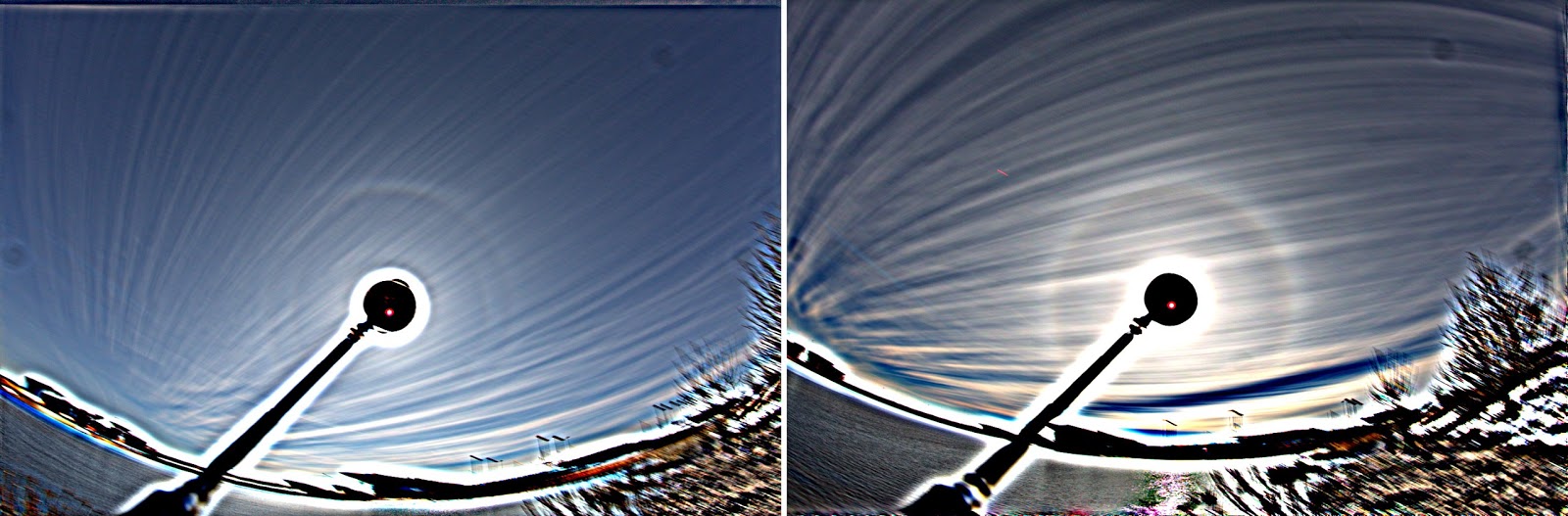
Display of 3rd August 2017 in Pskov oblast, Russia

Every frame of animation is stack which covers 2,5 min. Colored version is here
At the begining of the display, beautiful cirrus covered the sky, but I did not notice any halos at the time. When I came out a little later, I was surprised to see a bright parhelion and a middle Lowitz arc which crosses it! Cumulus limited the display, so I could observe halos only in gaps between these clouds. There was one short episode when I saw bright upper tangent and suncave Parry arcs. The following rare halos were found in the stacks:

 -well defined upper and middle Lowitz arcs (1) and possible lower Lowitz arc (2)
-part of helic arc (3)
-supralateral Tape arc (4)

Wednesday, 17 May 2017

Recent displays from Northwestern Russia

In this post I want to share some of my observations from last month, which I made in St Petersburg (from 15th April to 5th May) and in Pskov Oblast (from 7th May to present time). In total there were eleven displays, six of them comprising pyramidal halo forms. Many of these pyramidal displays were minor, so I will not present them.

20th April

The photo on left shows a purely odd-radius plate complex. There are only the upper 23 plate arc with its 23 halo and a couple of 18 plate arcs. On the photo on right you can see fragments of weak odd radius circular halos. Together with the broad 22 halo at the 02-00 position there is the 20 halo and also the diffuse 35 halo.

28th April

Together with classic halo forms in stacks pyramidal halos appeared with odd-radius plate arcs. On photos above you can see lower 24 plate arcs with the 24 halo and the 9 halo (with possible the lower 9 plate arc). The weak and diffuse upper 23 plate arc is also available.

30th April


In the morning there was a short display which lasted less than one hour. The display was not predicted by the meteogram, so maybe I missed most of the display, which was earlier that morning. In any case I saw bright parhelia with the colourful circumzenithal arc, and got in the stack the strong parhelic circle and the upper suncave Parry arc together with the nice upper tangent arc. I think it is the Parry arc, and not an upper 23 plate arc, because the display does not contain no other pyramidal halo forms, and the arc looks pretty sharp.

1st May

In the morning I observed the large and bright upper tangent arc for around one hour. Infralateral arcs were easily seen with naked eye. Together with bright parhelia I saw fragments of a parhelic circle. In stacks the rare Wegener arc was found.

5th May

On that day there was a protracted display, that lasted between six and sixteen hours. But my camera had recorded interesting halos only at the start, on the sunrise. It was an odd-radius circular complex which contained pyramid halos with radii 9, 18, 24 and 35 degrees. It seems the 24 halo included rudimentary upper and lower 24 plate arcs.

10th May

No rare halos on that morning but I saw the supralateral arc visually very well, that happens not often. A curious circumzenithal arc appeared a little later. The CZA was diffuse, that is not typical for this halo. 

Friday, 14 April 2017

Recent displays from St Petersburg, Russia

In this post, I'm including the most interesting displays observed during the last month.

14th March 2017


On that day, halos appeared in the morning in separate cirrus clouds. Their arrival was not predicted by the meteogram. When I looked out from the window, I saw a bright CZA, but when I came down, it had disappeared. Nevertheless, I could see the weak supralateral arc. Half an hour later, I also saw a nice infralateral arc, when the cirrus cloud reached the horizon.

29th March 2017


In the evening bright parhelion was detected, and then a little while later also the wide circumzenithal arc. The halos were produced by the anvil of a convection cell.

1st April 2017


In the morning, at 10-00, the sky was clear. But in the south-west direction, low over the horizon a lot of cirrus clouds were visible. Their arrival was extended for an hour and a half. When a border of a front of cirrus clouds started to arrive, I noticed that it was weak and almost transparent. When these weak clouds reached the sun, at first I did not notice any halos. But soon, some markers of sub-visual odd radius display appeared.

It was broad and undefined halo in 22° area, with pretty obvious upper 23° plate arc in some moments. In the reflection of my sunglasses these things were visible a lot better. These weak odd radius halos were visible for around a half of hour, or even more while the area of weak cirrus crossed the sun.

Then, on the right-hand side pretty bright 22° halo started to appear. It was the arrival of main part of cirrus. In that area clouds were common and solid. After few minutes both bright tangent arcs appeared. Lower tangent arc was brighter than upper. I also noticed big infralateral arc on the right-hand side. It was pretty weak, but well coloured. I could see the arc better when I used peripheral vision.

This peak of the display was rather lengthy, and during its course I also watched both 120° parhelia, parhelic circle (it was easily seen within 22° ring), and the top part of 46° halo (likely it was the combination of supralateral arc and 46 halo. Although both were weak, together they became visually visible).
The peak was interrupted when middle-level cloud started to arrive. Then I saw a couple times only bright 22° halo

7th April 2017


The display looked quite ordinary, so I was glad I detected pyramidal halos such as upper 23° plate arc and 9° column arc.

9th April 2017


On that day, there was only a weak 22° halo. But the stack discovered also 18° halo/18° plate arc

10th April 2017


It was the weak display, which lasted most of the day. There was no suspicion that there may be pyramidal halos. But still I got upper 23° plate, 18° plate arc and 9° halo in the stacks.

Sunday, 26 March 2017

Halo Phenomena in Olaus Magnus’s Historia de Gentibus Septentrionalibus (Part 2)


Halo phenomena in Historia de Gentibus Septentrionalibus, Bk. 1, Ch, 14. Image from www.avrosys.nu

The Swedish Olaus Magnus’s 16th century Historia de Gentibus Septentrionalibus (History of the Nordic Peoples) has several chapters and woodcuts dedicated to halos. The first part of our series introduced this medieval best-selling work, and concentrated on parhelia and paraselenae as described by Olaus. This time the halos of Book 1, Chapter 14 are to be introduced, which is the very first section of his work where he deals with halo phenomena. 

We don’t  know whether Olaus saw any halos in his life, though in Chapter 17, he notes that there were three suns and moons in the sky at the time of his birth. Besides classical natural historical authorities like Pliny the Elder, his information comes most probably from accounts collected during his journeys, which he later recorded according to his own understanding and imagination. He introduces halos as seasonal phenomena, which are connected to early spring and hardly last longer than two and a half hours. He does not even start the list of halo forms with the most frequent ones: the first halos that he describes are the parhelic circle and three patches on it which could be interpreted as the 120° parhelia and the anthelion.

“Up in the north when deep snow covers the earth round about the vernal equinox, circles sometimes appear with the following formation and position. The most spacious circle, spread over the horizon is entirely white, as also are three small circles, each hanging separately from its circumference; towards the east, however, these are distinguished by their yellow colour, as if they are trying to resemble the sun (…)”

Olaus then continues his presentation with the more frequent forms. The 22° halo, the parhelia and the upper tangent arc are easily recognizable, and so is the circumzenith arc. But what comes afterwards (a blackish rainbow and a dusky but colourful one) is more difficult to interpret. We could deduce from their position in the woodcut that he may be talking about supra- and infralateral arcs, but since the depiction and the description are not obvious and they contradict to what such arcs look like in reality, we should not draw further conclusions from them. Olaus’s description is typical of similar accounts: he presents events which took place over a longer stretch of time, disregarding the changes in halo forms as time passes, what is more, he probably never witnessed such halos in the sky.

“(…) and even the body of the sun can be surrounded by a corona or halo of rainbow hues, and has reddish likenesses of itself attached on either side. From these likenesses, or if you wish, from these two suns,  two semicircles, like bows, rise to intersect each other; eventually, after expanding as halos do, they vanish. Around the navel or centre of the most spacious of these circles can be seen an inverted rainbow, which gleams in a cloud of fine vapour. Next there appears another blackish rainbow, opposite to the first in colour and position. Afterwards this bow, dusky but ever varying in colour, as is customary with the celestial arc or rainbow, extends towards the south, crossing through the most spacious of the circles.” 

Vädersolstavlan by Jacob Heinrich Elbfas. Image from Wikipedia

The woodcut illustrating his chapter might look familiar to people interested in historical displays. It bears resemblance to Vädersolstavlan, an oil-on-panel painting by another Swedish man, Jacob Heinrich Elbfas. The painting is the 17th century copy of the now lost original ordered by the Swedish reformer Olaus Petri, and created by Urban Målare. It shows the halos that appeared over Stockholm on 20 April 1535, 20 years before Olaus Magnus’s book was published. The country at this time was turning to the Lutheran faith, and religious reformation fuelled serious conflicts and controversies between the ruthless reformer king Gustav Vasa, and more moderate Protestants like Olaus Petri. Both parties saw a celestial sign in the appearance of this halo phenomenon, and we can easily deduce that the Catholic Church was also prone to interpreting the halo as a divine premonition. Olaus Magnus himself was the last Catholic archbishop of Uppsala, who had to live in exile for the rest of his life after Sweden had turned to the new religion. Although he does not mention the ominous 1535 Stockholm halo and its contemporary reception, but the striking similarity between the woodcut and Vädersolstavlan might indicate a conscious choice for deciding to start his description of halos in Historia de Gentibus Septentrionalibus with this very emblematic appearance.

Either influenced by his own fate, or due to contemporary superstitions, Olaus attributes bad omens to such halos. Much of his chapter elaborates on what misery they may bring. As he claims, they “always cause, either by their own nature or for some other, hidden reason, the worst consequences in the time immediately following them: for example, ominous thunderings and thunderbolts which throw houses and animals to the ground; capturing and killing of nobles and common folk, and pillaging of the people in that region, not to speak of enemy fleets, pirate raids, and acts of arson; and when the circles disappear at the end of spring, grains of suphur commonly rain down in a stinking mist.”

By Ágnes Kiricsi


English translation by Peter Fisher and Humphrey Higgens from: Olaus Magnus, A Description of the Northern Peoples, 1555, Vol. 1. Ed.: Peter Foote, Hakluyt Society, 1996.

Friday, 3 March 2017

The great 24 February 2017 halo display in Pskov region of Russia

In the evening, I looked at meteoblue's meteogram (like I do everyday), and saw on it plenty of high-level clouds, but at the same time together with middle-level clouds. At 09-30 I woke up that to check whether middle clouds would not allow observing halos.

I came out and saw that the sky indeed was pretty dirty and contained not only cirrus but also low and middle clouds. But above the sun were the central part of UTA and diffuse pillar. I could leisurely to prepare my camera before halos became brighter.

After a few minutes, UTA became seen pretty well. Viewing the sky I was very surprised to detect the supralateral arc to the left of the sun. The arc was not bright but it was clearly visible. It was weird to see such good halos in such dense clouds. Clouds from different levels merged with each other. So at first, I did not understand that it was a big display that penetrated through the gaps of the lower clouds.

After 10-15 minutes came a big gap in those clouds and I saw the full Supralateral arc which was noticeably brighter than previously. I already was very glad because the arc in this form I saw only on my screen when I processed stacks. And at the moment I saw it in the sky with my own eyes. However, this was only a prelude of what was to come.

Wegener arc, subhelic arc, and blue spot on parhelic circle


Around 11-00 the sky started to clear and above the supralateral arc and a nice circumzenithal arc appeared. In that moment I noticed to the west a bright fragment of the parhelic circle which was low over trees. Cirrus arrived from this direction. While I changed the direction of my camera's field of view, I noticed also the anthelion. High clouds arrived quickly, and they were very uniform and smooth. The brightness of halos quick started to accrue. I ran in my home in order to show the current display to my father, and during this couple of minutes the brightness of halos increased even more. I ran back to my camera, and in this moment halos became extremely bright! The upper tangent arc was very perfect and sharp. The supralateral arc was brighter than a common primary rainbow! Probably it reached such extreme brightness not only because crystals were perfect, but also because the sun elevation was almost optimal. The parhelic circle was also incredible and looked like jets of light. Wegener arc was visually visible as well. Its oblique wide lines pointed out on far and weak anthelion. Around anthelion from time to time X-shaped arc was visible.

Near sun there are 9° halo together 9° column arcs
All sky view. Near anthelion there is Tricker arc
Anthelion and some of diffuse anthelic arcs
Upper tangent arc with diffuse upper 23° plate arc and sharp 24° column arcs. Thanks to M.Riikonen for the confirmation
Halos lasted in this bright form around 45 minutes. After the brightness of complex a few decreased, but all details continued were visually visible. I remember that I saw well crossing of Supra/Infra-lateral arcs on the parhelic circle. Also from time to time appeared 120° parhelia.

On the left there is 120° parhelion
At 13-10 was the end of this great display, only halos near the sun remained. Parhelia were most bright in this moment and seemed to me that near them were Lowitz arcs. But stacks showed that is not true.

Sunday, 26 February 2017

Germania in Dove Bay

The etching shown above is based on the drawing of Austrian mountaineer, cartographer and landscape artist, Julius von Payer, and was published in the 30 December 1871 issue of Illustrirte Zeitung. The halo phenomenon was sketched in Dove Bay in the region previously known as King William’s Land, the northernmost area the Second German North Polar Expedition reached. 

In the mid-19th century, German ambitions to explore to North Polar region resulted in two expeditions. The first, in 1868, got as far as latitude 81°5' near Spitsbergen, but could not reach its planned destination and yielded no significant scientific achievement. The second one was a more extensive journey and aimed at getting to know the central Arctic regions with a planned wintering in the hitherto unexplored northeastern Greenland. 

It was on 15 June 1869, when the two schooners, Germania and its supply vessel Hansa left Bremerhaven. The captain of Germania was Carl Koldewey, who had already gathered experience in polar journeys during the previous German expedition.  After about a month, the two ships met pack ice and got separated due to misreading the flag signs. Hansa was not fortunate: it was crushed by the ice and sank at latitude 70°32', a few kms from the Greenland coast. Its crew of 13 spent the winter in a coal dust briquette shelter and was finally saved. 

Germania, with its crew of 15 men, reached Sabine Island, where the wintering camp was established. In the autumn of 1869 and spring 1870, they made sledge explorations, reaching  the northernmost latitude of 76°30'N. The investigations were led by Payer and the most significant achievement was the discovery of Kaiser Franz Joseph Fjord, named after the Austro-Hungarian emperor, who had contributed to the expedition with significant donations. The return of Germania was adventurous. The engine broke, but finally she defeated pack ice, and managed to return to Bremerhaven on 11 September 1870, mostly by using sail.

The Illustrirte Zeitung article does not comment much on the peculiarities of the display witnessed by the explorers. It explains that parhelia are formed by the reflection of sunlight on ice crystals and then explains that sometimes a double ring and colourful arches may form, and even a horizontal line starting from the Sun (i.e.: the parhelic circle). The article then continues with praising the magnificent colours of the display. 

By Ágnes Kiricsi

Tuesday, 7 February 2017

Lowitz - the new normal?


In 2017, halo activity in my part of the United Kingdom has so far been very quiet with not much to get excited about apart from the occasional odd radius lunar halo. However, on the 6th February things improved a little with a nice little display which included 22°, both parhelia (sporting parhelic tails), uta, possible Parry, cza, supralateral and all three Lowitz variants. The upper and lower Lowitz were vestigial, but the middle Lowitz illustrated here was quite clearly defined.

This burst of activity got me ruminating about the frequency of certain types of halos and the nature of “rarity”. Compared to many of you 'old hands', I am a comparative newcomer to halo observation. When I first started to observe, many halos were still considered to be extreme rarities or at least exceptionally infrequent. Others, such as the Kern, were so rare that they were considered to be the Holy Grail of halos, so few were their sightings. What I have noticed over the last few years is that many of these rarities are seemingly becoming far more frequent and in my own mind at least, I have downgraded them from ‘rare’ to ‘infrequent’.

Take the Lowitz arc for example. It is only a few short years ago that its very existence was being doubted, controversial to say the least. First, there were a few sightings, then a trickle of photographic images emerged which confirmed it as a reality. Over the past ten years, their frequency has seemingly increased to the point where I will see several per year and look out for them as a matter of course. Whilst not commonplace, they are certainly hovering somewhere in that vague, nebulous no-man’s land between infrequent and relatively frequent. Likewise, the Kern. At first a mythical creature, but now we are seeing the first drips which will eventually become a trickle….

So what has caused this apparent change in frequency, this downgrading of status? I would like to posit two possible causes: the ubiquity of digital imaging and advances in image processing. It is not that these halos are actually becoming more frequent in reality but that the effect of digital imaging and the development of image processing techniques are revealing them to be present in many more displays than were hitherto thought. In the past, one would take a roll of traditional film, but prior to image processing what did one do with them? Answer, nothing in most cases. You either saw the halo on a particular frame or you didn’t. This resulted in some of these rare halos only showing themselves under exceptional conditions. With the advent of inexpensive digital cameras and image processing software we saw far more phenomena being recorded. However, it is only with the introduction of the B-R processing technique pioneered by Nicolas Rossetto and perfected by Nicolas Lefaudeux and to a lesser extent image stacking, do we really notice an apparent increase in all types of rare halos. These techniques alone have been responsible for the massive increase of rare halo frequency and the identification of several new halo species. We have now reached a point where what was new and exciting yesterday, is passé today.

I think this trend is going to continue as more and more observers embrace these new methods of working. We have already seen it occur in the wider field of atmospheric optics where photographic identification of higher order rainbows, especially the third and fourth orders, are now becoming a reality. One might argue where is the hard evidence to prove this is anything but a theory or personal opinion? This evidence is indeed hard to come by, however projects such as Lefaudeux's 'HaloCam' has demonstrated without a shadow of a doubt that certain halos are far more frequent than previously thought. For example, he has very clearly demonstrated that the 46° halo is present almost as often as the 22°, whereas at one time it was considered to be a very infrequent visitor to the skies. So not only will this trend continue, I think it will also accelerate, especially in the field of spotlight displays where new halos are being discovered on a very regular basis. Even in daylight displays, new halos are still being captured from time to time using these techniques.

A few years ago, it seemed like everything that could be seen had been seen. We are now on the cusp of a new era of halo research. Today may indeed be considered passé by some, but tomorrow is definitely going to be tremendously exciting! I want to be a part of that new wave of discovery.

Alec Jones