Hello everyone,
after several talks with Alec, I decided to make some digging into my old odd radius halos displays to search for rare halos and find out some more 28d halo (and 13d halos too).
Here are some examples of what I found so far that might be interesting to submit here to your assessment. I hope you will find those cases interesting.
For some of them, I still have all the raw files of the sequence, for others, I kept few raw images, but for all of them (exposed here at least) I made various time-lapses to keep sequence in B-R rendering, colour rendering, stacked with 4 or 8 images each, like the one I presented earlier in this blog.
I will start with a sharp display of odd radius circular halos I got last year, in April, at the morning.
I'm not usually an early bird so I can miss some nice displays each year. For this one I got the chance to have the display still available to start a capture from my roof window. The center of my house is a stair tower which offer a nice blocking roof for the spot I am from. Therefore, with the shaprness of the display, the 9° ring was particularly well visible on B-R rendering before the sun comes out of the roof (because the diffusion of the light on the lens add noise up to the 9° ring area).
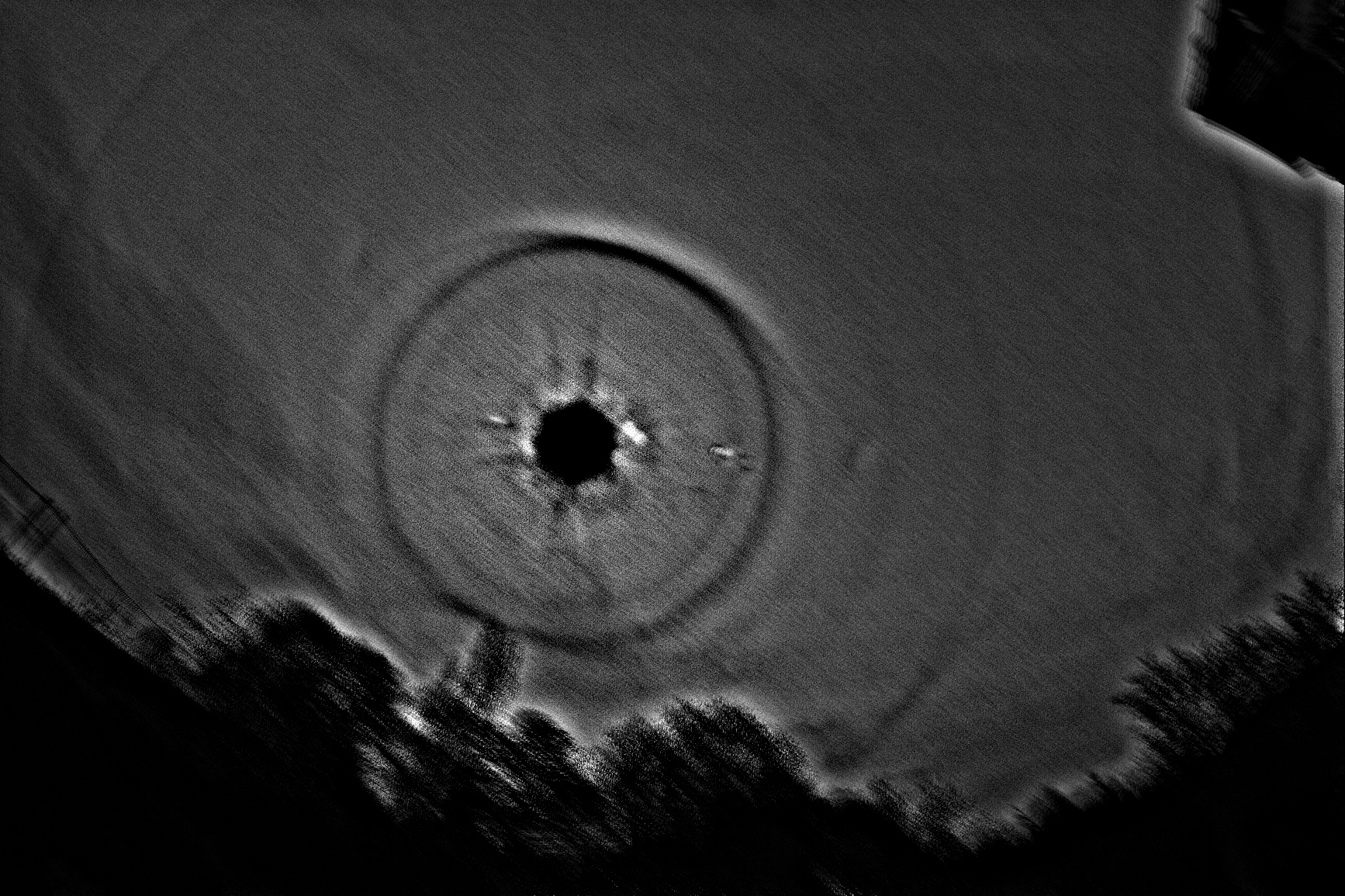
There is a first image, B-R rendered from a sole raw image, to give a view of the sharpness of the event:
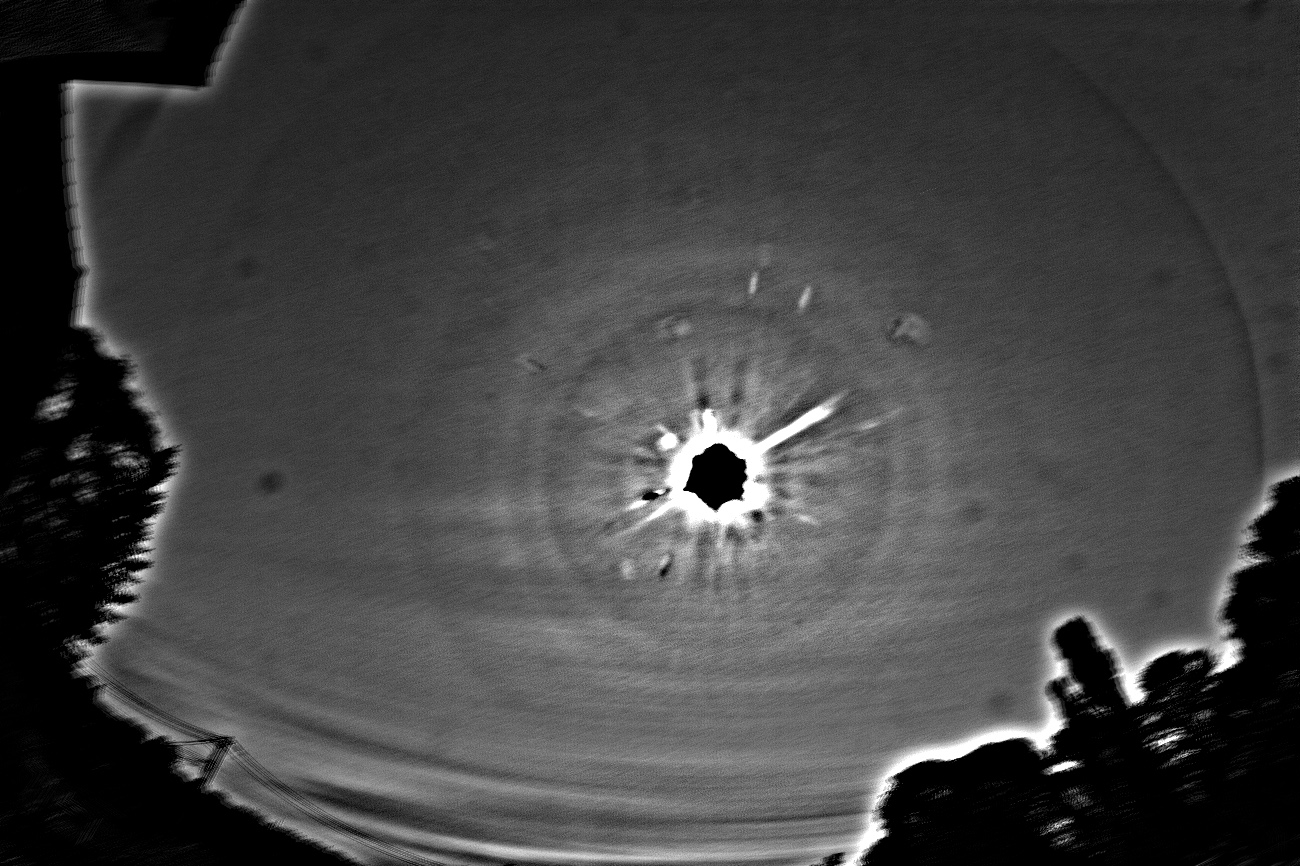
Stacking with the above one as first image, with the 25 following images makes those odd radius halos more clear:
Well, in the light of recent search for 28+° ring, this was one of my first tries even if I was expecting, like for the 13° halo, to find it when the rings are not sharp. But if you don't try, you won't find anything.
So there is a processing the the previous stack to enhance sharp halo first then eventually larger borders ones if any.
There is a folder on my drive, so you can take a look at the time-lapses of the day. As usual, better download it rather than viewing it as a Youtube video, to have a better video compression (as is the original one)
Many years ago, I got a nice odd radius display at sunset, during a day of November 2014. The view is not ideal, as I placed my camera on the edge of a window, look south, with a wide angle rectangular lens, hence the distortion. (EoS 1200D + Sigma 8-16mm, set at 8mm).
I was so amazed by the display I sent it to Nicolas Lefaudeux to have his expertise on the matter. And then he told me I caught the 28° halo, again (but I don't recall why this 'again') ;-)
There is the display, B-R rendered, and unsharp masked.
Unfortunatly, I did not keep any raw file of this event.
There is a folder where are all the remainings.
And any old how, here are some I cannot say it is, but looks like there might be something there.... or not:
And while browsing at all of those, I realized I got at least a dozen of 13° halos, with at least one with the Moon. Which could make a post after this one, for the record.
And a last one, not for the 28d spotting, but only because I like it a lot:
Now, a couple hours after starting this post, I think I may go get some rest ;-).
Greetings from France.
Nicolas R.
Showing posts with label 20° halo. Show all posts
Showing posts with label 20° halo. Show all posts
Thursday, 18 May 2023





Sunday, 30 April 2023
Odd radius display on sunset time, 2022-10-16 (Jouhe, France)
Often, when I see the clouds coming from west, I try to do a high cloud sunset to see if there is something to see (like sun pillar and sunvex halos).
this day, we had mosly contrails making here and there some ice halos from my position, but nothing unusual to catch the eye (furtive sundogs, 22° halos, upper tangent and maybe Lowitz buddies but too short in time to be exploitable) (Time-Lapse of part of the day in here, South-South-East Field of View). To find other halos at sunset, the exercice can be tricky, as the global backgroud turn progressivly to yellow then orange so the b-r rendering is more complicated, with adaptation to make in the last 30-45 mins before the end of sunset.
As I don't have automatized this, I find myself resigned to make one setting for the whole sequence to save time in my processings.
And sometimes, something catch my eye, as it did this last 16th of october, last year.
The three next images show 3 differents times of the event, with slightly different processings:
 2022-10-16-[17h14à18h58]-NNW-bw-v1-[4-2]-UsM-(49)-5s5-histo-UsM-h20-h28?-h35
 2022-10-16-[17h14à18h58]-NNW-bw-v2-[4-2]-UsM-(47)-7s7-UsM-histo
 2022-10-16-[17h14à18h58]-NNW-bw-v2-[4-2]-UsM(56)-6s6-UsM-h28?-histo
If needed, I can provide the bw sequence, so you can see (as I do with VirtuaDub) the evolution of the display and distinguish the 28° halo with dynamic (back and forth) play on the sequence.
A sequence you will be able to see there (Version1 & Version2), but with the compression due to GoogleVideo. Again, all raw images are still in my possession, as I guess I might not be done with this display yet.
this day, we had mosly contrails making here and there some ice halos from my position, but nothing unusual to catch the eye (furtive sundogs, 22° halos, upper tangent and maybe Lowitz buddies but too short in time to be exploitable) (Time-Lapse of part of the day in here, South-South-East Field of View). To find other halos at sunset, the exercice can be tricky, as the global backgroud turn progressivly to yellow then orange so the b-r rendering is more complicated, with adaptation to make in the last 30-45 mins before the end of sunset.
As I don't have automatized this, I find myself resigned to make one setting for the whole sequence to save time in my processings.
And sometimes, something catch my eye, as it did this last 16th of october, last year.
The three next images show 3 differents times of the event, with slightly different processings:


If needed, I can provide the bw sequence, so you can see (as I do with VirtuaDub) the evolution of the display and distinguish the 28° halo with dynamic (back and forth) play on the sequence.
A sequence you will be able to see there (Version1 & Version2), but with the compression due to GoogleVideo. Again, all raw images are still in my possession, as I guess I might not be done with this display yet.
Thursday, 28 January 2021
A clear 28° halo on snow surface
Sunshine has been a rare phenomenon in Finland this winter. On 16th January, the sky was finally clear and temperature had dropped to -25°C, so I headed to a nearby lakeshore to observe possible surface halos. There were indeed 22° and 46° halos visible on the snow, so I took a set of 335 photos by moving back and forth of a 50 m stretch of a road along the lake. The mirrored stack revealed that this was an odd radius display with 18°, 20°, 23° and 24° halos present. An interesting feature was that 22° and 23° halos were equally strong and well defined in the stack.

Two days later I got another chance to photograph surface halos in the same place. The temperature was -8°C. Only a modest 22° halo with some bright glints outside it were visible to naked eye, so I did not expect much from the stack. Nevertheless, I took 147 photos. This time the mirrored stack looked even better than two days ago: a strong 22° halo accompanied by several odd radius halos, including a clear 28° ring.

A comparison with the previous display (limited by blue frame in the photograph below) provided another surprise: the prominent ”22° halo” was in fact a 23° halo and 22° halo was missing. So this was an odd radius display with 18°, 20°, 23°, 24°, 28°, 35° and 46° halos. Although there are not many observations of 28° halo on surface yet, it seems probable that it is not as rare as has been thought. This gives some hope that a crystal sample can be obtained one day.

The strong 23° halo and the absence of 22° halo in this surface display is interesting. It means that the usual ”22° halo” on snow may in some rare instances be something else than it looks, but it is not easy to detect such cases from the abundance of common 22° halos. For example, the first observation of surface 28° halo on 7 April 2012 by Jari Luomanen and Marko Riikonen looks rather similar as the current one, and it may perhaps contain 23° halo instead of 22° halo (yellow frame below, photo Jari Luomanen). Although all photos in this collage were taken with Samyang 8 mm fisheye lens, the result should be viewed with caution due to the robust alignment.

Monday, 1 June 2020
Odd radius display at low sun in Berkshire, UK

11-frame stack at sun elevation 2°: unsharp mask and colour enhancement (top), and background subtraction + blue-minus-red colour subtraction (bottom; the latter by Nicolas Lefaudeux).
In the evening of 24th May 2020, a notable display of odd-radius halos and their associated plate arcs occurred in Berkshire, UK. I first noticed faint traces of circular halos - 20° and 23° as I could later confirm from photos - at around 19:20 BST, when the sun was at 13° elevation. Less than 30 minutes later the sun had come down to 9° and first signs of the upper 20° plate arc appeared, making obvious the need to find a view down to the horizon. The display got weaker after some time but regained some intensity less than 30 minutes before the sunset. Unfortunately there were some lower-level cloud interfering with my view for most of the observing time.
Stacked and further processed images from the first stages of the display (below) reveal 18°, 20°, 23°, and 35° circular halos in addition to the aforementioned 20° plate arc. At the end of the display (above), the circular halos are less clear, but plate arcs at 20° and 35° show up better. Most interestingly, perhaps, there are suggestions of 28° circular halo and the associated plate arc at the upper left-hand side at solar elevations 7° and 2°. Previously 28° arcs have been reported in the Lascar display of 1997 and in a few more recent occasions in China, but possibly never before in Europe.

50-frame stacks at sun elevation 9° (top) and 7° (bottom): Background subtraction (left) and background subtraction + blue-minus-red colour subtraction (right).
Monday, 30 October 2017
Display of 4th June 2017 in Pskov oblast

It was a weak odd-radius display which contained not only familiar pyramidal halos with radii of 9, 20, 24 and 35 degrees, but also a mysterious 13° halo! You can notice this diffuse 13° ring between 9° and 20° halos on the image above. You can also notice that the 20° halo is brighter than the 22°. The 35° halo is clearly visible on the image below.
With the naked eye only parhelia were visible during the display. The display was short and lasted about an hour and a half.

Monday, 29 May 2017
Large scale odd radius halo complex on Memorial Holiday 5-29-17
About an hour before midday a layer of cirrus stratus clouds began moving toward the sun and I looked up and saw a colorful 22d halo and I noticed it looked doubled all the way around and looking close to the sun I saw weak 9d halo. I grabbed my camera and then it got spectacular. The 24d halo not only was bright it was sharp and complete and was my best yet to date. While taking picture after picture I saw a segment of a larger halo appear and it turned out the be 35d halo. As the clouds moved thru it peaked with a total of 5 rings the 9,20,22,24, and 35d halos and the 35d halo I got today was my best to date. This could be my best pyramidal display to date but who knows I could get better some day.


Wednesday, 17 May 2017
Recent displays from Northwestern Russia
In this post I want to share some of my observations from last month, which I made in St Petersburg (from 15th April to 5th May) and in Pskov Oblast (from 7th May to present time). In total there were eleven displays, six of them comprising pyramidal halo forms. Many of these pyramidal displays were minor, so I will not present them.
20th April

The photo on left shows a purely odd-radius plate complex. There are only the upper 23 plate arc with its 23 halo and a couple of 18 plate arcs. On the photo on right you can see fragments of weak odd radius circular halos. Together with the broad 22 halo at the 02-00 position there is the 20 halo and also the diffuse 35 halo.
28th April

Together with classic halo forms in stacks pyramidal halos appeared with odd-radius plate arcs. On photos above you can see lower 24 plate arcs with the 24 halo and the 9 halo (with possible the lower 9 plate arc). The weak and diffuse upper 23 plate arc is also available.
30th April

In the morning there was a short display which lasted less than one hour. The display was not predicted by the meteogram, so maybe I missed most of the display, which was earlier that morning. In any case I saw bright parhelia with the colourful circumzenithal arc, and got in the stack the strong parhelic circle and the upper suncave Parry arc together with the nice upper tangent arc. I think it is the Parry arc, and not an upper 23 plate arc, because the display does not contain no other pyramidal halo forms, and the arc looks pretty sharp.
1st May

In the morning I observed the large and bright upper tangent arc for around one hour. Infralateral arcs were easily seen with naked eye. Together with bright parhelia I saw fragments of a parhelic circle. In stacks the rare Wegener arc was found.
5th May

On that day there was a protracted display, that lasted between six and sixteen hours. But my camera had recorded interesting halos only at the start, on the sunrise. It was an odd-radius circular complex which contained pyramid halos with radii 9, 18, 24 and 35 degrees. It seems the 24 halo included rudimentary upper and lower 24 plate arcs.
10th May

No rare halos on that morning but I saw the supralateral arc visually very well, that happens not often. A curious circumzenithal arc appeared a little later. The CZA was diffuse, that is not typical for this halo.
20th April
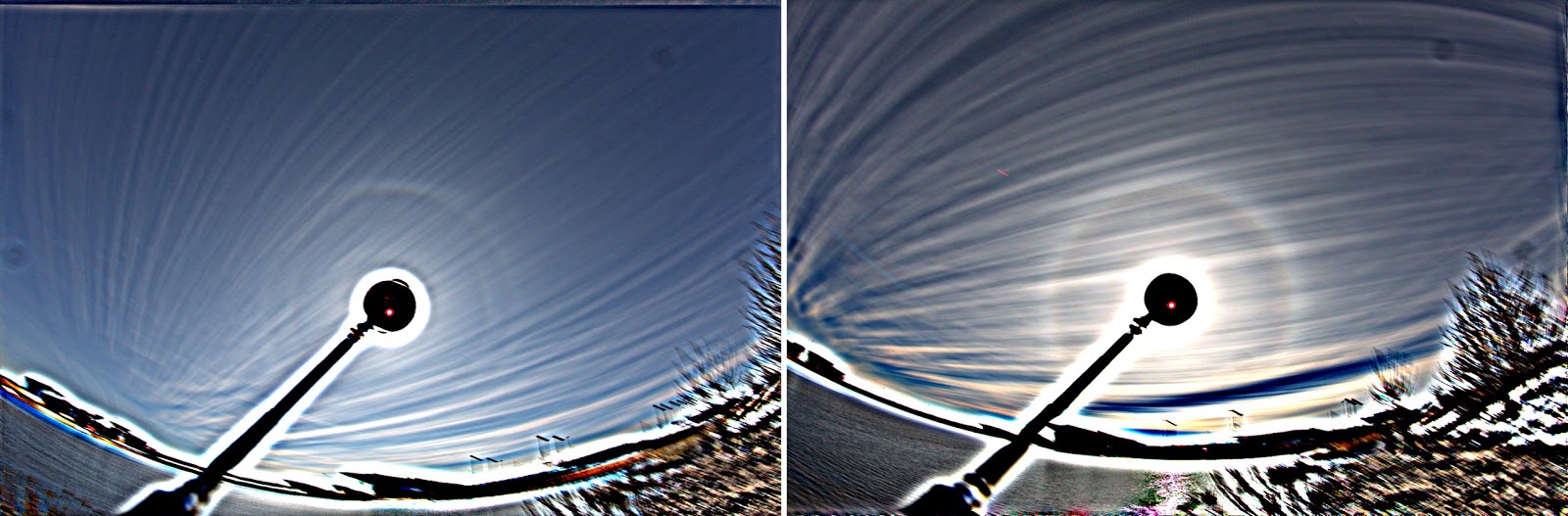
The photo on left shows a purely odd-radius plate complex. There are only the upper 23 plate arc with its 23 halo and a couple of 18 plate arcs. On the photo on right you can see fragments of weak odd radius circular halos. Together with the broad 22 halo at the 02-00 position there is the 20 halo and also the diffuse 35 halo.
28th April

Together with classic halo forms in stacks pyramidal halos appeared with odd-radius plate arcs. On photos above you can see lower 24 plate arcs with the 24 halo and the 9 halo (with possible the lower 9 plate arc). The weak and diffuse upper 23 plate arc is also available.
30th April

In the morning there was a short display which lasted less than one hour. The display was not predicted by the meteogram, so maybe I missed most of the display, which was earlier that morning. In any case I saw bright parhelia with the colourful circumzenithal arc, and got in the stack the strong parhelic circle and the upper suncave Parry arc together with the nice upper tangent arc. I think it is the Parry arc, and not an upper 23 plate arc, because the display does not contain no other pyramidal halo forms, and the arc looks pretty sharp.
1st May

In the morning I observed the large and bright upper tangent arc for around one hour. Infralateral arcs were easily seen with naked eye. Together with bright parhelia I saw fragments of a parhelic circle. In stacks the rare Wegener arc was found.
5th May

On that day there was a protracted display, that lasted between six and sixteen hours. But my camera had recorded interesting halos only at the start, on the sunrise. It was an odd-radius circular complex which contained pyramid halos with radii 9, 18, 24 and 35 degrees. It seems the 24 halo included rudimentary upper and lower 24 plate arcs.

No rare halos on that morning but I saw the supralateral arc visually very well, that happens not often. A curious circumzenithal arc appeared a little later. The CZA was diffuse, that is not typical for this halo.
Friday, 10 March 2017
Weak odd radius display on 09 March 2017

The morning was cloudy. Around 11-30 sky started to clear. After half an hour the whole sky was covered high clouds. But I did not see any halos. It seemed it was usual bad clouds, which not produce halos. Nevertheless, in some moments I saw very weak and wide 22° halo with something resembles upper 23° plate arc. Also was an episode when I saw compact CZA, which apeared without parhelia. My suspicions have only become stronger, about that I faced with subvisual odd radius display.
It was brilliantly confirmed when I returned to home and processed stacks. I was able to identify such pyramidal forms as upper 9° plate arc (possible), upper 23° plate arc, lower 24° plate arc. Also were captured 9, 18, 20, 22, 24, 35 (very diffuse, link) and 46 halos. Odd radius halos lasted 50 minutes, until 13-30. Then until the end of display (until 15-30) were captured only weak common halos, such as upper tangent arc, parhelia and 22° halo.

It was fourth display since 15 February, which includes pyramidal halos.
Wednesday, 7 November 2007
Pyramidal crystal halos

A funny coincidence that a halo-observer may want to experience is travelling to Egypt and seeing some pyramidal crystal halos.
This odd-radius display was photographed by Márk Laczkó of Budapest, Hungary somewhere over the southern borders of Romania. He was sitting on an airplane heading towards Egypt on 27th October. When he realised they were flying in cirrus clouds, he deliberately started looking for some halo phenomena. The surprisingly well distinguishable 18°, 20°, 23° and 24° halos were visible for about a minute at 06:21 UTC. Unfortunately, there is no documentation or report of a possible 35° halo. The original photo and two other pictures are also available (#1 and #2).


by Ágnes Kiricsi
Saturday, 30 June 2007
Moon pyramidal halo complex in Czech Republic

In June when conditions for observing halos aren’t fine because of low full moon elevation, I have had my best observation ever. On cirrostratus veil divided from cumulonimbus cloud firstly appeared 9° halo and later thick halo at 22-24 area. After stacking 20 pictures, it turned out to be 23° and 24° halo. Fragments of 20° halo were not recognizable until stacking photos. Halos were seen at the highest intensity for about half an hour.
Martin Popek
Odd radius halos at Crete

These odd radii were a little bit surprising, I didn’t expect something like this at Asimenia beach in Kavroz. I had been waiting for any halos for five days and the first display was directly pyramidal 18°, 20° and 23° halos. Fortunately I had a piece of welding glass because photos I took without this protective glass was totally unusable because of reflections. The display originated at very thin cirrus clouds.
Martin Popek
Sunday, 6 May 2007
Odd radius halos in Czech Republic

On April 5th 2007 there was typical nice, but, dry“ cirrostratus in the sky without presence of halos. I was continuously checking the sky and after 10:00 I noticed very faint halo that had unusually wide upper part. That was very suspicious to me so I started to take photos which were after processed by Registax. You can see the result in the output picture. There are two separated halos which I later identified through the comparison with night sky, as 20° and 23° halos. Maybe there is also 35° halo, but it cant be certainly identified from the picture. The phenomenon could originate at 0,3-0,0-0,0 or 1,0-0,0-0,0 crystals.
I saw very similar displays with nice, "dry" cirrostratus and then with faint odd radius halos on June 22nd 2006 and August 26th 2006 so that is quite interesting.
Martin Popek
Odd radii in Southern Finland

A horrendously quiet April passed by without any noteworthy action (except Jarmo's fantastic bolide halo). Halo people were awakened from oblivion on 5th May, when a smooth cirrostratus veil crept in from west and offered plate crystals and odd radii halos. The display was seen and photographed by Ismo Luukkonen in Turku, Marko Riikonen in Helsinki (photo on the right by Marko) and Jukka Ruoskanen in Riihimäki.
Most likely all odd radius halos were on the sky, of which 9, 18, 20 and 35 degree halos were easily discernible. The 22-24 region may have consisted of all three possible rings. Also few of the odd radius plate arcs were present, although rather poorly.
Tuesday, 6 March 2007
Odd radius halos in diamond dust in Finland

On 23 February an another diamond dust display with odd radius halos occured in Vaala, Finland. Temperature was dropping from -29°C to -24° during my observation.
A parhelic circle and circumzenithal arc were present with nice parhelia. A subsun and subparhelia were also seen as sparkling ice crystals in front of the ground.
Odd radius halos labelled in this enhanced photo are A) a pyramidal heliac arc, B1) upper 24° plate arc, B2) lower 24° plate arc and C) upper 23° plate arc.
The most brightest odd radius halo was 18° halo and in some photos there probably are also 9° upper plate arc and 20° halo. The ice crystal cloud was produced by a local heating plant about 2 km away. More photos can be found here.
By Jarmo Moilanen
By Jarmo Moilanen
Friday, 2 February 2007
First odd radius halos observed 31st January 2007
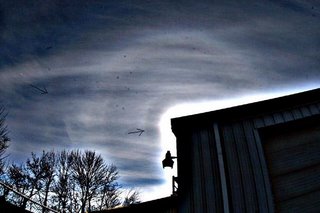
While at work on break I saw some cirrus clouds gather in the sky and I later saw a halo appear so I got my camera out of the car and my sunglasses. As the minutes passed I notice that there were three halos: 9 degree halo 18 degree halo and possible 23 degree halo. The left side of the 9 degree halo looks strange because it is brighter on one side and has a somewhat vertical look to it.
When I later downloaded the pictures I went through them with adobe photoshop and I applied the USM and I noticed possible 20 degree halo and even a 35 degree halo! You can see at least 4 halos in the enhanced photo. The possible 9 degree column arc and 35 degree halo have been pointed out with black arrows.
Thursday, 1 February 2007
Combination of high level cloud and diamond dust activity

On the evening of 30th January cirrostratus clouds filled the sky and odd radius halos (9, 20 and 35) were seen in the Moonlight in Hyvinkää, Finland. The 20 and 35 halos were very weak, and couldn't be seen with naked eye. In addition to the high clouds there were good but fast moving diamond dust areas on the ground level. At times the halo display was a combination of cirrostratus and diamond dust halos. In the photo on the left the parhelic circle was caused solely by diamond dust, whereas the other halos were mainly originated in high clouds. A collection of photographs taken by Jukka Ruoskanen is here. 9 degree halo was also seen in Espoo by Timo Kuhmonen, in Helsinki by Marko Riikonen, in Turku by Ismo Luukkonen and in Tampere by Jari Luomanen.
Exciting divergent light halos were photographed as well in Hyvinkää. A more detailed description of the divergent light halos is here.
Wednesday, 1 November 2006
Rare halos in Czech rep. Oct. 30 and 31

On October 30 in Prague was observed rare halos. Stepanka Kosova had Lowitz arcs and 120 deg. parhelia (title photo). Lukas Shrbeny had nice 120 deg. parhelia too. I observed rare halos in two last days. On October 30 I saw: 9°, 20° halos and Parry suncave arc. On October 31 I seen: Parry suncave arc , upper and lower Lowitz arcs and probably circular Lowitz arc too. M.Popek and R.Manak seen 9° halos in Lunar displays.
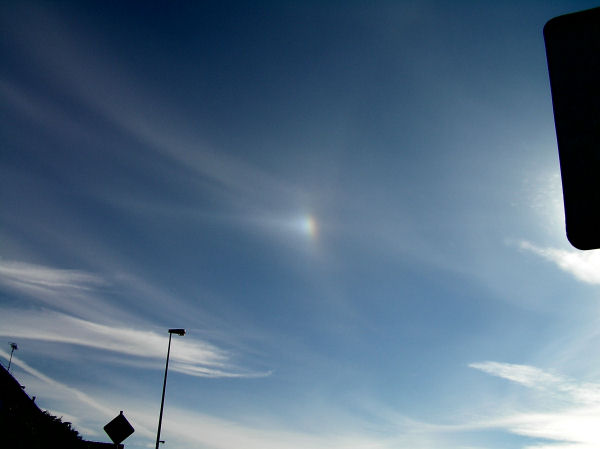
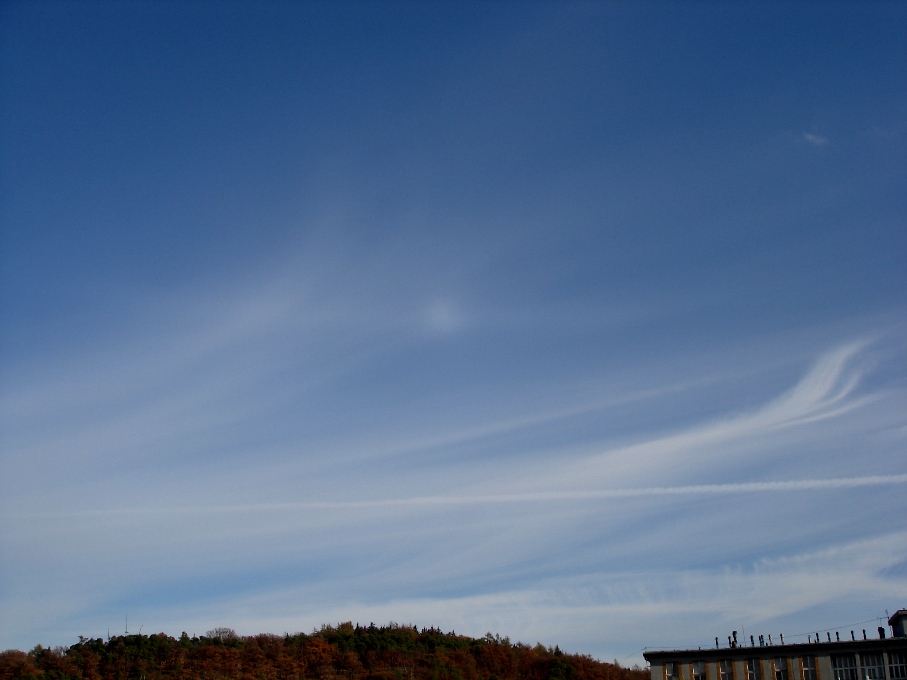
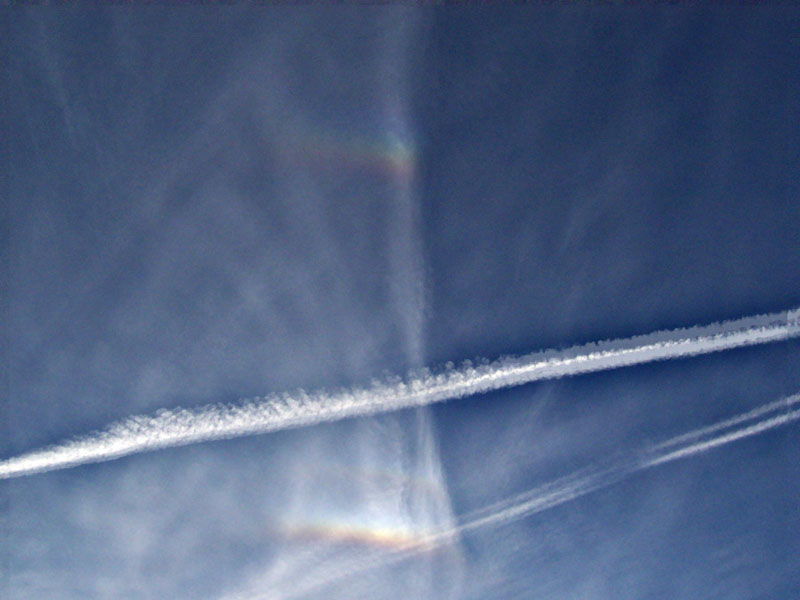
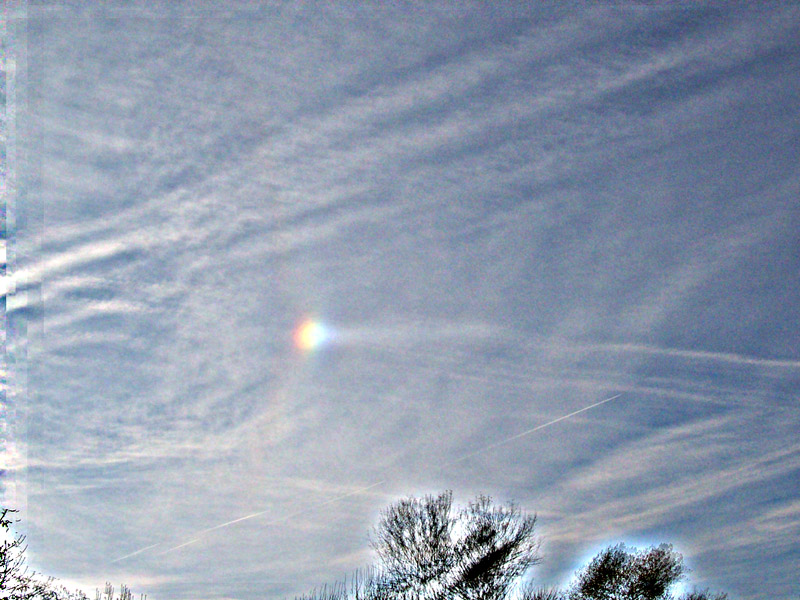
by Patrik Trncak
Saturday, 9 September 2006
Odd radii in Czech Republic
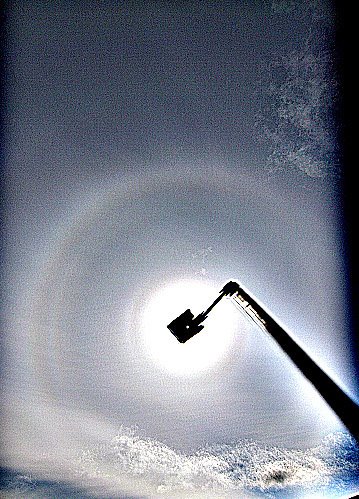
During the Czech halo observers meeting in Kuncice, high clouds created some good displays. This odd radius halo complex was seen on 14. August. It shows 9,° 18°, 20°, 22-24° and 35° halos. Judging from the non-uniform intensity distribution of some of the halos (9° and 20° halos being brightest on the sides), this display was caused by poorly oriented columnar pyramid crystals. It's also interesting that 20° halo is brighter than 18° halo. This type of occurrence is uncommon.
This is stacked image processed by Roman Manak and Patrik Trncak. Original photos were taken by Martin Popek.
By Marko Riikonen
By Marko Riikonen
Wednesday, 26 April 2006
Complex display with odd radius column arcs in Finland
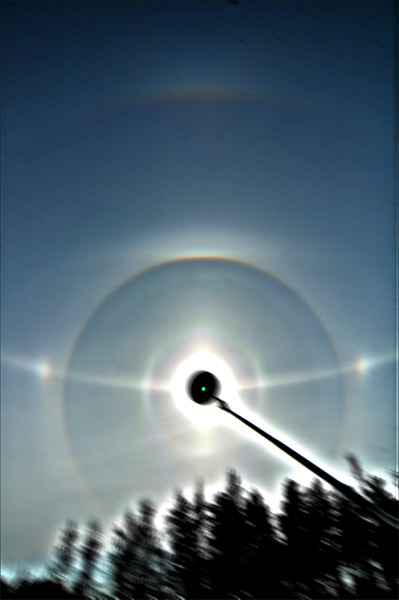
A long-lasting halo display was seen in Southern Finland on 25th April. The gems of the display were odd radius column arcs, of which 9, 20 and 24 degree arcs were seen. Additionally, 9 and 24 degree lower plate arcs as well as an 18 degree halo and possibly a 23 degree upper plate arc were visible for a short period of time during the day. The duration of the display was spectacular; for instance the Wegener anthelic arcs and 120° parhelia were continuously on the sky for almost three to four hours. At the latter stages of the display a beautiful 46° supralateral arc and magnificent circumzenith arc appeared. The display was photographed by many people - Marko Riikonen in Helsinki, Jari Luomanen in Tampere, Lauri Kangas in Espoo, Marja Wallin in Lahti, Timo Viinanen in Hameenlinna and Jukka Ruoskanen in Hyvinkaa.
Thursday, 12 January 2006
Lower 23 plate arc observed in Chile
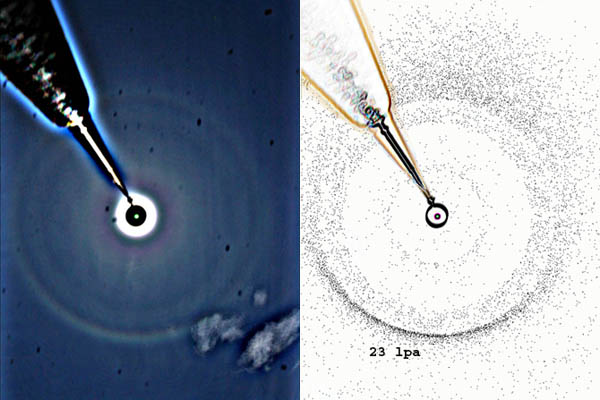
Lower 23 plate arc is a rare halo, that, as far as I am aware, has been observed and photographed only once. This was in Chile on 28. November 1997. Now the lower 23 plate arc seem to have made another appearance - and again in Chile.
The accompanying picture is from halo display seen at Aucanquilcha volcano on 3. Debember 2005 by J. Ruoskanen and I. The image is stacked from 63 individual photos taken during 20 minutes. Unsharp masking has also been used. The simulation is made of populations of random and plate oriented pyramid crystals. Halos are 9°, 18°, 20° and 23° circular halos and lower 23 plate arc (23 lpa). Sun elevation change in the photos was from 71° to 75°, the simulation is for 73°.
Subscribe to:
Posts (Atom)