Showing posts with label circumzenithal arc. Show all posts

Sunday, 1 March 2020

Secondary CZA from Sun Pillar

* For ease of reading, in the following texts: CZA = circumzenithal arc, CNA = circumnadir arc.

The Siziwang Qi display (http://www.thehalovault.blogspot.com/2020/02/intense-kern-arc-from-china.html) on Feb 14 2020 has almost certainly secured itself a spot in the halo history book, featuring record-high 44° parhelia, full circle Kern arc and off-the-chart overall intensity.

The story doesn't just end there.

In a discussion with Marko Riikonen, he pointed us to a similar Finnish moonlight display in 2013 (https://www.taivaanvahti.fi/observations/show/19422), during which a novel arc was discovered below the moon CZA. Seven years have passed and a repeat event is long overdue. Now the wait is officially over.

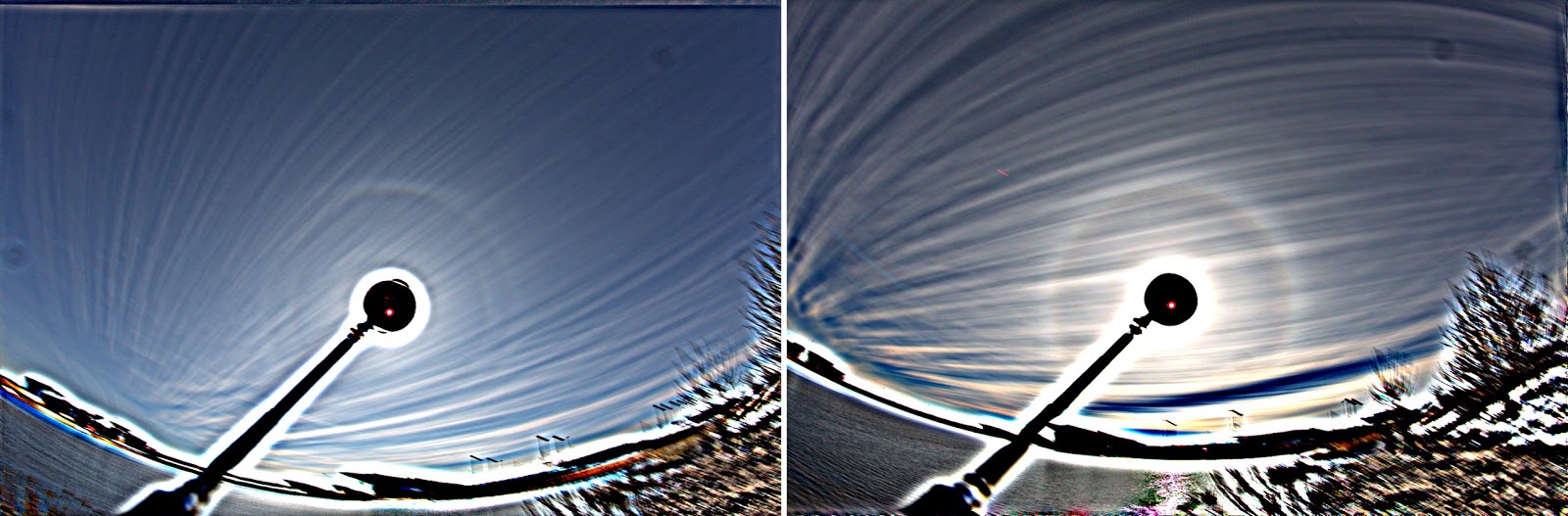
As more Siziwang Qi material emerged, one of them caught our attention. In the following iPhone photo by LI Tingfang, there seems to be hint of a long, sun-vex arc below the dazzling CZA.

© LI Tingfang, shown with permission

With some minor processing, the arc stands out and appears surprisingly well defined. It looks exactly like the novel arc in the 2013 Finnish display.

© LI Tingfang, shown with permission

© LI Tingfang, shown with permission

Back then, Nicolas Lefaudeux managed to replicate the Finnish display scene with simulation and identified the novel arc to be a multi-scattered secondary CZA created by the moon pillar. In the Siziwang Qi display, strong sun pillar appeared in most material and multi-scattering has been proven intense, so it's very likely Nicolas' theory applies here too. After some experiments, we managed to reproduce the secondary CZA in simulation by introducing a large amount of pillar-making wobbly plates.

Simulation by ZHANG Jiajie

At first the appearance of the secondary CZA in both displays baffled us. It's hard to imagine how the long and diffuse pillars create such a sharp-looking arc. With the help of ZHANG Jiajie's simulation program we were able to dissect the arc and fully grasp the underlying mechanism.

First let's review the CZA mechanism:

  • Light source altitude 0° ~ 33°: CZA ray path 1-3 works. When light source drops to 0°, CZA reaches minimum altitude of around 57°. 
  • Light source altitude -33° ~ 0°: CZA ray path 1-3 no longer works. Instead, the 'flipped' CNA ray path 2-1-3 kicks in and produces a flipped CNA overhead. This flipped CNA doesn't get lower than 57° either. 

Simulation by ZHANG Jiajie, sun altitude ranges from -35° to 35° at 2.5° increment.

When the pillar is treated as the light source in multi-scattering scenarios, it can effectively be viewed as an infinite number of light sources with altitude covering the 33° to -33° range. The 0° to 33° portion creates an infinite number of CZAs, while the -33° to 0° portion creates an infinite number of flipped CNAs. These two light clusters turn out in simulation as two broad, sun-vex, zenith-hugging arcs, both capping sharply at 57° altitude.

Simulation by ZHANG Jiajie, sun altitude 20.8°

These two secondary arcs together get us the sharp-looking novel arc in the Finnish and Siziwang Qi displays. As long as the pillar covers the horizon, the arc's overall appearance hardly changes as light source rises. The intensity of the arc peaks when light source sits low, which makes sense since pillar also peaks under the same condition.

Simulation by ZHANG Jiajie, sun altitude ranges from 0° to 25° at 5° increment.

When light source altitude drops below 15°, the arc's close proximity to the original CZA could severely hinder detection. According to the animation below, altitude 15° to 25° may be the most ideal observing window.

Simulation by ZHANG Jiajie, sun altitude ranges from 0° to 25° at 5° increment.

There's one thing in the actual display that doesn't go well with simulations. The azimuthal extent of the arc is very long in the actual photo, as if it'll go full circle. The simulated arc, however, hardly goes beyond the 46° halo. To make it longer in simulation, very thick triangular plates need to be employed, which doesn't sound very realistic. There're probably other light sources responsible for the arc's azimuthal extension and we'll need your help to figure it out : )

Jia Hao

Tuesday, 21 November 2017

Display of 11th June 2017 in Pskov Oblast

Each frame of animation covers ten minutes
There were not rare halos during the display, exept for a weak upper 23° plate arc and a 9° halo. However, the display contained classic halo forms that were quite bright and long lived. I want to show you how these halos change their distance from the sun and curvature in nature. The thing that I remember most is the bright upper tangent arc, that was seen against a very thin ice cloud layer (1).

Wednesday, 18 October 2017

Display of 3rd August 2017 in Pskov oblast, Russia

Every frame of animation is stack which covers 2,5 min. Colored version is here
At the begining of the display, beautiful cirrus covered the sky, but I did not notice any halos at the time. When I came out a little later, I was surprised to see a bright parhelion and a middle Lowitz arc which crosses it! Cumulus limited the display, so I could observe halos only in gaps between these clouds. There was one short episode when I saw bright upper tangent and suncave Parry arcs. The following rare halos were found in the stacks:

 -well defined upper and middle Lowitz arcs (1) and possible lower Lowitz arc (2)
-part of helic arc (3)
-supralateral Tape arc (4)

Wednesday, 17 May 2017

Recent displays from Northwestern Russia

In this post I want to share some of my observations from last month, which I made in St Petersburg (from 15th April to 5th May) and in Pskov Oblast (from 7th May to present time). In total there were eleven displays, six of them comprising pyramidal halo forms. Many of these pyramidal displays were minor, so I will not present them.

20th April

The photo on left shows a purely odd-radius plate complex. There are only the upper 23 plate arc with its 23 halo and a couple of 18 plate arcs. On the photo on right you can see fragments of weak odd radius circular halos. Together with the broad 22 halo at the 02-00 position there is the 20 halo and also the diffuse 35 halo.

28th April

Together with classic halo forms in stacks pyramidal halos appeared with odd-radius plate arcs. On photos above you can see lower 24 plate arcs with the 24 halo and the 9 halo (with possible the lower 9 plate arc). The weak and diffuse upper 23 plate arc is also available.

30th April


In the morning there was a short display which lasted less than one hour. The display was not predicted by the meteogram, so maybe I missed most of the display, which was earlier that morning. In any case I saw bright parhelia with the colourful circumzenithal arc, and got in the stack the strong parhelic circle and the upper suncave Parry arc together with the nice upper tangent arc. I think it is the Parry arc, and not an upper 23 plate arc, because the display does not contain no other pyramidal halo forms, and the arc looks pretty sharp.

1st May

In the morning I observed the large and bright upper tangent arc for around one hour. Infralateral arcs were easily seen with naked eye. Together with bright parhelia I saw fragments of a parhelic circle. In stacks the rare Wegener arc was found.

5th May

On that day there was a protracted display, that lasted between six and sixteen hours. But my camera had recorded interesting halos only at the start, on the sunrise. It was an odd-radius circular complex which contained pyramid halos with radii 9, 18, 24 and 35 degrees. It seems the 24 halo included rudimentary upper and lower 24 plate arcs.

10th May

No rare halos on that morning but I saw the supralateral arc visually very well, that happens not often. A curious circumzenithal arc appeared a little later. The CZA was diffuse, that is not typical for this halo. 

Friday, 14 April 2017

Recent displays from St Petersburg, Russia

In this post, I'm including the most interesting displays observed during the last month.

14th March 2017


On that day, halos appeared in the morning in separate cirrus clouds. Their arrival was not predicted by the meteogram. When I looked out from the window, I saw a bright CZA, but when I came down, it had disappeared. Nevertheless, I could see the weak supralateral arc. Half an hour later, I also saw a nice infralateral arc, when the cirrus cloud reached the horizon.

29th March 2017


In the evening bright parhelion was detected, and then a little while later also the wide circumzenithal arc. The halos were produced by the anvil of a convection cell.

1st April 2017


In the morning, at 10-00, the sky was clear. But in the south-west direction, low over the horizon a lot of cirrus clouds were visible. Their arrival was extended for an hour and a half. When a border of a front of cirrus clouds started to arrive, I noticed that it was weak and almost transparent. When these weak clouds reached the sun, at first I did not notice any halos. But soon, some markers of sub-visual odd radius display appeared.

It was broad and undefined halo in 22° area, with pretty obvious upper 23° plate arc in some moments. In the reflection of my sunglasses these things were visible a lot better. These weak odd radius halos were visible for around a half of hour, or even more while the area of weak cirrus crossed the sun.

Then, on the right-hand side pretty bright 22° halo started to appear. It was the arrival of main part of cirrus. In that area clouds were common and solid. After few minutes both bright tangent arcs appeared. Lower tangent arc was brighter than upper. I also noticed big infralateral arc on the right-hand side. It was pretty weak, but well coloured. I could see the arc better when I used peripheral vision.

This peak of the display was rather lengthy, and during its course I also watched both 120° parhelia, parhelic circle (it was easily seen within 22° ring), and the top part of 46° halo (likely it was the combination of supralateral arc and 46 halo. Although both were weak, together they became visually visible).
The peak was interrupted when middle-level cloud started to arrive. Then I saw a couple times only bright 22° halo

7th April 2017


The display looked quite ordinary, so I was glad I detected pyramidal halos such as upper 23° plate arc and 9° column arc.

9th April 2017


On that day, there was only a weak 22° halo. But the stack discovered also 18° halo/18° plate arc

10th April 2017


It was the weak display, which lasted most of the day. There was no suspicion that there may be pyramidal halos. But still I got upper 23° plate, 18° plate arc and 9° halo in the stacks.

Friday, 17 March 2017

Weak odd radius display with possible column arcs


This display occurred on 22th February 2017 in Izborsk (Pskov region, Russia). In the morning it was sunny and the first cirrus started to arrive around 13-00. In that moment, I saw a faint 22° halo, but it was visible because the cloud layer was smooth. Also it seemed to me that I saw a 9° halo through the viewfinder of my camera. The stacks showed pyramidal halos such as 9°, 24° and 35° halo.

The 24° halo looks pretty curious, because B-R processing shows the pause in 24° ring in area of upper tangent arc. It reminds me of 24° column arcs from crystals with big tilts. 9° halo also looks curious, brighter on the sides than on the top, what looks like 9° column arcs.

What do you think of that? 

Friday, 10 March 2017

Weak odd radius display on 09 March 2017


Yesterday in St Petersburg was an odd radius display with a predominance of plate forms.

The morning was cloudy. Around 11-30 sky started to clear. After half an hour the whole sky was covered high clouds. But I did not see any halos. It seemed it was usual bad clouds, which not produce halos. Nevertheless, in some moments I saw very weak and wide 22° halo with something resembles upper 23° plate arc. Also was an episode when I saw compact CZA, which apeared without parhelia. My suspicions have only become stronger, about that I faced with subvisual odd radius display.

It was brilliantly confirmed when I returned to home and processed stacks. I was able to identify such pyramidal forms as upper 9° plate arc (possible), upper 23° plate arc, lower 24° plate arc. Also were captured 9, 18, 20, 22, 24, 35 (very diffuse, link) and 46 halos. Odd radius halos lasted 50 minutes, until 13-30. Then until the end of display (until 15-30) were captured only weak common halos, such as upper tangent arc, parhelia and 22° halo.

It was fourth display since 15 February, which includes pyramidal halos.

Thursday, 9 February 2017

Observing diamond dust halos at the Bílá ski centre

Superparhelia and sharp light pillars
Taken by Daniel Neumann

At the night between 18th and 19th January 2017 me and my friend Daniel decided to try our luck and head towards the Bílá ski centre (approx. 50 km away). Before we headed out, we checked the webcams located at the centre. All cameras showed sharp and tall light pillars extending out of every light source. Faint superparhelia were visible, too.

The crystal swarm was extending 3 km away from the centre itself. On the way there, upcoming cars spawned tall light pillars and visible parhelia.

Just as we arrived, the centre closed down and turned off the lights. We parked near the slope and noticed that it was completely overcast. The crystals were in the form of very thick fog that was hanging in the valley. More on the "weather side" later.

As we walked for a few hundred meters away from the centre, we stumbled upon a very bright lamp illuminating a local church. Only a sharp and tall light pillar was visible. But as we stayed for a little longer, the whole situation changed and superparhelia started to appear. At first they were hardly noticeable, but with each minute they were getting brighter and brighter.

We decided to try our not-so-much bright "spotlight" to see if anything interesting appeared. And yes it did. By shining the lamp towards the snowy surface, true divergence took form and divergent sub-parhelia appeared. They were eerily 3D, hanging in the air. Along with them, an extremely bright and tall light pillar was observed, too.

A multitude of light pillars


Tall light pillars and superparhelia


Circumzenithal arc along with light pillar and superparhelia 


Light pillar, sub-parhelia, parhelia, and parhelic circle

Now let's discuss the weather situation a little. The temperature reached below -16°C which was lower than other temperatures observed at meteorological stations (due to the topography). The ski centre was at the time actually located at the edge of a low hanging stratus that was just barely touching the mountain ridge. The snow guns then probably nucleated its lower layer and the crystals started to precipitate out. Below is a georeferenced image from the Suomi-NPP satellite along with the location of the centre. The microphysical product along with a high resolution of the image shows how the edge of a low stratus (yellow colour) extends towards our location. Now bare in mind that this image was taken approx. 1 hour after we left, so the stratus actually retreated a little by that time. There are two "branches" of a low stratus visible at the image. The right branch follows the exact location of a local dam called Šance. The left branch follows a river called Čeladenka.

(c) Suomi-NPP 24h microphysical product

What stuns me about this location is its abundance of diamond dust occurrences. Almost every time the snow guns are operating, a crystal swarm is created within minutes and light pillars are always visible on the webcam images. I have a theory about why that happens:
  • Microclimate - the topography is in the form of a depressed valley, which allows for a cool and moist air to accumulate at the bottom. 
  • Moisture - the river that flows through the village could possibly be a substantial source of moisture 
  • Snow gun additives - if I have learned well, it is the additives in the snow guns that serve as nuclei on which the crystal formation takes place. In that case, they are probably using a specific additive that makes the crystal formation so abundant. 
The local relief of Bílá
Shaded relief + topographic map
(c) ČÚZK


METAR analysis shows a high pressure centre located above Czechia
(c) METAR

Temperature distribution

Wednesday, 8 February 2017

Diamond Dust and Air Pollution in Hungary

By: Zsuzsanna Sándor-Tóth (Hatvan, Hungary - 29 January 2017)
Diamond dust halos are scarcely observed phenomena in Hungary, mostly because of our climate. When it is cold enough, dry airmasses of Siberian origin fill the Carpathian Basin. But when the air is moist enough, it is not really cold. Special locations, however, share some attributes needed for diamond dust formation: at ski resorts with snowguns, for example, condensation seeds are present. Interestingly, this year’s Hungarian diamond dust observations, show a different type of seeding.

Industrial districts are well known for ‟industrial snow” production around the world because of their seeding - and this is the same with diamond dust for some locations. Also some places (mostly less advanced regions, small rural towns and villages) have houses with an old heating system based on wood and coal, and we all know how much air polluting soot particles these create. We also noticed diamond dust formation near highways, which are also a ‟good” source of air pollution


In winter Hungary usually has some weeks of high pressure weather which in our case means cold, foggy days with only a small amount of sunshine once in a while. These weeks help accumulating a dense, highly polluted air, especially in valleys (while the highest hills still might be clear). If the temperatures are low enough, and there is enough moisture present (imagine a river valley for example where fog formation is always possible), and these circumstances coincide with local air pollution, diamond dust might form, no matter if it is industrial or due to high traffic or heating.

Still some kind of light source is needed for any halo... We see diamond dust falling without any optical side-effects on grey, foggy days, and sometimes when it happens at night, we might see light pillars. During rare hours when the Sun decides to look at our pale faces there might be some sundogs, 22° halos, sun pillars, tangent arcs, CZA too. But mostly we see only a small amount of diamond dust glinting around us in the air, maybe a weak subsun with it. 90% of these displays are very faint, last only for a short time and are limited to a small area.

My personal experiences from this winter have been that almost every foggy night there was some diamond dust falling. It, however, made not even a single light pillar, as it was observed only within a 20-30 meter area. Typically, I could only see diamond dust forming around one certain house which was wooden heated. Ákos Ujj saw similar cases around a central heating supply building near his home ‒ although farther away the conditions (fog and low temperature) were the same.
 
By Tibor Tátrai (Tápiószőlős, Hungary - 10 January 2017)
Tibor Tátrai is our ‟diamond dust king” as he has the most abundant observations in our country. For some years he has been collecting these observations from his village and the nearby town where he attends school. Both places have air pollution, the village because of the heating, the town because of a small industrial district near the road which he travels each day and where he usually sees diamond dust halos. He also has temperature records for these observations and it was not uncommon to see a diamond dust halo with only -3,5 / -6°C instead of the more proper below -10°C temperatures (still this winter he was at the lower edge with several light pillars seen with -15/-17°C). He lives at Tápiószőlős which lies at a lowland with lots of small creeks and irrigation channels nearby ‒ these keep the moisture high there. Similar circumstances are present at his school town (only 10kms from the village) and there is also a highway right beside the industrial district, so maybe industrial and traffic air pollution is added up there.

By: Zsuzsanna Sándor-Tóth (Hatvan, Hungary - 29 January 2017)
Another location where a nice display appeared and lasted for about 1,5-2 hours is Hatvan, a town by a main highway and also with a river. That town also has some industry but not any special air polluting type (and a new gas-heated power station which is not producing condensation seeds).

By: Mónika Landy-Gyebnár

Tuesday, 7 February 2017

Lowitz - the new normal?


In 2017, halo activity in my part of the United Kingdom has so far been very quiet with not much to get excited about apart from the occasional odd radius lunar halo. However, on the 6th February things improved a little with a nice little display which included 22°, both parhelia (sporting parhelic tails), uta, possible Parry, cza, supralateral and all three Lowitz variants. The upper and lower Lowitz were vestigial, but the middle Lowitz illustrated here was quite clearly defined.

This burst of activity got me ruminating about the frequency of certain types of halos and the nature of “rarity”. Compared to many of you 'old hands', I am a comparative newcomer to halo observation. When I first started to observe, many halos were still considered to be extreme rarities or at least exceptionally infrequent. Others, such as the Kern, were so rare that they were considered to be the Holy Grail of halos, so few were their sightings. What I have noticed over the last few years is that many of these rarities are seemingly becoming far more frequent and in my own mind at least, I have downgraded them from ‘rare’ to ‘infrequent’.

Take the Lowitz arc for example. It is only a few short years ago that its very existence was being doubted, controversial to say the least. First, there were a few sightings, then a trickle of photographic images emerged which confirmed it as a reality. Over the past ten years, their frequency has seemingly increased to the point where I will see several per year and look out for them as a matter of course. Whilst not commonplace, they are certainly hovering somewhere in that vague, nebulous no-man’s land between infrequent and relatively frequent. Likewise, the Kern. At first a mythical creature, but now we are seeing the first drips which will eventually become a trickle….

So what has caused this apparent change in frequency, this downgrading of status? I would like to posit two possible causes: the ubiquity of digital imaging and advances in image processing. It is not that these halos are actually becoming more frequent in reality but that the effect of digital imaging and the development of image processing techniques are revealing them to be present in many more displays than were hitherto thought. In the past, one would take a roll of traditional film, but prior to image processing what did one do with them? Answer, nothing in most cases. You either saw the halo on a particular frame or you didn’t. This resulted in some of these rare halos only showing themselves under exceptional conditions. With the advent of inexpensive digital cameras and image processing software we saw far more phenomena being recorded. However, it is only with the introduction of the B-R processing technique pioneered by Nicolas Rossetto and perfected by Nicolas Lefaudeux and to a lesser extent image stacking, do we really notice an apparent increase in all types of rare halos. These techniques alone have been responsible for the massive increase of rare halo frequency and the identification of several new halo species. We have now reached a point where what was new and exciting yesterday, is passé today.

I think this trend is going to continue as more and more observers embrace these new methods of working. We have already seen it occur in the wider field of atmospheric optics where photographic identification of higher order rainbows, especially the third and fourth orders, are now becoming a reality. One might argue where is the hard evidence to prove this is anything but a theory or personal opinion? This evidence is indeed hard to come by, however projects such as Lefaudeux's 'HaloCam' has demonstrated without a shadow of a doubt that certain halos are far more frequent than previously thought. For example, he has very clearly demonstrated that the 46° halo is present almost as often as the 22°, whereas at one time it was considered to be a very infrequent visitor to the skies. So not only will this trend continue, I think it will also accelerate, especially in the field of spotlight displays where new halos are being discovered on a very regular basis. Even in daylight displays, new halos are still being captured from time to time using these techniques.

A few years ago, it seemed like everything that could be seen had been seen. We are now on the cusp of a new era of halo research. Today may indeed be considered passé by some, but tomorrow is definitely going to be tremendously exciting! I want to be a part of that new wave of discovery.

Alec Jones

Thursday, 2 February 2017

Subparhelia and sub 120° parhelion on ice surface

average stack of 15 frames
In the morning after new year's night, I noticed through a window cirrus clouds, and I went to observe. While I was waiting for the appearance of halos, I noticed weak subparhelia on the ice surface. Out of curiosity, I decided to look for a place where they could be brighter, and I found it (1, 2). It was quite a small area near a coast, almost all sides limited. There I saw not only bright subparhelia, but also clearly visible sub 120° parhelion in pillar form.

maximum stack of 3 frames
It was perfectly visible even when I did not move. The temperature was negative only at night until this morning. In the previous day it was positive (around +4 degrees of Celsius), as during of the observation (0...+1). 

At that time, while I was shooting halos on the ice surface, in the sky appeared parhelion and 22 degree halo (3). Later the upper tangent arc was spotted in cirrus clouds (on the stack also well visible supralateral arc - 4). At the end of the day, I also noticed weak and wide circumzenithal arc (5) from low sun.

Date: 2017-01-01

Wednesday, 3 October 2007

46° contact arcs


About a year ago in Muonio, Finland, a diamond dust display produced a new halo, the 46° contact arcs. The display was shortly reported in the blog, but no simulation was shown. So here is a simulation, together with a composite of the photos that were taken by Päivi Linnansaari. The 46° contact arcs, which arise from Lowitz-oriented crystals, appear as three arcs below the circumzenith arc.

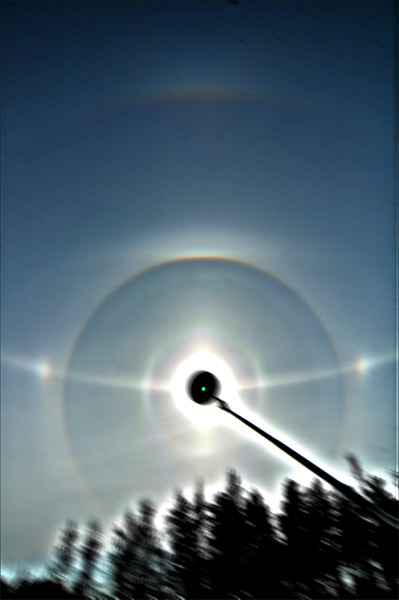
The Lowitz crystals used in the simulation are regular plate-like hexagons, with aspect ratio of 0.4, tilt about the Lowitz axis 28° and Lowitz axis rotation 1°. Sun elevation is 9°. The Lowitz arcs themselves are faintly visible at 10 and 2 o'clock positions, separating from the 22° halo and reaching towards the upper sunvex Parry arc. This is the circular component of the Lowitz arcs, also known as the c-component (after Greenler).


Occasionally, in high cloud displays there is seen a short patch of 46° halo under the circumzenith arc, as shown here in the photo by Stepanka Kosova, taken on 20 August in Prague. It has been sometimes suspected that these might be indications of 46° contact arcs. Whether that's the case, it may be confirmed if a series of photos are taken for stacking.

The simulation is made with HaloSim by Les Cowley and Michael Schroeder.
 
text: Marko Riikonen 
 

Sunday, 9 September 2007

Anthelic arcs in Finland


On August 28th anthelic arcs appeared in the northern part of Finland. My coffee break was suddenly halted as watching from the window I noticed several arcs. Once outside my eye was first caught by well developed parhelic circle. Then, looking up I noticed a colourful Wegener arc. Colours were red on the bottom and blue on the upper part. In the later stage of the display I noticed faint X at the anthelion indicative of the diffuse/Tricker arcs. I had no camera but my friend borrowed his camera equipped cellphone. Image quality is quite poor, but halos are still recognizable. Also Parry arc and 120 parhelia were present. Other halos were 22halo, parhelia, 22 upper tangent arc, parhelic circle, circumzenith arc, infralateral arc and supralateral arc. The display was noticed over large areas in Finland. More photos is here. Also see the photos by Arto Oksanen and Panu Lahtinen

By Marko Mikkila

Sunday, 6 May 2007

46° halo in Czech Republic


The April 21st 2007 was undoubtely one of the best halo days in this year. Observers from all over the Czech Republic enjoyed very bright 22° halo with tangent arcs and infralateral arcs.

We probably observed Wegener arcs and 120° parhelia, but this cannot be proven, because even fotos from Registax didn’t help us to clearly identify them. Anyway, Martin Popek saw that day very nice 46° halo and he took these pictures which were stacked from 40 images in Registax.


As the Sun was setting down, more halos appeared. In the second picture you can see parhelion with a part of parhelic circle (parhelic tail), 22° halo, circumzenithal arc and probably supralateral arc.

Edit: It isn’t supralateral arc in the second photo, but 46° halo because there is no upper tangent arc. That signifies absence of horizontal oriented columns, which are necessary in order to make supralateral arc.

46° halo in Czech Republic


The April 21st 2007 was undoubtely one of the best halo days in this year. Observers from all over the Czech Republic enjoyed very bright 22° halo with tangent arcs and infralateral arcs.

We probably observed Wegener arcs and 120° parhelia, but this cannot be proven, because even fotos from Registax didn’t help us to clearly identify them. Anyway, Martin Popek saw that day very nice 46° halo and he took these pictures which were stacked from 40 images in Registax.


As the Sun was setting down, more halos appeared. In the second picture you can see parhelion with a part of parhelic circle (parhelic tail), 22° halo, circumzenithal arc and probably supralateral arc.

Edit: It isn’t supralateral arc in the second photo, but 46° halo because there is no upper tangent arc. That signifies absence of horizontal oriented columns, which are necessary in order to make supralateral arc.

Tuesday, 6 March 2007

Odd radius halos in diamond dust in Finland


On 23 February an another diamond dust display with odd radius halos occured in Vaala, Finland. Temperature was dropping from -29°C to -24° during my observation.

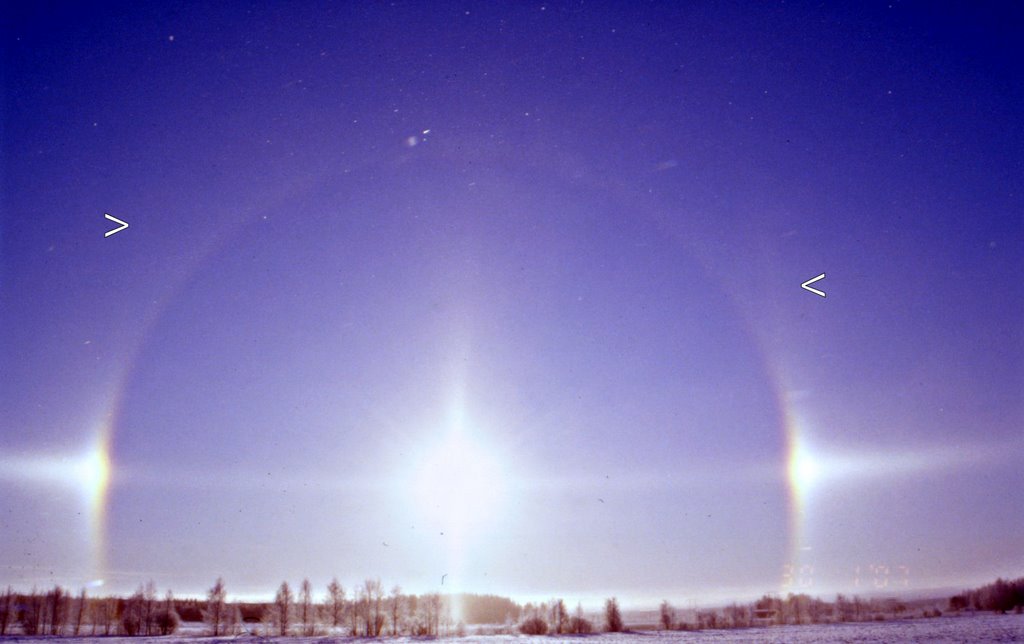
A parhelic circle and circumzenithal arc were present with nice parhelia. A subsun and subparhelia were also seen as sparkling ice crystals in front of the ground.

Odd radius halos labelled in this enhanced photo are A) a pyramidal heliac arc, B1) upper 24° plate arc, B2) lower 24° plate arc and C) upper 23° plate arc.

The most brightest odd radius halo was 18° halo and in some photos there probably are also 9° upper plate arc and 20° halo. The ice crystal cloud was produced by a local heating plant about 2 km away. More photos can be found here.

By Jarmo Moilanen

Friday, 2 February 2007

Reflected Lowitz arcs in Finland


On 30th January 2007 I found that local district heating plant was causing a nice diamond dust display. Temperature was -22 C and the steam crystallized immediately. Only a few hundreds meters from the plant was already a plenty of crystals, but the best was about 2 km from the plant.

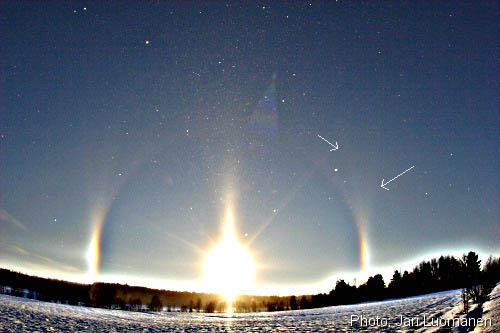
There I drove to a small road and got out and saw a display like never before. Parhelia were very bright, like fireballs. Also circumzenith arc was bright, but 22 halo was quite weak. Almost full parhelic circle was present with faint 120 parhelia, that looked more like pillars than fuzzy balls.

I had a film camera and eventually run out of film. The only choice was to drive home to get digital camera and fisheye lenses. On returning back the display had lost intensity and the 120 parhelia were completely gone. Anyway, I took about 80 photos with digital and later stacking of those photos revealed faint reflected Lowitz arcs rising up from the parhelia (marked in the photos with arrows). More photos of display is here. The looks of the display is quite similar to the one that was observed by Jari Luomanen a year ago. See photo here.

Friday, 3 November 2006

Diamond dust season opened in Finland


On October 26 the pupils of the Särkijärvi school near the small northern Finland town of Muonio stopped suddenly their indoor activities and rushed out - somebody had noticed a halo wonder in the sky.

At the school were also excursionists from University of Lapland. Among them, Päivi Linnansaari happened to have a camera handy and took several photos of which a selection is presented here.

The display had all the basic flavourings of a great diamond dust display, including the helic arc, circular Lowitz arc and diffuse anthelic arc - the latter of which is seen faintly in the lower left image. But then there is also a new halo: the 46° contact arcs. Theoretically it has been known for quite a while, but no convincing photographs have come up untill now. The halo shows up in the upper right image as three arcs below the circumzenith arc. Probably a comparison with simulation is needed to get a proper grip of it.

The halo display made it also to local newspaper. Couple of kilometres from the location there is a ski center, so the halos may likely have originated from snow guns.

Wednesday, 26 April 2006

Complex display with odd radius column arcs in Finland

A long-lasting halo display was seen in Southern Finland on 25th April. The gems of the display were odd radius column arcs, of which 9, 20 and 24 degree arcs were seen. Additionally, 9 and 24 degree lower plate arcs as well as an 18 degree halo and possibly a 23 degree upper plate arc were visible for a short period of time during the day. The duration of the display was spectacular; for instance the Wegener anthelic arcs and 120° parhelia were continuously on the sky for almost three to four hours. At the latter stages of the display a beautiful 46° supralateral arc and magnificent circumzenith arc appeared. The display was photographed by many people - Marko Riikonen in Helsinki, Jari Luomanen in Tampere, Lauri Kangas in Espoo, Marja Wallin in Lahti, Timo Viinanen in Hameenlinna and Jukka Ruoskanen in Hyvinkaa.