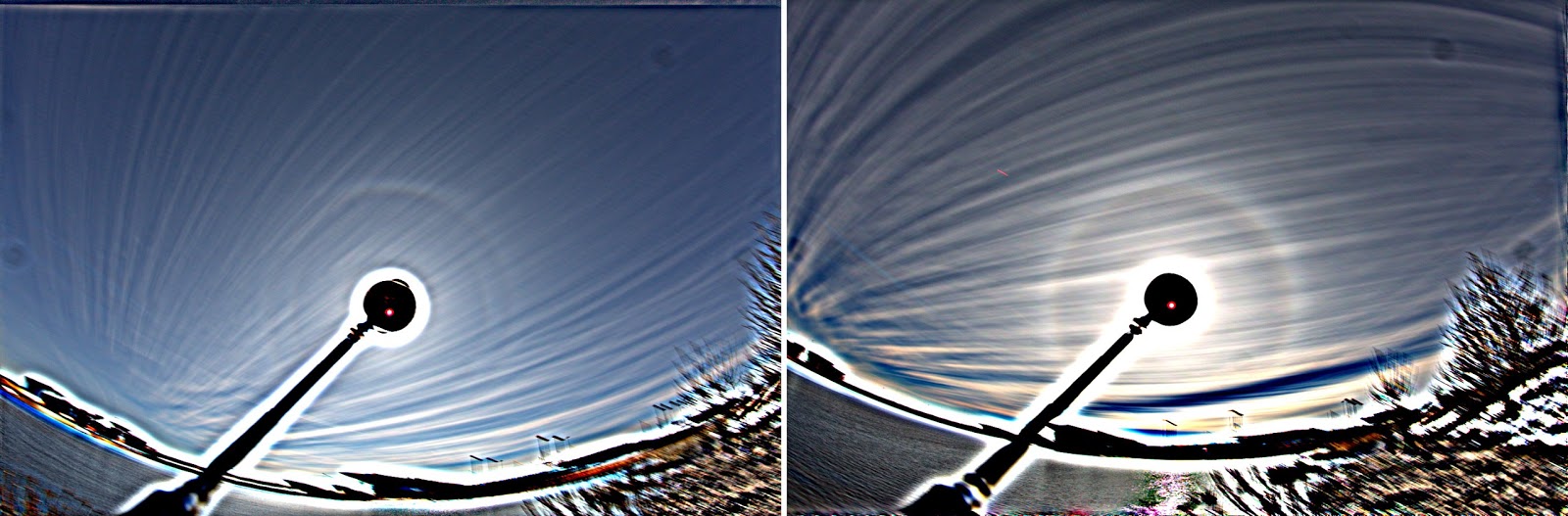
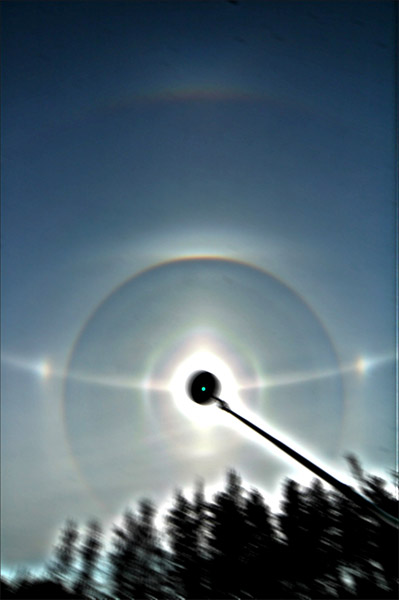
Often, when I see the clouds coming from west, I try to do a high cloud sunset to see if there is something to see (like sun pillar and sunvex halos).
this day, we had mosly contrails making here and there some ice halos from my position, but nothing unusual to catch the eye (furtive sundogs, 22° halos, upper tangent and maybe Lowitz buddies but too short in time to be exploitable) (Time-Lapse of part of the day in here, South-South-East Field of View).
To find other halos at sunset, the exercice can be tricky, as the global backgroud turn progressivly to yellow then orange so the b-r rendering is more complicated, with adaptation to make in the last 30-45 mins before the end of sunset.
As I don't have automatized this, I find myself resigned to make one setting for the whole sequence to save time in my processings.
And sometimes, something catch my eye, as it did this last 16th of october, last year.
The three next images show 3 differents times of the event, with slightly different processings:
2022-10-16-[17h14à18h58]-NNW-bw-v1-[4-2]-UsM-(49)-5s5-histo-UsM-h20-h28?-h35
2022-10-16-[17h14à18h58]-NNW-bw-v2-[4-2]-UsM-(47)-7s7-UsM-histo
2022-10-16-[17h14à18h58]-NNW-bw-v2-[4-2]-UsM(56)-6s6-UsM-h28?-histo
If needed, I can provide the bw sequence, so you can see (as I do with VirtuaDub) the evolution of the display and distinguish the 28° halo with dynamic (back and forth) play on the sequence.
A sequence you will be able to see there (Version1 & Version2), but with the compression due to GoogleVideo.
Again, all raw images are still in my possession, as I guess I might not be done with this display yet.
Showing posts with label 23° upper plate arc. Show all posts
Sunday, 30 April 2023
Sunday, 18 August 2019
Odd Radius Display, Southern Ohio, USA, 17th August 2019
On the evening of Saturday, 17th August 2019, I observed this complex pyramidal halo display. In total, I saw a faint 9d halo, lower 9d plate arc, bright 18d plate arc, 18d halo, upper and lower 24d plate arcs and a weak upper 23d plate arc. This display is very similar to the one I captured in 2017, the only difference being the one in 2017 the lower 9d plate arc was bright and colorful and in the present display it was weak.
Thursday, 11 July 2019
Pyramidal halos 7-10-19
Before leaving for work yesterday, I saw some cirrus clouds moving in and in a short time later 18 and 23d halos along 18d plate arcs, and bright upper 23d arc appeared. The display went on for a while and when the sun was high enough, a bright and well-defined lower 23d plate arc formed. The lower 23d plate arc in this display is my best to date.
Thursday, 18 October 2018
New case of exotic 19d plate arcs
When I first noticed the display at 08-10 local time on 31 May 2018, it was already well-developed. The high cloud layer was very thin and it was visible only in the area close to the sun. At first the display consisted of an upper 23d plate arc and an upper quarter of a 23d halo. A little later I noticed arcs as light spots in the side area of the sun, that reminded me lower 24d plate arcs.
When I processed images, I noticed that these arcs are more like 18d plate arcs than lower 24d plate arcs. But during the observation I distinctly saw that the arcs were located at an elevation lower than the sun, while 18d plate arcs are always located at the same elevation as the sun. I applied stronger processing and revealed a gap between the arcs and a 18d halo. As a result, it became clear that the arcs are exotic 19d plate arcs that were first observed during the legendary Lascar display. In addition, a trace of exotic 28d halo was also revealed.
Some analysis
The halos, known as Lascar halos, are caused by exotic pyramidal crystals with pyramidal faces of (2 0 2 3) Miller index. These exotic pyramids have a 39.1 apex angle while pyramids from regular pyramidal crystals have a 56.1 angle. To simulate the display, I used four different crystal populations. Not one of them have basal crystal faces. The first population is plate oriented pyramidal crystals with upper exotic and lower regular pyramidal faces. This population makes most visible features of the display (19d and 23d plate arcs). The second population consists of crystals with regular upper and lower pyramids, and it contributes to 18d and 23d halos. The population is poorly oriented, in order to reproduce some features of 18d and 23d halos. The third population contains plate oriented regular pyramidal crystals consisting only of lower pyramidal faces. It needs only to enhance the upper 23d plate arc. Finally, the fourth population is added to reproduce the 28d halo. Its crystals is randomly oriented and consists of upper exotic pyramidal faces in triangular habit. That is, the crystals are almost regular tetrahedrons.
The result shows quite good agreement with the observation, except for an exotic lower 3d plate arc. There are two possible reasons for it. The first is that a glow around the sun has much more intensity than halos presented here. It does not allow to reveal a 3d arc, unlike the Lascar display, whose observing place was located at an altitude more than of 4000 m above sea level. At this altitude the atmosphere has a low level of aerosols, and therefore the glow around the sun is very small, and the sky background is dark. My observation point was in Pskov Oblast, which has a flat topography with usual atmospheric conditions. The second reason is that exotic crystals may have triangular, but not hexagonal habit. The 3d arc disappears when triangular exotic crystals are applied.
References
- Nicolas A. Lefaudeux, "Crystals of hexagonal ice with (2 0 2 3) Miller index faces explain exotic arcs in the Lascar halo display"
- Nicolas A. Lefaudeux (personal communication, 2018)
When I processed images, I noticed that these arcs are more like 18d plate arcs than lower 24d plate arcs. But during the observation I distinctly saw that the arcs were located at an elevation lower than the sun, while 18d plate arcs are always located at the same elevation as the sun. I applied stronger processing and revealed a gap between the arcs and a 18d halo. As a result, it became clear that the arcs are exotic 19d plate arcs that were first observed during the legendary Lascar display. In addition, a trace of exotic 28d halo was also revealed.
![]() |
| Sun elevation is about 36 degrees |
Some analysis
The halos, known as Lascar halos, are caused by exotic pyramidal crystals with pyramidal faces of (2 0 2 3) Miller index. These exotic pyramids have a 39.1 apex angle while pyramids from regular pyramidal crystals have a 56.1 angle. To simulate the display, I used four different crystal populations. Not one of them have basal crystal faces. The first population is plate oriented pyramidal crystals with upper exotic and lower regular pyramidal faces. This population makes most visible features of the display (19d and 23d plate arcs). The second population consists of crystals with regular upper and lower pyramids, and it contributes to 18d and 23d halos. The population is poorly oriented, in order to reproduce some features of 18d and 23d halos. The third population contains plate oriented regular pyramidal crystals consisting only of lower pyramidal faces. It needs only to enhance the upper 23d plate arc. Finally, the fourth population is added to reproduce the 28d halo. Its crystals is randomly oriented and consists of upper exotic pyramidal faces in triangular habit. That is, the crystals are almost regular tetrahedrons.
![]() |
My attempt to simulate the display.
Software: HaloPoint 2.0 by Jukka Ruoskanen
|
References
- Nicolas A. Lefaudeux, "Crystals of hexagonal ice with (2 0 2 3) Miller index faces explain exotic arcs in the Lascar halo display"
- Nicolas A. Lefaudeux (personal communication, 2018)
Monday, 5 June 2017
Odd radius plate display in Czechia
On June 4th a cold front was advancing towards Czechia with thick Ci/Cs cloud cover ahead of the front.
Zbyněk Černoch was keeping an eye for any potential halos that might show up. As soon as the cloud cover started to sublimate (it was nicely visible on satellite imagery), bright pyramidal plate arcs showed up. The 23° parhelion is very easily distinguishable with its characteristic shape.
A few moments later, the 23° parhelion lost its initial shape, but became a little more coloured.
The same photos, with B-R processing:
Thursday, 1 June 2017
The all-sky display of 30th May 2017 at Pskov Oblast, Russia
![]() |
| 08-09 |
Thereafter, cirrus clouds cleared, and in satellite images no high-level clouds were visible, so I went to a bicycle training although the meteogram would predict the arrival of a new portion of cirrus in the coming hours. If I had looked at sat24.com during my training, I could have seen that the air ahead of a low-pressure system after passing the Baltic sea, created fresh cirrus clouds above Estonia!
At 15-40 I found that far cirrus clouds which were visible for the last hour at the horizon, now reached the sun. At this moment I saw a colourful lower tangent arc. It was only 5 km to my house , so I accelerated in order to be in time to photograph it. However, a few minutes later I saw a large scale complex in the sky - above the sun there also appeared an upper tangent arc, both parhelia, and a full parhelic circle! The last few kilometers I rode as fast as I could. Luckily, I not too late!
![]() |
| 16-17. All three Lowitz arcs are in one image. The B-R version is available here |
![]() |
| 16-37 |
![]() |
| 17-08 |
Wednesday, 17 May 2017
Recent displays from Northwestern Russia
In this post I want to share some of my observations from last month, which I made in St Petersburg (from 15th April to 5th May) and in Pskov Oblast (from 7th May to present time). In total there were eleven displays, six of them comprising pyramidal halo forms. Many of these pyramidal displays were minor, so I will not present them.
20th April
The photo on left shows a purely odd-radius plate complex. There are only the upper 23 plate arc with its 23 halo and a couple of 18 plate arcs. On the photo on right you can see fragments of weak odd radius circular halos. Together with the broad 22 halo at the 02-00 position there is the 20 halo and also the diffuse 35 halo.
28th April
Together with classic halo forms in stacks pyramidal halos appeared with odd-radius plate arcs. On photos above you can see lower 24 plate arcs with the 24 halo and the 9 halo (with possible the lower 9 plate arc). The weak and diffuse upper 23 plate arc is also available.
30th April
In the morning there was a short display which lasted less than one hour. The display was not predicted by the meteogram, so maybe I missed most of the display, which was earlier that morning. In any case I saw bright parhelia with the colourful circumzenithal arc, and got in the stack the strong parhelic circle and the upper suncave Parry arc together with the nice upper tangent arc. I think it is the Parry arc, and not an upper 23 plate arc, because the display does not contain no other pyramidal halo forms, and the arc looks pretty sharp.
1st May
In the morning I observed the large and bright upper tangent arc for around one hour. Infralateral arcs were easily seen with naked eye. Together with bright parhelia I saw fragments of a parhelic circle. In stacks the rare Wegener arc was found.
5th May
On that day there was a protracted display, that lasted between six and sixteen hours. But my camera had recorded interesting halos only at the start, on the sunrise. It was an odd-radius circular complex which contained pyramid halos with radii 9, 18, 24 and 35 degrees. It seems the 24 halo included rudimentary upper and lower 24 plate arcs.
10th May
No rare halos on that morning but I saw the supralateral arc visually very well, that happens not often. A curious circumzenithal arc appeared a little later. The CZA was diffuse, that is not typical for this halo.
20th April
The photo on left shows a purely odd-radius plate complex. There are only the upper 23 plate arc with its 23 halo and a couple of 18 plate arcs. On the photo on right you can see fragments of weak odd radius circular halos. Together with the broad 22 halo at the 02-00 position there is the 20 halo and also the diffuse 35 halo.
28th April
Together with classic halo forms in stacks pyramidal halos appeared with odd-radius plate arcs. On photos above you can see lower 24 plate arcs with the 24 halo and the 9 halo (with possible the lower 9 plate arc). The weak and diffuse upper 23 plate arc is also available.
30th April
In the morning there was a short display which lasted less than one hour. The display was not predicted by the meteogram, so maybe I missed most of the display, which was earlier that morning. In any case I saw bright parhelia with the colourful circumzenithal arc, and got in the stack the strong parhelic circle and the upper suncave Parry arc together with the nice upper tangent arc. I think it is the Parry arc, and not an upper 23 plate arc, because the display does not contain no other pyramidal halo forms, and the arc looks pretty sharp.
1st May
In the morning I observed the large and bright upper tangent arc for around one hour. Infralateral arcs were easily seen with naked eye. Together with bright parhelia I saw fragments of a parhelic circle. In stacks the rare Wegener arc was found.
5th May
On that day there was a protracted display, that lasted between six and sixteen hours. But my camera had recorded interesting halos only at the start, on the sunrise. It was an odd-radius circular complex which contained pyramid halos with radii 9, 18, 24 and 35 degrees. It seems the 24 halo included rudimentary upper and lower 24 plate arcs.
No rare halos on that morning but I saw the supralateral arc visually very well, that happens not often. A curious circumzenithal arc appeared a little later. The CZA was diffuse, that is not typical for this halo.
Labels:
18° plate arc,
20° halo,
23° halo,
23° upper plate arc,
24° halo,
24° lower plate arc,
35° halo,
9° halo,
circumzenithal arc,
infralateral arc,
supralateral arc,
upper suncave Parry arc,
Wegener arc
Friday, 10 March 2017
Weak odd radius display on 09 March 2017
The morning was cloudy. Around 11-30 sky started to clear. After half an hour the whole sky was covered high clouds. But I did not see any halos. It seemed it was usual bad clouds, which not produce halos. Nevertheless, in some moments I saw very weak and wide 22° halo with something resembles upper 23° plate arc. Also was an episode when I saw compact CZA, which apeared without parhelia. My suspicions have only become stronger, about that I faced with subvisual odd radius display.
It was brilliantly confirmed when I returned to home and processed stacks. I was able to identify such pyramidal forms as upper 9° plate arc (possible), upper 23° plate arc, lower 24° plate arc. Also were captured 9, 18, 20, 22, 24, 35 (very diffuse, link) and 46 halos. Odd radius halos lasted 50 minutes, until 13-30. Then until the end of display (until 15-30) were captured only weak common halos, such as upper tangent arc, parhelia and 22° halo.
It was fourth display since 15 February, which includes pyramidal halos.
Labels:
18° halo,
20° halo,
22° halo,
23° upper plate arc,
24° halo,
24° lower plate arc,
9° halo,
circumzenithal arc,
parhelia
Location:
St Petersburg, Russia
Friday, 3 March 2017
The great 24 February 2017 halo display in Pskov region of Russia
I came out and saw that the sky indeed was pretty dirty and contained not only cirrus but also low and middle clouds. But above the sun were the central part of UTA and diffuse pillar. I could leisurely to prepare my camera before halos became brighter.
After a few minutes, UTA became seen pretty well. Viewing the sky I was very surprised to detect the supralateral arc to the left of the sun. The arc was not bright but it was clearly visible. It was weird to see such good halos in such dense clouds. Clouds from different levels merged with each other. So at first, I did not understand that it was a big display that penetrated through the gaps of the lower clouds.
After 10-15 minutes came a big gap in those clouds and I saw the full Supralateral arc which was noticeably brighter than previously. I already was very glad because the arc in this form I saw only on my screen when I processed stacks. And at the moment I saw it in the sky with my own eyes. However, this was only a prelude of what was to come.
| Wegener arc, subhelic arc, and blue spot on parhelic circle |
| Near sun there are 9° halo together 9° column arcs |
| All sky view. Near anthelion there is Tricker arc |
| Anthelion and some of diffuse anthelic arcs |
| Upper tangent arc with diffuse upper 23° plate arc and sharp 24° column arcs. Thanks to M.Riikonen for the confirmation |
| On the left there is 120° parhelion |
Labels:
120° parhelion,
23° upper plate arc,
24° column arc,
9° column arc,
9° halo,
anthelion,
blue spot,
diffuse anthelic arc,
infralateral arc,
subhelic arc,
supralateral arc,
Tricker arc,
Wegener arc
Location:
Izborsk, Pskov region, Russia
Monday, 24 September 2007
Odd radius display

12th August 2007 - This day I can see interesting halo display. I thought that I could see upper tangent arc and inexpressive 22 degree halo. But the upper tangent arc was more and more brighter and lower tangent arc has not been seen. It crossed my mind that this phenomenon what i can see isn’t 22 degree tangent arc but 23 degree plate arc. I searched another pyramidal halos, but didn’t see it. Through that I took some photo. When I stacked and adjusted this photo was seen 9° halo, 18° halo, 23° upper plate arc and 22° or 23° halo. Lukas Kosarek
More photos: Martin Popek, Nydek (2.7.) , Stepanka Kosova, Prague (20.8.) and Jiri Los, Prague (20.8.)
By Patrik Trncak
By Patrik Trncak
Labels:
18° halo,
22° halo,
23° plate arc,
23° upper plate arc,
9° halo,
lower tangent arc,
pyramid halos,
upper tangent arc
Tuesday, 6 March 2007
Odd radius halos in diamond dust in Finland

On 23 February an another diamond dust display with odd radius halos occured in Vaala, Finland. Temperature was dropping from -29°C to -24° during my observation.
A parhelic circle and circumzenithal arc were present with nice parhelia. A subsun and subparhelia were also seen as sparkling ice crystals in front of the ground.
Odd radius halos labelled in this enhanced photo are A) a pyramidal heliac arc, B1) upper 24° plate arc, B2) lower 24° plate arc and C) upper 23° plate arc.
The most brightest odd radius halo was 18° halo and in some photos there probably are also 9° upper plate arc and 20° halo. The ice crystal cloud was produced by a local heating plant about 2 km away. More photos can be found here.
By Jarmo Moilanen
By Jarmo Moilanen
Friday, 9 February 2007
Pyramidal heliac arc in Finland
I
In 8 Feb 2007 an odd radius display was produced by local heating plant plumes in -28°C temperature in Vaala, northern Finland. I photographed this display on a road about 1.5 km away from the heating plant.
Odd radius halos in display were 18° halo, 23° upper plate arc, very faint 35° halo and rare pyramidal heliac arc. See arrows in a stacked and strongly unsharp masked photo shown.
Pyramidal heliac arc is formed by reflection from pyramidal side faces of horizontally oriented pyramidal ice crystal. It is usually visible near the sun only. It is usually very faint but this time I was able to see it also visually.
Same odd radius halos except 35° halo were also present in similar but much fainter display in Vaala couple of days earlier in 6 Feb 2007. More photos from both displays can be seen in Jarmo Moilanen's halo photo gallery or directly 8 Feb. 2007 here and 6. Feb 2007 here.
Labels:
18° halo,
23° upper plate arc,
35° halo,
heliac arc,
odd radius halo
Wednesday, 26 April 2006
Complex display with odd radius column arcs in Finland
A long-lasting halo display was seen in Southern Finland on 25th April. The gems of the display were odd radius column arcs, of which 9, 20 and 24 degree arcs were seen. Additionally, 9 and 24 degree lower plate arcs as well as an 18 degree halo and possibly a 23 degree upper plate arc were visible for a short period of time during the day. The duration of the display was spectacular; for instance the Wegener anthelic arcs and 120° parhelia were continuously on the sky for almost three to four hours. At the latter stages of the display a beautiful 46° supralateral arc and magnificent circumzenith arc appeared. The display was photographed by many people - Marko Riikonen in Helsinki, Jari Luomanen in Tampere, Lauri Kangas in Espoo, Marja Wallin in Lahti, Timo Viinanen in Hameenlinna and Jukka Ruoskanen in Hyvinkaa.
Labels:
120° parhelion,
18° halo,
20° halo,
23° halo,
23° upper plate arc,
24° halo,
46° supralateral arc,
9° halo,
anthelic arc,
circumzenithal arc,
odd radius halo,
Wegener arc
Subscribe to:
Posts (Atom)