Showing posts with label 24° lower plate arc. Show all posts

Sunday, 18 August 2019

Odd Radius Display, Southern Ohio, USA, 17th August 2019

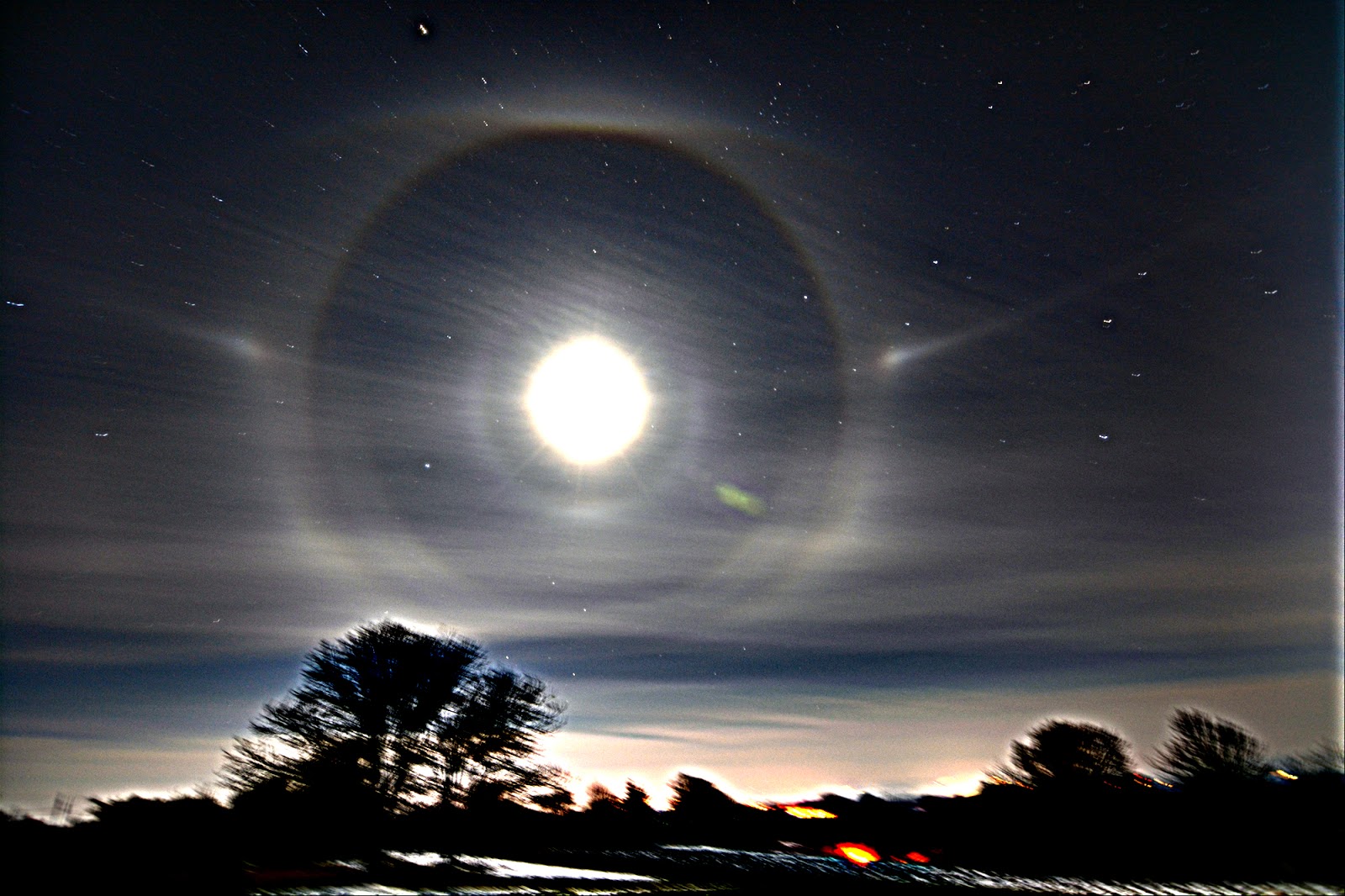
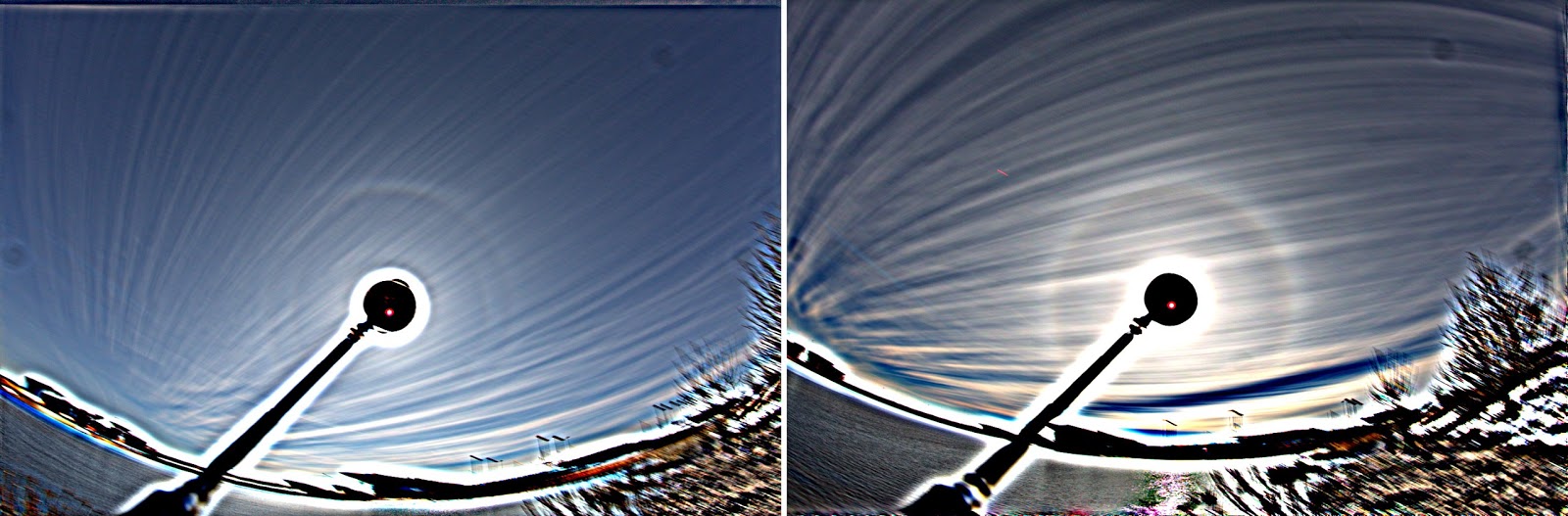
On the evening of Saturday, 17th August 2019, I observed this complex pyramidal halo display. In total, I saw a faint 9d halo, lower 9d plate arc, bright 18d plate arc, 18d halo, upper and lower 24d plate arcs and a weak upper 23d plate arc. This display is very similar to the one I captured in 2017, the only difference being the one in 2017 the lower 9d plate arc was bright and colorful and in the present display it was weak.


Saturday, 14 April 2018

Odd Radius Display, Bolton, United Kingdom

On the 5th April 2018, there was a short lived but rather nice odd radius display in Bolton, a town situated in the north west of the United Kingdom. As I was preparing to go to work, I noticed the top of what I initially took to be a 22d halo. However, it rapidly developed and became more complex and very soon an 18d became easily visible to the eye. The display lasted about thirty minutes in total and I was only able to take a few single shots and a couple of stacks before it began to fade and I had to leave. Upon processing the images, 9, 18, 23, 24 and 35d halos with attendant plate arcs were identified as being present.

Processing courtesy Nicolas Lefaudeux.


Monday, 5 March 2018

Odd radius plate display from the Czech Republic


On 4th March Jitka R. from the Czech republic captured this magnificent odd radius display on the Moon. After stacking multiple images, many halo forms showed up - particulary 9°, 18°, 20°, 24° and 35° halos, along with 9° and 24° plate arcs.

It was a case of sublimating cirrus, which could be easily seen on the satellite images.

And I have a question for the halo experts - is it possible that the 9° column arcs are captured, too? Or could it just be a cirrus of a higher quality?

Thursday, 1 June 2017

The all-sky display of 30th May 2017 at Pskov Oblast, Russia

08-09
The first part of this display occurred between 6-50 and 8-30 hours. During this period only the 22 halo (which accompanied by other common halos in stacks) were seen in this part of the sky. However, at the end of this period a wonderful cloud crossed the sun. This cloud gave a complex of rare halos from Parry and Lowitz orientations - on the stack I found the sharp and bright upper suncave Parry arc together with the upper Lowitz arc. I saw a part of the middle Lowitz arc, which was below the right parhelion, with the naked eye (1).

Thereafter, cirrus clouds cleared, and in satellite images no high-level clouds were visible, so I went to a bicycle training although the meteogram would predict the arrival of a new portion of cirrus in the coming hours. If I had looked at sat24.com during my training, I could have seen that the air ahead of a low-pressure system after passing the Baltic sea, created fresh cirrus clouds above Estonia!

At 15-40 I found that far cirrus clouds which were visible for the last hour at the horizon, now reached the sun. At this moment I saw a colourful lower tangent arc. It was only 5 km to my house , so I accelerated in order to be in time to photograph it. However, a few minutes later I saw a large scale complex in the sky - above the sun there also appeared an upper tangent arc, both parhelia, and a full parhelic circle! The last few kilometers I rode as fast as I could. Luckily, I not too late!

16-17. All three Lowitz arcs are in one image. The B-R version is available here
Visually, it seemed to me that the bright parhelic circle contained a red fringe, which also surrounded a diffuse 120 parhelion. Blue minus red versions of some stacks clearly show this diffraction effect (2).  The cirrus clouds were beautiful, they contained not only a smooth veil, but also sharp textures like virga. What they are fresh was seen with the naked eye.

16-37
After half an hour, the bright parhelic circle disappeared, when clouds which produced it, drifted to the south-east direction. The upper tangent arc then started to get brighter. At this time I also saw visually both the infralateral arc and the 46 halo above the sun from the 11-00 to 01-00 positions. The complex became less bright after one hour, but at the same time, fragments of a distant parhelic circle was still visible.

17-08
Thereafter, I could see only a split upper tangent arc. With the naked eye I could not understand what it is - a Parry arc or a 23 plate arc. The stack taken during this period showed an excellent odd-radius plate complex!

Wednesday, 17 May 2017

Recent displays from Northwestern Russia

In this post I want to share some of my observations from last month, which I made in St Petersburg (from 15th April to 5th May) and in Pskov Oblast (from 7th May to present time). In total there were eleven displays, six of them comprising pyramidal halo forms. Many of these pyramidal displays were minor, so I will not present them.

20th April

The photo on left shows a purely odd-radius plate complex. There are only the upper 23 plate arc with its 23 halo and a couple of 18 plate arcs. On the photo on right you can see fragments of weak odd radius circular halos. Together with the broad 22 halo at the 02-00 position there is the 20 halo and also the diffuse 35 halo.

28th April

Together with classic halo forms in stacks pyramidal halos appeared with odd-radius plate arcs. On photos above you can see lower 24 plate arcs with the 24 halo and the 9 halo (with possible the lower 9 plate arc). The weak and diffuse upper 23 plate arc is also available.

30th April


In the morning there was a short display which lasted less than one hour. The display was not predicted by the meteogram, so maybe I missed most of the display, which was earlier that morning. In any case I saw bright parhelia with the colourful circumzenithal arc, and got in the stack the strong parhelic circle and the upper suncave Parry arc together with the nice upper tangent arc. I think it is the Parry arc, and not an upper 23 plate arc, because the display does not contain no other pyramidal halo forms, and the arc looks pretty sharp.

1st May

In the morning I observed the large and bright upper tangent arc for around one hour. Infralateral arcs were easily seen with naked eye. Together with bright parhelia I saw fragments of a parhelic circle. In stacks the rare Wegener arc was found.

5th May

On that day there was a protracted display, that lasted between six and sixteen hours. But my camera had recorded interesting halos only at the start, on the sunrise. It was an odd-radius circular complex which contained pyramid halos with radii 9, 18, 24 and 35 degrees. It seems the 24 halo included rudimentary upper and lower 24 plate arcs.

10th May

No rare halos on that morning but I saw the supralateral arc visually very well, that happens not often. A curious circumzenithal arc appeared a little later. The CZA was diffuse, that is not typical for this halo. 

Friday, 10 March 2017

Weak odd radius display on 09 March 2017


Yesterday in St Petersburg was an odd radius display with a predominance of plate forms.

The morning was cloudy. Around 11-30 sky started to clear. After half an hour the whole sky was covered high clouds. But I did not see any halos. It seemed it was usual bad clouds, which not produce halos. Nevertheless, in some moments I saw very weak and wide 22° halo with something resembles upper 23° plate arc. Also was an episode when I saw compact CZA, which apeared without parhelia. My suspicions have only become stronger, about that I faced with subvisual odd radius display.

It was brilliantly confirmed when I returned to home and processed stacks. I was able to identify such pyramidal forms as upper 9° plate arc (possible), upper 23° plate arc, lower 24° plate arc. Also were captured 9, 18, 20, 22, 24, 35 (very diffuse, link) and 46 halos. Odd radius halos lasted 50 minutes, until 13-30. Then until the end of display (until 15-30) were captured only weak common halos, such as upper tangent arc, parhelia and 22° halo.

It was fourth display since 15 February, which includes pyramidal halos.

Monday, 26 March 2007

A spring-starter in Finland

On 25th March a relatively small high-cloud area swept over Southern Finland and produced a fine halo for observers in Helsinki, Espoo, Turku and Riihimaki. In Riihimaki the upper Lowitz arc was continuously in the sky for over three hours. In addition to Lowitz, there were also pyramidal crystal halos (9 halo/column arc?, 24 lower plate arcs, 18 plate arcs), helic arc and Wegener anthelic arc.

The photograph above is taken by Jukka Ruoskanen, and more photographs can be found here. In Helsinki the display was photographed by Marko Riikonen, in Espoo by Panu Lahtinen and Timo Kuhmonen and in Turku by Ismo Luukkonen

By Jukka Ruoskanen

Tuesday, 6 March 2007

Odd radius halos in diamond dust in Finland


On 23 February an another diamond dust display with odd radius halos occured in Vaala, Finland. Temperature was dropping from -29°C to -24° during my observation.

A parhelic circle and circumzenithal arc were present with nice parhelia. A subsun and subparhelia were also seen as sparkling ice crystals in front of the ground.

Odd radius halos labelled in this enhanced photo are A) a pyramidal heliac arc, B1) upper 24° plate arc, B2) lower 24° plate arc and C) upper 23° plate arc.

The most brightest odd radius halo was 18° halo and in some photos there probably are also 9° upper plate arc and 20° halo. The ice crystal cloud was produced by a local heating plant about 2 km away. More photos can be found here.

By Jarmo Moilanen

Sunday, 24 September 2006

From archives: odd radius column arcs in 2001


I saw this display in Oulu on 17 September 2001. Because the photos have not been around in the internet, I dare to make posting even though the event is not so recent.

The display has all the odd radius column arcs except the 23° arc. Images are stacked from 3-8 individual images. The one on the lower right is also flipped horizontally to get a bit more definition. For the upper left and lower images, simulations of the pyramid column arcs give crystals as in the figure. Also shown is similarly shaped real crystal, photographed during a weak odd radius column arc display at South Pole in 1999.

From pyramid plate crystals there is the 23° plate arc in all photos, and lower 9° and 24° plate arcs in the upper right photo. The display was discussed in more detail in September 2003 number of journal Weather. It also appears in the book "Atmospheric halos and the search for angle x" by Tape and Moilanen.

By Marko Riikonen